
Edge AI Moves Industrial Decision-Making Closer to the Line - TALS
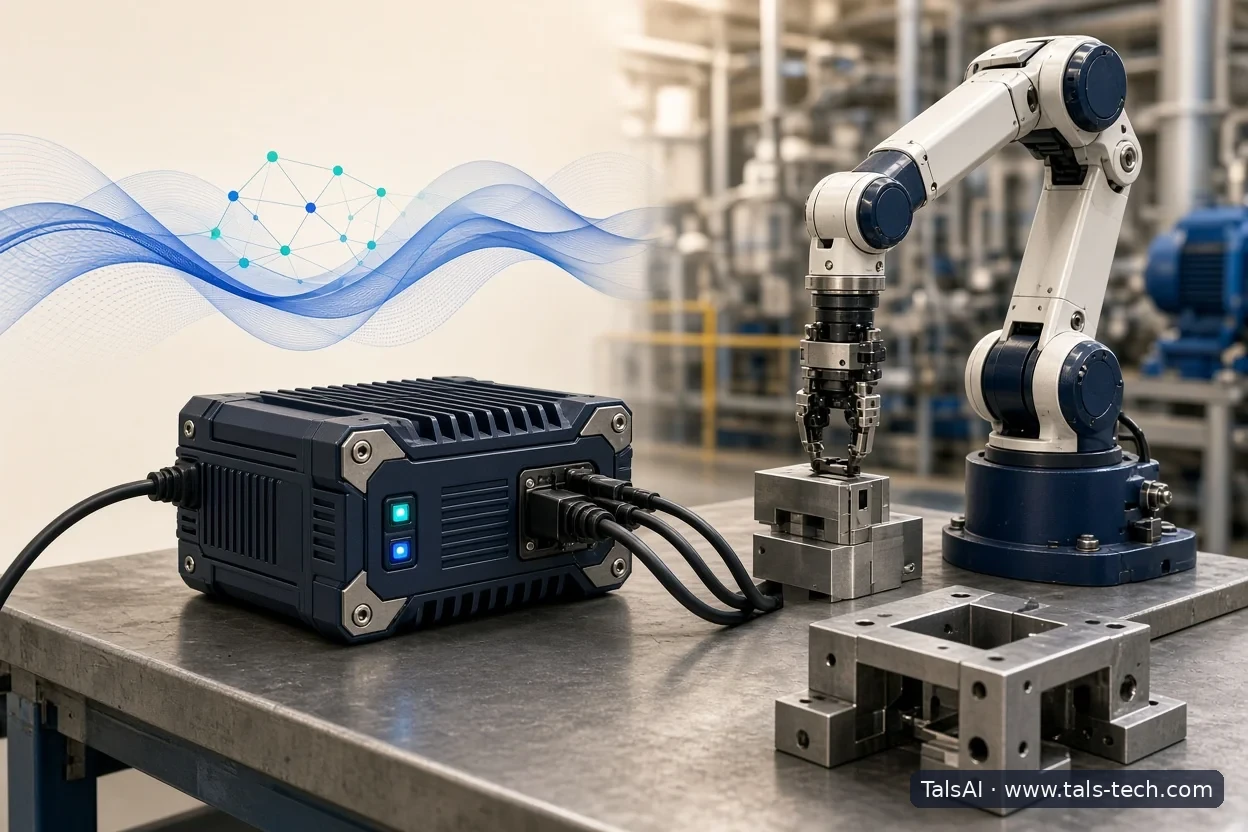
AI-generated industrial technology concept illustration, not a customer site or product screenshot.
Electronic Products & Technology reports an industrial edge AI platform positioned for Industry 4.0, robotics and edge AI applications. The headline is narrow, but it points to a broader shift: factory intelligence is moving from centralized dashboards toward inference that runs close to machines.
What the source actually says
The source summary only states that an industrial edge AI platform serves Industry 4.0, robotics and edge AI applications. It does not provide deployment results, performance numbers, named customers or architecture details. That limitation matters: the article should be read as evidence of a product category, not proof that a particular factory has already gained measurable productivity.
Still, the wording is useful. By grouping Industry 4.0, robotics and edge AI applications, the headline suggests the platform is intended as a general runtime environment rather than a single-purpose vision inspection tool. In manufacturing, that distinction is important because general-purpose edge stacks must manage multiple devices, models, safety constraints and data paths at once.
Where it changes operations
The first operational effect is latency. When a camera, robot controller or PLC needs a decision within milliseconds, waiting for a cloud round trip can create stoppages, false rejects or unsafe motion. Edge AI can keep the immediate loop local: detect a defect, pause a station, adjust a gripper path or flag a torque anomaly before the line moves on.
The second effect is boundary redefinition. MES, ERP and QMS do not disappear; they become the systems of record and constraint. The edge platform may decide how to react to a vision signal, but MES still owns the work order, ERP still governs material availability, and QMS still requires traceable evidence. The real design question is which decisions are delegated and which must be escalated.
The implementation question
A platform like this raises a harder question than model accuracy: how will it coexist with legacy equipment? Factories contain old PLCs, proprietary robot controllers, nonstandard cameras and long-lived control code. If the edge AI stack only works with new devices, it may become another island rather than an orchestration layer. Integration effort, not algorithm quality, often decides whether edge AI scales.
Another limitation is governance. Edge inference can fail in ways cloud analytics does not: a model update may change reject rates, a robot may interpret a scene differently after lighting changes, or an offline node may lose synchronization with the plant historian. Teams need rollback plans, event logging, operator override rules and clear ownership between automation, IT and quality functions.
Outlook
From TALS's smart-manufacturing perspective, edge AI is most valuable when it is treated as a governed execution layer, not a standalone technology showcase. The winning factories will be those that connect local inference to MES, ERP and QMS with clear decision rights, audit trails and human fallback.
Related product and scope
For this topic, explore TalsAI’s MES manufacturing execution system: work orders, shop-floor reporting and production progress; machine connectivity is project-specific. This is not an endorsement by the original news source.
Source date: 2026-11-20 13:29 UTC
Original source