
ABB China Challenge Spotlights AI Automation Engineering - TALS
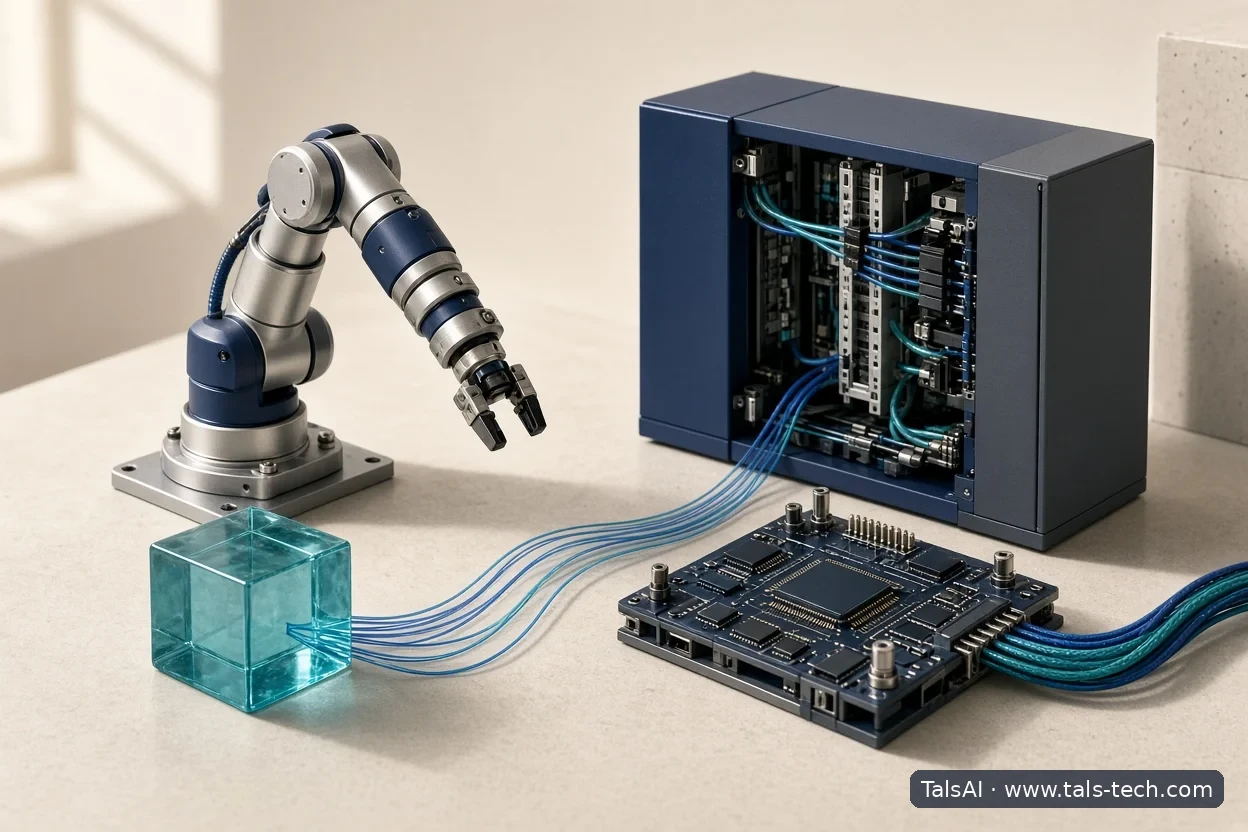
AI-generated industrial technology concept illustration, not a customer site or product screenshot.
ABB and its open innovation platform SynerLeap named Wasome winner of the ABB Startup Challenge China 2026, with the source describing an AI automation solution meant to make automation engineering faster, simpler and more accessible. The challenge was hosted in China for the first time, and ABB experts will work directly with Wasome, though the summary stops before the next phase.
What the source actually says
The verified facts are narrow. ABB, with SynerLeap, announced Wasome as winner of the ABB Startup Challenge China 2026. The source says the solution will make automation engineering faster, simpler and more accessible. It also says the challenge was hosted for the first time in China and is now in its seventh year. This shows a corporate innovation program focused on engineering workflow, not a generic dashboard.
The summary also states ABB experts will directly work with Wasome, but the text is truncated, so it would be wrong to infer a product, customer deployment, benchmark or integration scope. The signal is that ABB is using open innovation to test whether AI can reduce friction in automation engineering, a domain shaped by specialized, fragmented tools and scarce expertise.
Where the operational leverage sits
Automation engineering is slow less because of missing algorithms than because of combinatorial complexity. A machine builder or integrator must reconcile control logic, HMI screens, robot programs, vision recipes, drive parameters, safety functions and network settings across vendors and versions. Much work is repetitive mapping, documentation and validation. If AI can convert requirements, drawings, code fragments and test notes into a reviewable configuration draft, the first gain may be shorter engineering cycles rather than faster line speed.
That changes economics. Integrators compete on delivery certainty, not only hardware price, so reusable templates and AI-assisted configuration could improve margin and reduce rework. Plants benefit because changeover, line modification and troubleshooting often depend on a few senior engineers. A tool that captures patterns from past projects may make those patterns more portable. Yet value depends on whether the output becomes an auditable engineering artifact, not just a convenient suggestion.
The hard question is trust and traceability
The limitation is not whether AI can generate code, but whether generated code can be trusted in an industrial environment. Automation errors can cause downtime, scrap, safety incidents or delayed commissioning. AI-generated configuration needs provenance, validation rules, version control, rollback paths and approval workflows. A factory will not accept a black-box recommendation if it cannot answer which data were used, which constraints applied and who approved the change.
There is also an organizational trade-off. If AI automation engineering is used only by experts, it may accelerate existing teams. If marketed to novices, it may hide knowledge gaps and create brittle systems. The safer path is human-in-the-loop engineering, where AI drafts, checks and explains while engineers retain responsibility. For TALS, smart manufacturing needs disciplined engineering data, reusable templates and audit-ready configuration, not isolated demonstrations.
Key Statistics
- ABB Startup Challenge China 2026: the challenge is now in its seventh year (source summary).
Outlook
The story is not about a startup prize. It is about whether AI can move from slides into the engineering work that decides how quickly factories can be built, changed and trusted.
Related product and scope
For this topic, explore TalsAI’s MES manufacturing execution system: work orders, shop-floor reporting and production progress; machine connectivity is project-specific. This is not an endorsement by the original news source.
Source date: 2026-11-20 22:07 UTC
Original source