
Robot experience calibrates automation confidence - TALS
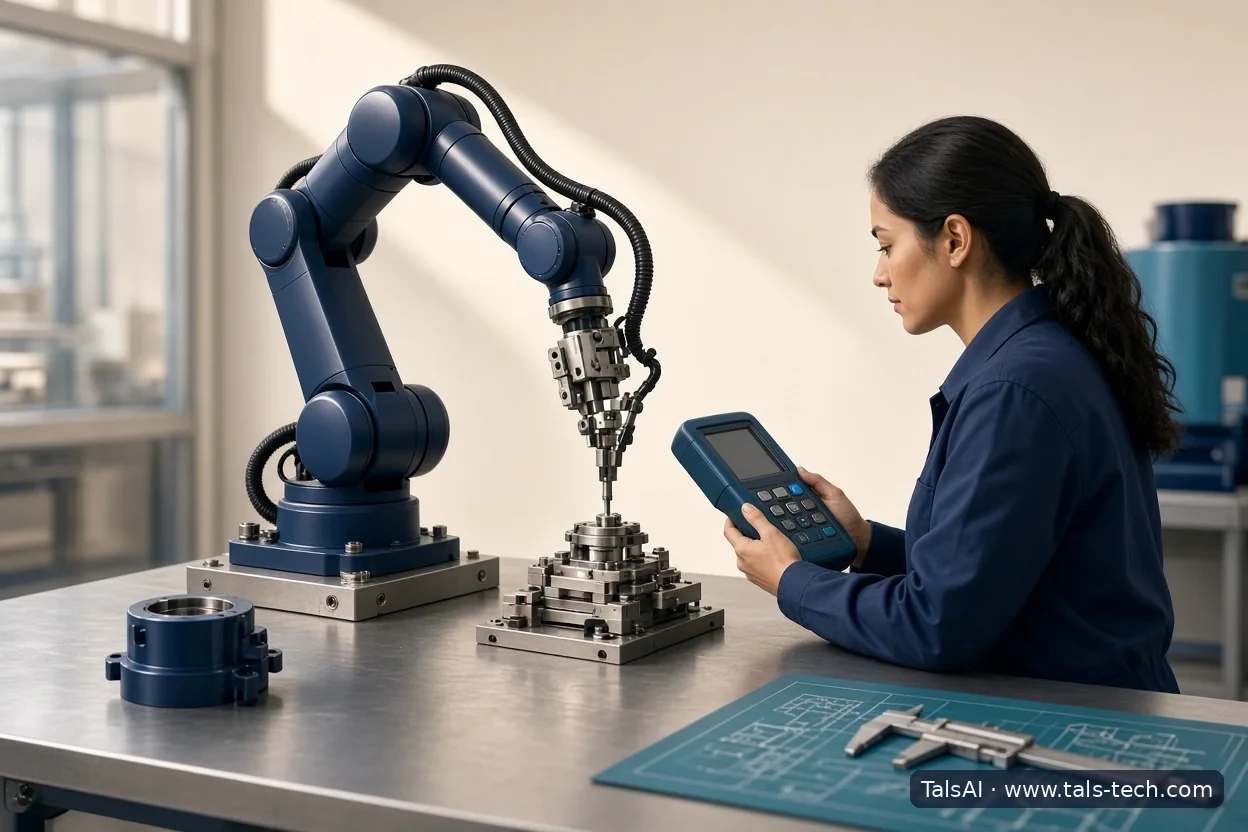
AI-generated industrial technology concept illustration, not a customer site or product screenshot.
RobCo’s survey suggests that factories already using robots are more confident they can automate the remaining manual steps. The finding is less about hype than about experience changing what decision makers believe is possible.
What the survey actually reports
The source summary states that RobCo surveyed 400 US automation decision makers and found that businesses at the forefront of automation are far more confident that they can automate their remaining manual processes. It also says these firms are more aware of recent advances in robotics and more optimistic about automation’s impact on workforces.
The available summary does not provide percentages, sector breakdowns, or details about the survey methodology, so the result should not be read as a universal law. The verified fact is narrow: among the surveyed US decision makers, prior robot use correlated with stronger confidence and greater awareness of robotics advances. This distinction matters because many automation discussions collapse into either techno-optimism or cautionary skepticism. The study only shows that confidence is uneven, and that experience is part of the explanation.
Why deployed factories see differently
In practice, factories that have already installed robots have learned what automation really costs and really changes. They have experienced integration, changeover, safety validation, operator training, and the quiet work of stabilizing a process before it can be repeated. That experience can make the remaining manual tasks look more tractable, not because they are simple, but because the plant now has a method for testing them.
This creates a practical implication for manufacturers that have not yet automated: confidence is often built through a small, bounded pilot rather than through a broad roadmap. A single station with a clear cycle time, a clear failure mode, and a clear handoff to operators can teach more than a slide deck. The lesson is not to buy more robots first; it is to create a repeatable way to evaluate automation.
The hard question before scaling
The limitation is that optimism can outrun operational readiness. A factory may be confident because it automated one stable, high-volume task, then mistakenly assume the same logic applies to low-volume, high-mix, or highly variable processes. In those settings, tooling, programming, data interfaces, and exception handling can dominate the business case. If the plant cannot measure downtime, changeover, or operator intervention, the next automation decision becomes guesswork.
A better implementation question is: can the organization turn one successful robot cell into a governed capability? That requires standardized acceptance tests, maintenance and spare parts planning, operator retraining, and a way to compare the automated cell against the manual baseline. Without those controls, the study’s optimism may simply reflect survivorship among early adopters rather than a general path to success.
Key Statistics
- RobCo surveyed 400 US automation decision makers.
Outlook
For TALS, the useful takeaway is not that automation makes companies optimistic, but that disciplined automation converts optimism into measurable capability. The smart factory begins with one verified process, then expands only when the data, people, and controls can follow.
Related product and scope
For this topic, explore TalsAI’s MES manufacturing execution system: work orders, shop-floor reporting and production progress; machine connectivity is project-specific. This is not an endorsement by the original news source.
Source date: 2026-11-18 21:17 UTC
Original source