
DHL Tests Adaptive Robots and AI Orchestration in Warehouses - TALS
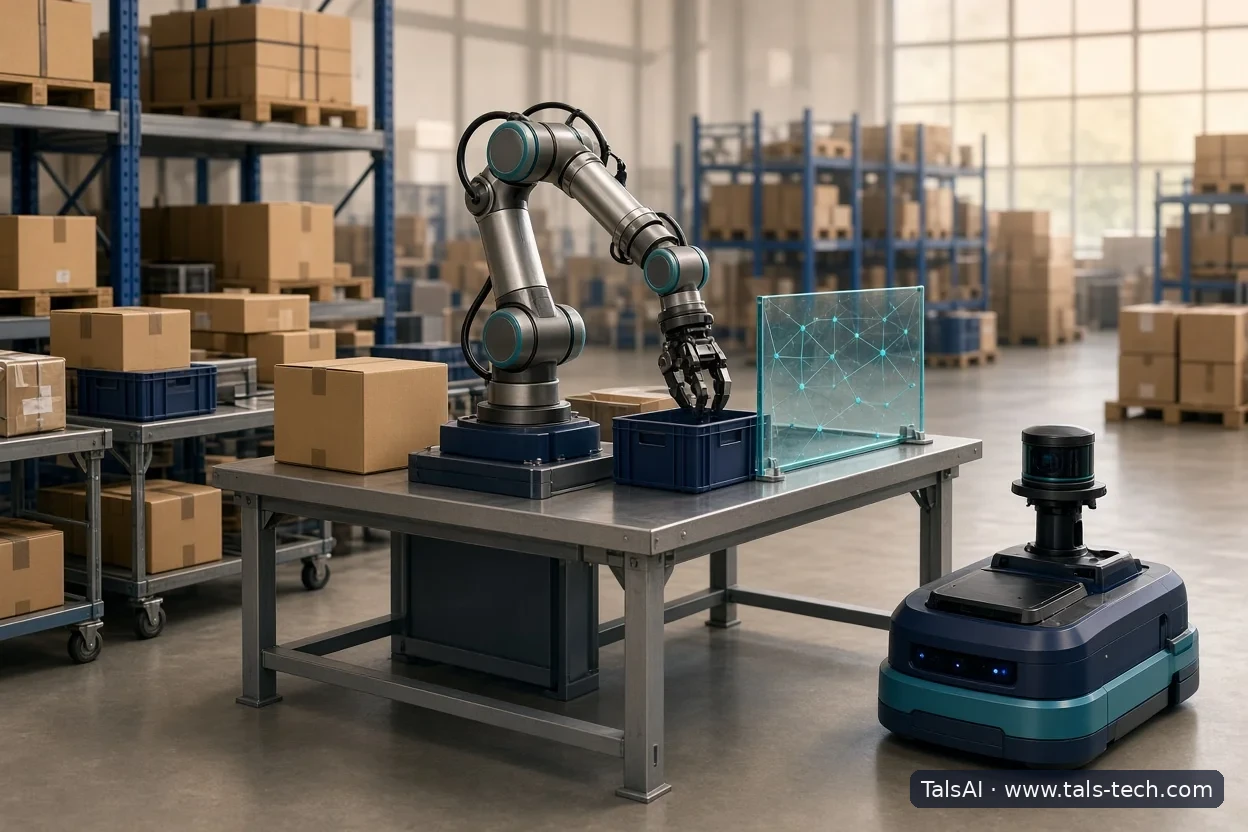
AI-generated industrial technology concept illustration, not a customer site or product screenshot.
DHL Supply Chain is testing adaptive AI-powered robots and AI orchestration inside live warehouse operations, according to the source summary, as part of its Intelligent Supply Chain framework. For manufacturers, the more useful signal is not the robot itself, but the attempt to coordinate heterogeneous assets, human workers and changing tasks in real time.
The orchestration layer becomes the product
The source says DHL is moving beyond automating individual tasks and is introducing AI orchestration into live warehouse operations. That wording matters. A warehouse is not a static line; it is a changing map of inventory, people, equipment, exceptions and order urgency. Orchestration therefore has to do more than assign jobs. It has to sense context, compare alternatives and decide what should happen next when conditions shift.
From a smart-factory perspective, the lesson is that the bottleneck is often not the fastest machine but the decision loop. A plant can buy robots, conveyors and vision systems, yet still lose throughput because events are handled by spreadsheets, radios or supervisor intuition. An orchestration layer tries to make those decisions explicit, auditable and repeatable, which is why it can matter more than any single piece of equipment.
Warehouse pilots expose factory realities
Logistics and manufacturing share a difficult condition: the environment changes while work is underway. Orders arrive differently, materials are misplaced, machines drift, people move between stations and quality issues interrupt the rhythm. The source frames DHL’s pilot as adaptive robotics plus orchestration, which suggests the robots are expected to respond to context rather than replay a fixed script.
For factories, that is a useful warning. Flexibility without coordination can create new bottlenecks. A robot may choose a locally rational path that blocks a forklift route, delays a takt cycle or triggers a safety stop. The operational question is not whether the robot can move, but whether the whole system can explain why it moved, when it should yield and how a human can take over without breaking the flow.
The hard part is decision rights and data
The source summary does not provide performance numbers, so the practical value should be read as a design problem rather than a proven benchmark. The hard part is deciding who controls what. AI may recommend a route, reprioritize a task or call for human intervention, but safety, downtime and conflicting priorities still need clear rules. If those rules are vague, the operation will fall back on manual overrides and dilute the system’s value.
A second limitation is data quality. Orchestration needs current equipment states, order states, task assignments and exception reasons. If those records come from disconnected systems and update slowly, the AI may optimize against an outdated picture. The logistics setting described in the source is already complex; discrete manufacturing adds more variables, including process states, maintenance windows and quality holds.
Outlook
For TALS, the takeaway is that smart manufacturing is less about adding isolated machines than building an explainable coordination layer that can handle exceptions, preserve human authority and turn operational variability into measurable flow.
Related product and scope
For this topic, explore TalsAI’s WMS warehouse management: locations, stock movements and production material issues and returns. This is not an endorsement by the original news source.
Source date: 2026-11-15 19:17 UTC
Original source