
AI reshaping production hinges on closed loops - TALS
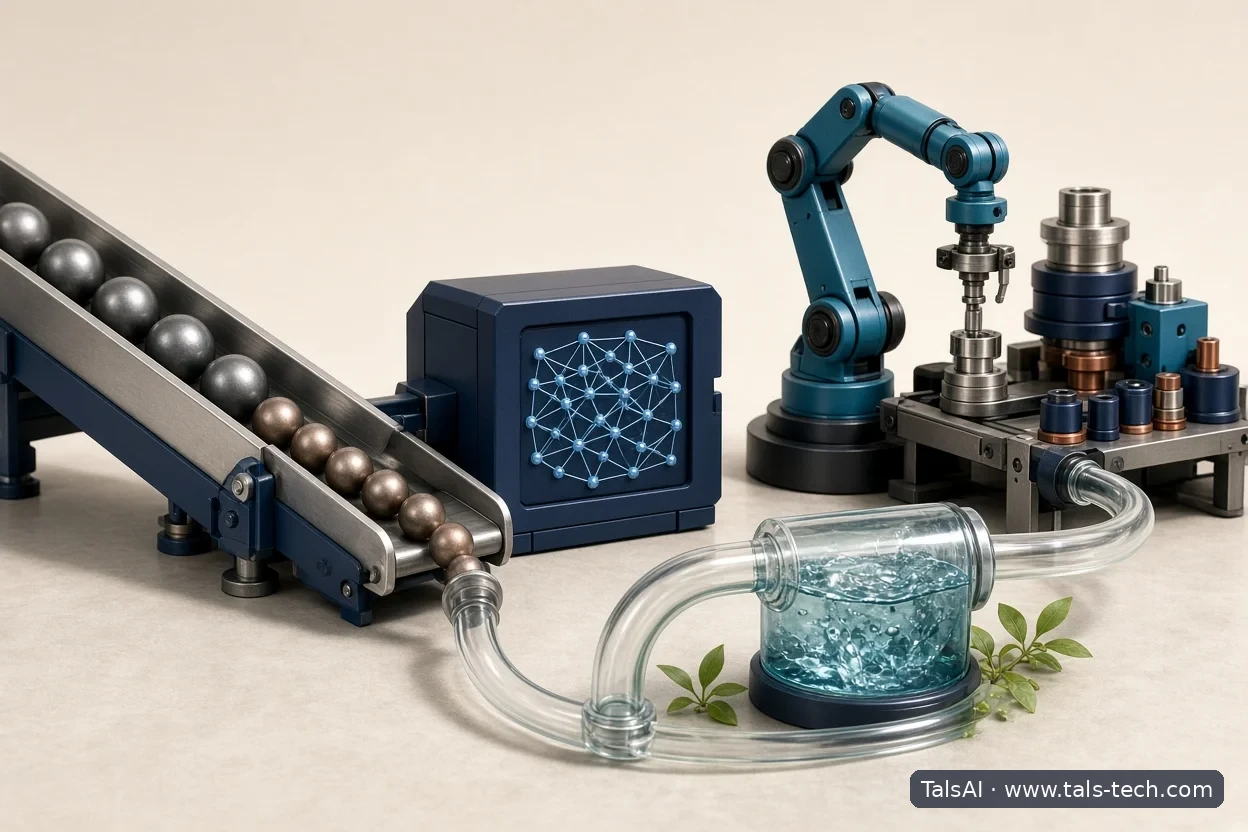
AI-generated industrial technology concept illustration, not a customer site or product screenshot.
Analytics Insight's headline says AI is reshaping industrial production in five ways. The more useful question is not how many ways there are, but which production decisions AI can change without breaking trust, traceability or throughput.
A headline signals direction, not proof
The source summary explicitly says only that AI is reshaping industrial production in five ways; it does not provide the list, the evidence, or the implementation maturity. That limitation matters. A number in a headline can create the impression that adoption is already standardized, when in practice each use case depends on data quality, equipment access, operator acceptance and the cost of being wrong. In smart manufacturing, the first discipline is to separate reported claims from operational assumptions.
A practical reading is to treat the five ways as five possible intervention points: sensing, prediction, scheduling, quality judgment and human-machine coordination. Each one changes information flow and accountability. If a plant only wants a showcase, it may display a model output as if it were production truth. If it wants closed-loop value, it asks whether inputs are reliable, whether outputs can be executed, and whether a human can override safely.
The real change is the feedback loop
On the shop floor, AI matters less as a single prediction and more as a way to compress feedback. Machine condition, process parameters, inspection results and order changes are often split across operators, engineers and planners. A model that turns scattered signals into executable recommendations can speed response. But if data is delayed or operating conditions drift, the same recommendation can amplify disturbance rather than prevent it.
That creates two operational requirements. First, the model must be tied to a defined production object: stoppage risk on one line, defect trend in one process, or changeover time for one material family. Second, each recommendation needs confidence limits and a clear manual takeover path. Without those boundaries, AI can reduce complex manufacturing to dashboard colors while managers still absorb the consequences.
Test the loop before scaling
The implementation question should shift from “which use cases exist?” to “which loop can close safely?” A verifiable minimum loop needs sourced input data, explainable model output, authorized execution, and recorded feedback. If any link is missing, the project remains a pilot. This is especially true in high-mix, low-volume production, where scarce samples and frequent condition changes weaken model stability.
Traceability is the other constraint. A factory needs to know why a recommendation was generated, who authorized it, and how to recover when it fails. In regulated or high-value manufacturing, model version, data window and exception events should all be auditable. If they are not, AI may deliver efficiency but become an unexplainable factor in a quality dispute.
Key Statistics
- Analytics Insight headline: AI is reshaping industrial production in five ways.
Outlook
From TALS's smart-manufacturing perspective, AI should not be treated as a replacement for manufacturing systems. It should enter through defined interfaces for data, decisions, execution and responsibility. Only when models are embedded in auditable, reversible and collaborative production loops can smart factories move from narrative to stable operations.
Related product and scope
For this topic, explore TalsAI’s MES manufacturing execution system: work orders, shop-floor reporting and production progress; machine connectivity is project-specific. This is not an endorsement by the original news source.
Source date: 2026-11-06 12:05 UTC
Original source