
Huayan Robotics at Robotworld: Industrializing Embodied AI - TALS
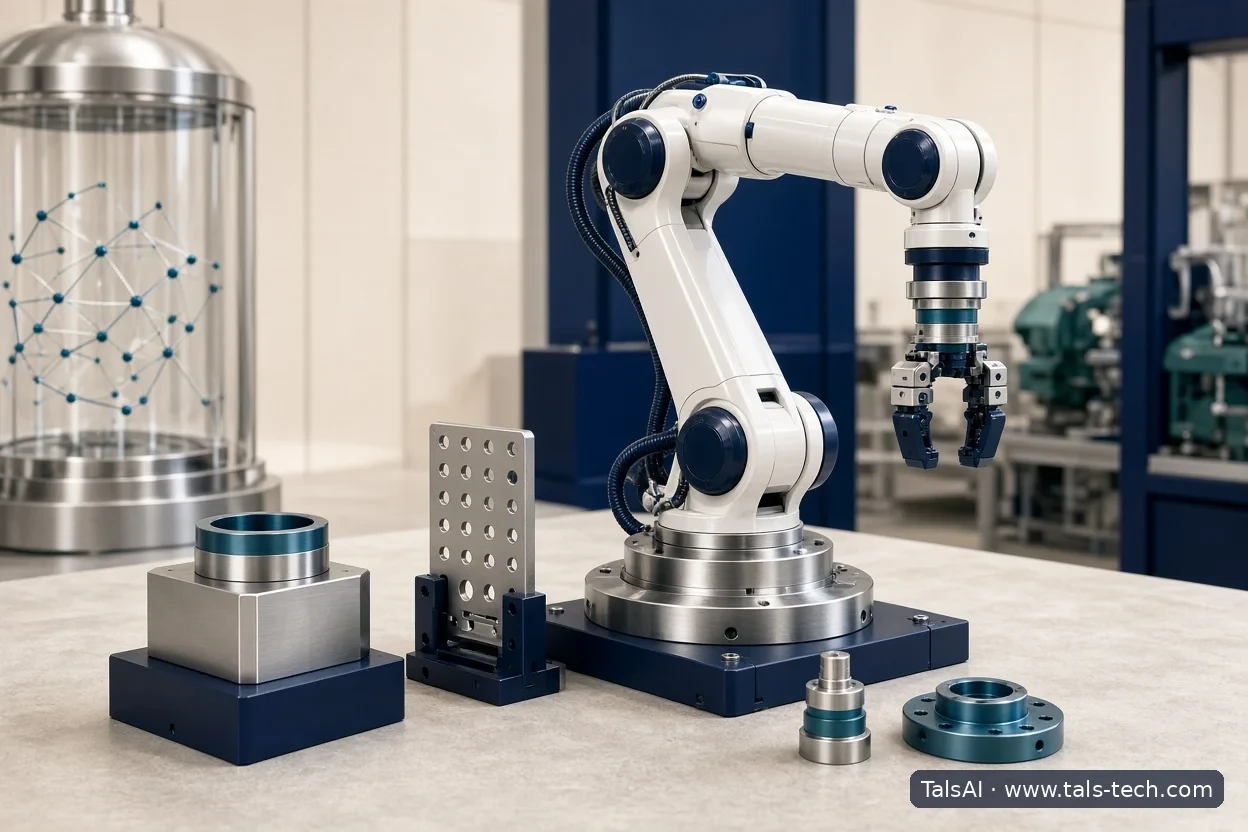
AI-generated industrial technology concept illustration, not a customer site or product screenshot.
Huayan Robotics has announced plans to showcase its latest smart manufacturing and embodied AI applications at Robotworld 2026 in Korea. The move illustrates how advanced robotic systems are evolving beyond fixed trajectories toward context-aware physical operations on the shop floor.
Embodied Intelligence Beyond Structured Environments
Public announcements indicate that Huayan Robotics will present embodied artificial intelligence solutions tailored for smart production at the Robotworld 2026 exhibition in Korea. Unlike conventional industrial manipulators restricted to pre-programmed paths, embodied AI couples machine perception directly with physical action. This shift aims to equip robotic hardware with the capacity to handle non-standardized variables, such as shifted part orientations or surface irregularities, without manual intervention.
In modern discrete assembly lines, maintaining rigidity through specialized jigs often limits operational flexibility and inflates tooling capital expenditure. Integrating embodied perception enables workcells to accommodate natural variations in component placement and geometry. However, translating these capabilities from controlled exhibition demos into dusty, high-vibration manufacturing environments remains a formidable operational hurdle that demands verified sensor durability and resilient inference logic.
Balancing Stochastic Learning with Deterministic Control
Industrial production is governed by strict tact times, microsecond synchronicity, and non-negotiable functional safety protocols. Modern embodied AI frameworks, frequently powered by deep neural networks, inherently introduce probabilistic behavior into motion planning. Deploying these models within production cells creates tension with hard-real-time programmable logic controllers, requiring rigorous architectural boundaries to ensure that adaptive decisions never breach core safety limits.
Compute architecture represents another practical constraint for plant engineers. Local execution of multi-modal vision and tactile models requires heavy edge processing hardware, which adds payload mass, thermal overhead, and energy consumption to robotic arms or mobile bases. Conversely, offloading compute to central industrial clouds exposes closed-loop control to network latency and packet jitter, both of which can compromise motion safety during high-speed physical interaction.
Integration Challenges with Manufacturing Infrastructure
Embodied robotic systems cannot operate as closed technological silos if they are to deliver measurable business returns. When an autonomous robot alters its gripping posture or compensates for a minor dimensional defect, that event generates critical operational and quality telemetry. Without standardized open interfaces, capturing this high-frequency behavioral data becomes difficult, preventing plant supervisors from tracking the root causes of process variations.
Industrial leaders must therefore scrutinize how embodied systems synchronize with broader manufacturing operations management. Dynamic adjustments performed by adaptive machines must map seamlessly into work orders, traceability records, and enterprise quality monitoring. Until embodied agents operate in tight coordination with centralized execution software, their practical value will remain confined to isolated pilot stations.
Outlook
Embodied AI offers transformative agility for complex assembly, but its ultimate success depends on seamless integration with enterprise execution platforms to maintain end-to-end operational visibility.
Related product and scope
For this topic, explore TalsAI’s MES manufacturing execution system: work orders, shop-floor reporting and production progress; machine connectivity is project-specific. This is not an endorsement by the original news source.
Source date: 2026-10-27 01:12 UTC
Original source