
Edge AI Moves Industrial Automation From Telemetry to Real-Time Action - TALS
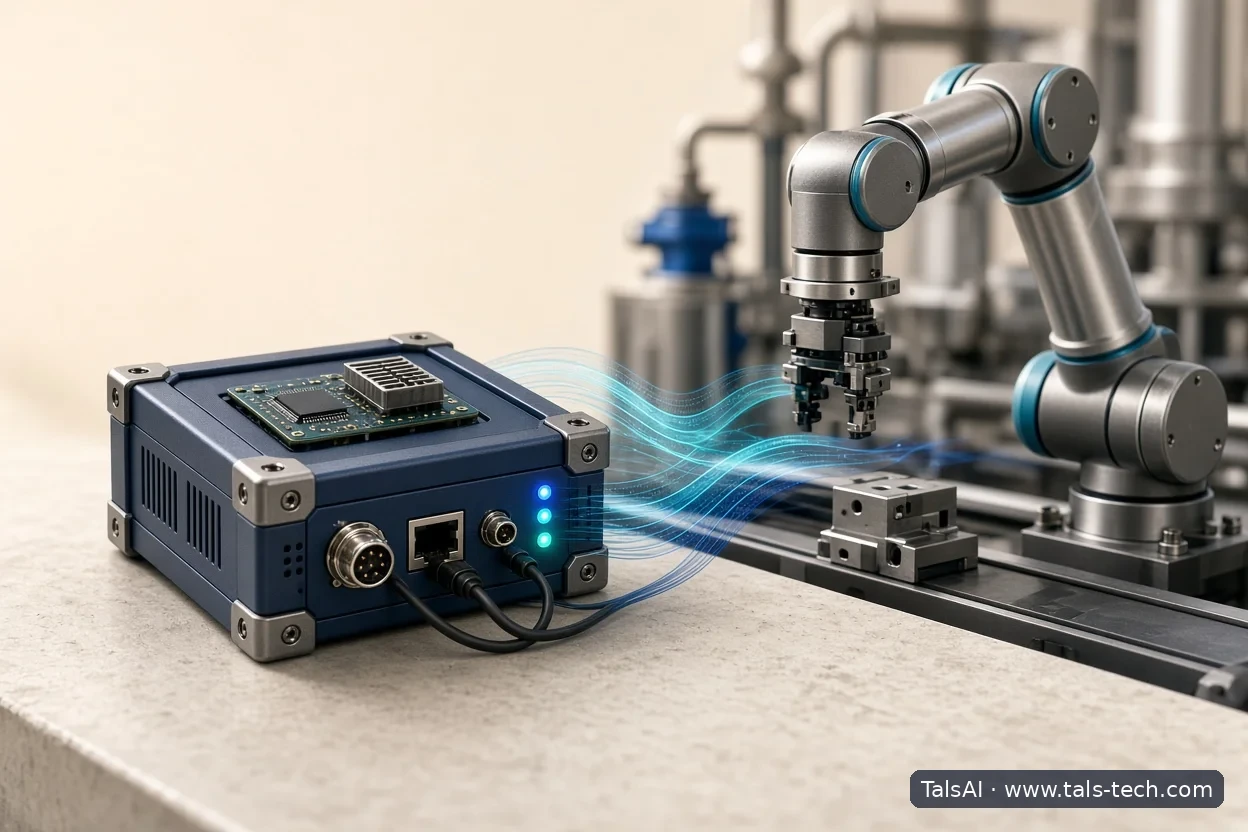
AI-generated industrial technology concept illustration, not a customer site or product screenshot.
Industrial reporting by Bisinfotech highlights a decisive evolution in smart manufacturing: the transition of edge computing from passive sensor aggregation to autonomous, on-device decision-making. As modern production environments demand sub-second responsiveness, moving AI inferencing directly to machine controllers is redefining factory automation architectures.
Closing the Latency Gap at the Machine Interface
Bisinfotech's perspective centers on transforming raw operational telemetry into immediate local intervention. In traditional industrial IoT deployments, sensor streams were backhauled to centralized cloud platforms for batch analytics, creating an inherent latency lag that restricted algorithms to post-incident auditing rather than real-time prevention. By executing neural networks directly on edge industrial PCs and smart gateways, manufacturing systems compress the control loop from minutes to milliseconds, enabling autonomous path correction, defect ejection, and dynamic spindle adjustments without waiting for cloud round-trips.
This shift fundamentally alters the value proposition of shop-floor data. Instead of flooding enterprise networks with high-frequency vibrational or acoustic noise, edge nodes distill gigabytes of operational signals into actionable state changes at the point of creation. Consequently, automation systems gain localized autonomy, ensuring that mission-critical safety interlocking and high-speed quality checks remain operational even during severe wide-area network disruptions.
Operational Gains in High-Speed Production Cycles
In operational environments such as precision stamping, electronics assembly, and continuous process manufacturing, processing telemetry locally delivers tangible operational resilience. Edge-deployed vision models, for instance, can evaluate component placement and solder integrity inline at full line speed, eliminating the buffer bottlenecks historically caused by asynchronous inspection stations. By executing inference locally, production lines sustain maximum throughput without risking quality degradation or incurring unsustainable cloud egress bandwidth fees.
Furthermore, edge AI bridges the longstanding gap between operational technology (OT) deterministic cycles and enterprise IT software. When inference engines feed predictions directly into programmable logic controllers (PLCs) via industrial protocols like OPC UA and MQTT, closed-loop process optimization becomes possible. Machine parameters automatically self-tune based on micro-deviations in ambient temperature or raw material variance, stabilizing overall yield before downstream defects manifest.
Distributed Lifecycle Governance and Hardware Fragility
Despite the compelling performance profile of edge AI, scaling these architectures across multi-site manufacturing networks introduces severe governance challenges. Unlike centralized cloud workloads where model deployment and retraining occur within unified container environments, edge computing distributes containerized models across hundreds of heterogeneous physical appliances exposed to thermal stress, electrical noise, and dust. Maintaining model version consistency, managing secure over-the-air firmware updates, and auditing inference drift across diverse hardware revisions remain formidable operational hurdles for plant engineers.
Moreover, edge inference hardware introduces a distinct maintenance lifecycle that conflicts with traditional twenty-year industrial equipment lifespans. Machine builders and plant operators must balance the capital expenditure of specialized edge neural processing units against rapid silicon obsolescence. Without centralized orchestration frameworks that reconcile local edge autonomy with fleet-wide observability, manufacturers risk creating fragmented digital silos that are difficult to secure, maintain, and upgrade.
Outlook
For modern smart factories, edge AI is not a replacement for enterprise platforms, but the critical execution layer that turns system-wide intelligence into instantaneous physical reality on the shop floor.
Related product and scope
For this topic, explore TalsAI’s MES manufacturing execution system: work orders, shop-floor reporting and production progress; machine connectivity is project-specific. This is not an endorsement by the original news source.
Source date: 2026-10-30 09:02 UTC
Original source