
Rethinking Automotive MES for Mixed Powertrains and Software Fleets - TALS
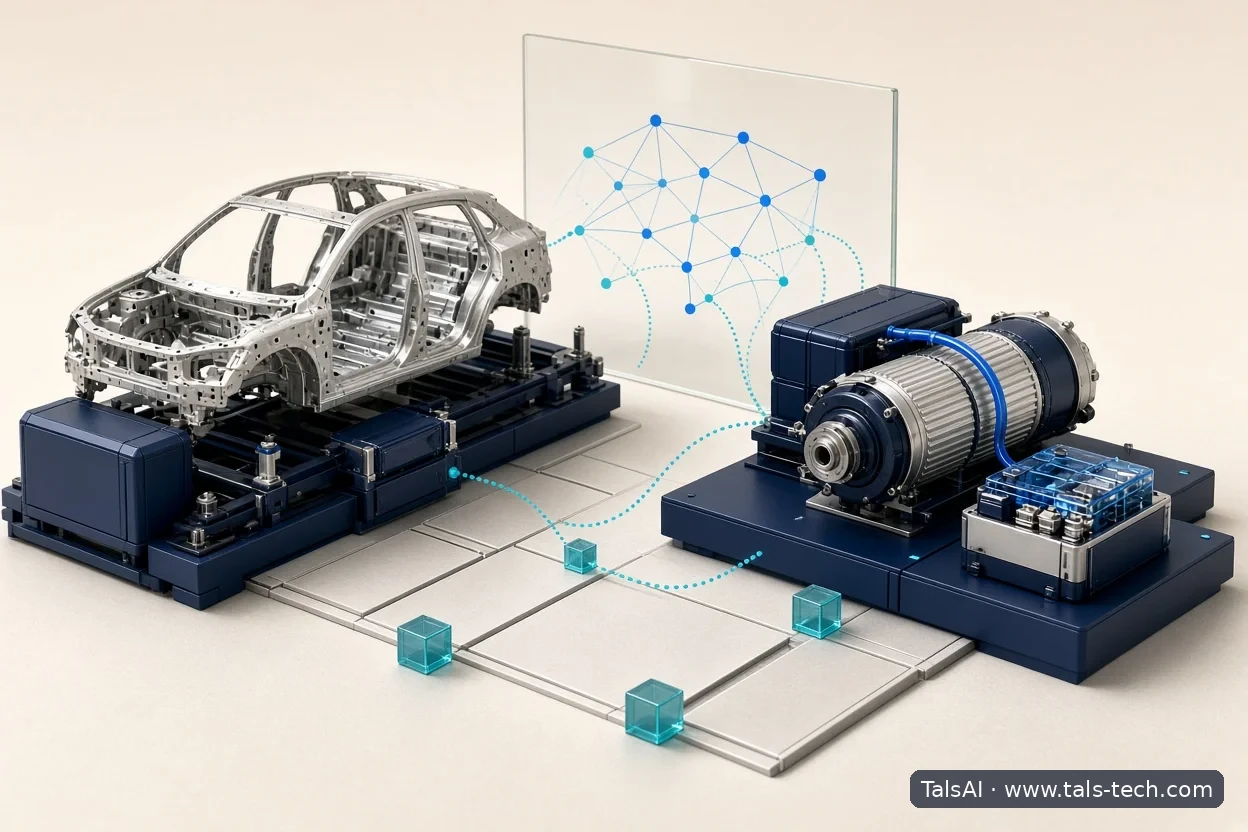
AI-generated industrial technology concept illustration, not a customer site or product screenshot.
As automotive manufacturing confronts fluctuating electric vehicle demand alongside persistent combustion platforms, assembly plants are outgrowing static execution systems. Industry analysis highlights that manufacturing execution systems entering 2026 must transition from rigid linear tracking to dynamic, highly adaptable orchestration platforms across varied powertrain architectures.
Deconstructing Linear Assembly for Dynamic Line Balancing
Automotive shop floors are increasingly challenged by co-producing electric, hybrid, and internal combustion vehicles on unified lines. Traditional MES architectures were engineered around deterministic cycle times and fixed routing, which falter when cycle variance between battery pack installation and engine mounting expands. Modern operational frameworks must decouple station sequencing, allowing automated guided systems and flexible cells to balance workloads without halting plant takt times.
Operationally, this shifts the MES from a passive transaction log to an active dispatcher of workstation logic. Facilities require execution layers capable of recalculating routing paths instantaneously when subassembly delays emerge. When a high-voltage testing cell experiences cycle variance, an adaptable MES instantly re-routes chassis units to parallel buffer stations, preventing line-wide micro-stoppages and preserving overall equipment effectiveness.
Deep Traceability and Software-Defined Vehicle Flashing
Beyond mechanical assembly, modern vehicle manufacturing requires flawless digital synchronization across dozens of electronic control units before end-of-line sign-off. The execution system must govern in-line firmware flashing, cryptographic key provisioning, and variant-specific calibration under strict time constraints. This demands immediate bidirectional handshakes between shop-floor controllers, supplier serialization registries, and central OEM digital vehicle records.
Component traceability has concurrently expanded from batch records to cell-level and torque-curve granularity. Stricter battery passport regulations and safety mandates require every fastening angle, thermal paste dispense volume, and weld parameter to tie indelibly to the vehicle identification number. Execution platforms must index high-volume process telemetry in real time without causing communication latency across critical machine networks.
The Integration Bottleneck of Heterogeneous Legacy Controls
Despite these technological imperatives, automotive manufacturers face substantial roadblocks when modernizing legacy brownfield facilities. Many assembly plants operate proprietary automation stacks accumulated over decades, creating acute integration friction for standardized API-first MES rollouts. Replacing or overlaying execution software without triggering catastrophic plant downtime represents an operational risk that plant managers approach with extreme caution.
Furthermore, orchestrating edge computing nodes with corporate cloud infrastructure introduces continuous cybersecurity and determinism trade-offs. If network handshakes stutter during electronic control unit flashing or torque validation, assembly lines stall immediately. Bridging modern open protocols with legacy fieldbus environments remains an expensive systems-engineering challenge that frequently delays plant modernization schedules.
Outlook
For automotive manufacturers navigating mixed-powertrain volatility and rigorous compliance, upgrading the execution layer is essential to maintaining operational resilience. TALS provides agile, composable smart manufacturing architectures that bridge legacy industrial hardware with high-precision traceability and automated shop-floor workflows.
Related product and scope
For this topic, explore TalsAI’s MES manufacturing execution system: work orders, shop-floor reporting and production progress; machine connectivity is project-specific. This is not an endorsement by the original news source.
Source date: 2026-10-30 15:03 UTC
Original source