
Valmet Acquires Tieto MES Business to Drive Autonomous Operations - TALS
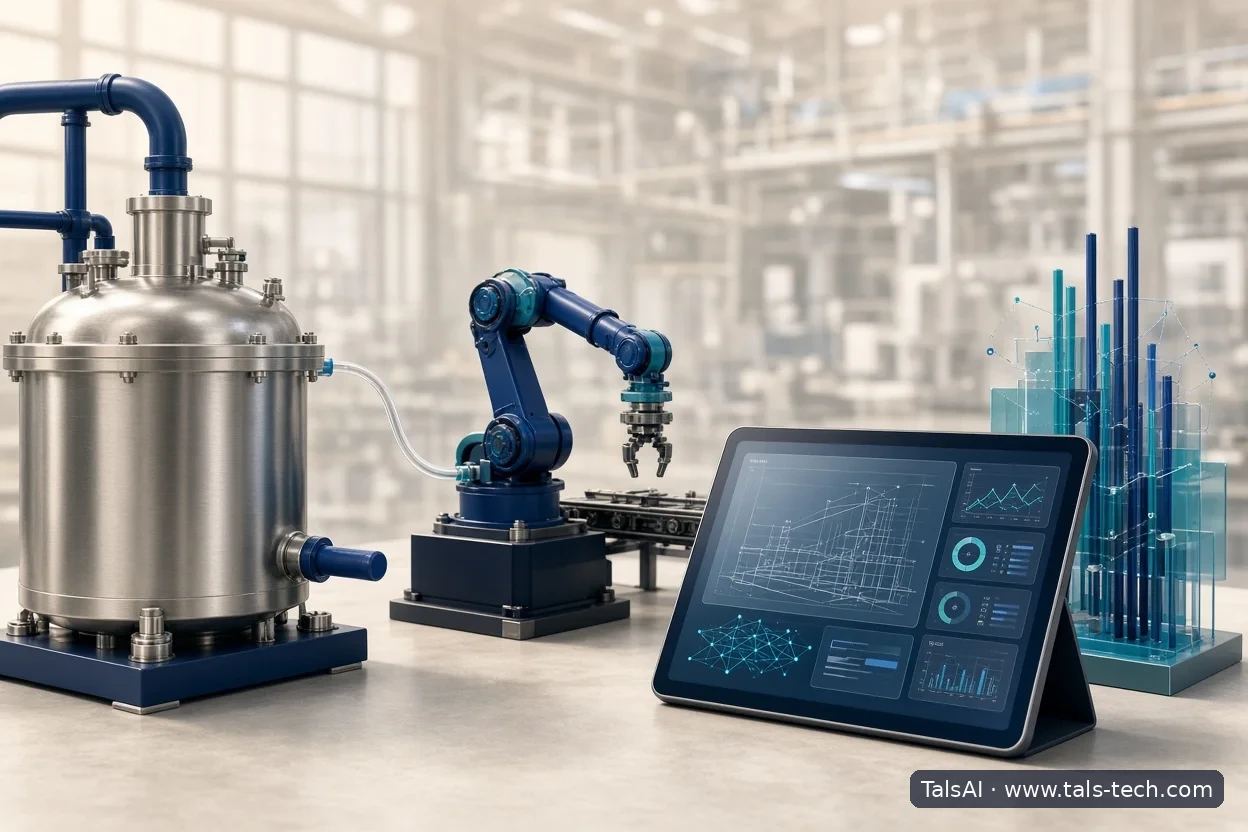
AI-generated industrial technology concept illustration, not a customer site or product screenshot.
Industrial equipment and automation supplier Valmet has announced an agreement to acquire the manufacturing execution system business from Tieto to accelerate industrial transition toward autonomous operations. This strategic portfolio expansion signals how major engineering groups are directly absorbing digital execution software to control the full operational stack.
Strategic Consolidation Across Process Automation Layers
The reported acquisition involves Valmet taking ownership of Tieto's MES software portfolio with the explicit objective of accelerating autonomous operations in industrial manufacturing. While financial details and specific timeline boundaries remain unelaborated in initial reports, the move represents a decisive consolidation step where a major process equipment and automation vendor incorporates a mature MES capability into its native technology ecosystem.
Historically, process automation suppliers focused predominantly on distributed control systems, machinery design, and basic supervisory layers, leaving execution scheduling and production tracking to independent software vendors. By absorbing Tieto's MES division, Valmet directly addresses the traditional disconnect between machine automation and higher-level plant management, positioning software as a core operational driver rather than an external bolt-on.
Operational Value of Native MES-Equipment Alignment
In high-throughput continuous and batch environments such as pulp, paper, and energy, achieving true autonomous operations requires sub-second process stability tightly synchronized with order-level dispatching. When MES capabilities reside within the same engineering domain as the process machinery, closed-loop optimization models can adjust production schedules based on direct equipment health metrics, process bottlenecks, and material variability in real time.
For plant operators, this alignment potentially reduces the friction typically found during integration projects between standalone MES platforms and underlying automation systems. Unified data semantics between the plant floor and plant-wide optimization engines simplify quality tracking, dynamic recipe execution, and energy balancing, laying the functional groundwork needed to progress from automated setpoint regulation to supervisory autonomous orchestration.
Architectural Independence and Brownfield Integration Challenges
However, an OEM-led MES acquisition raises practical architecture dilemmas for diversified manufacturers running multi-vendor plants. Most industrial facilities operate machinery supplied by multiple competing builders alongside heterogenous control systems; deploying an execution system tightly coupled to a single machine OEM can create fears of vendor lock-in or degraded performance on third-party assets.
Engineering leaders must therefore evaluate whether the newly absorbed software stack will maintain open API standards and vendor-neutral connectivity. If the platform prioritizes proprietary equipment hooks over modular interoperability with broader ERP and legacy systems, enterprise-wide standardization across geographically diverse plants could face substantial technical pushback.
Outlook
At TALS, we view the pathway to autonomous operations not through closed vendor silos, but via composable, standards-based execution layers that bridge multi-vendor equipment with modern ERP and quality governance.
Related product and scope
For this topic, explore TalsAI’s MES manufacturing execution system: work orders, shop-floor reporting and production progress; machine connectivity is project-specific. This is not an endorsement by the original news source.
Source date: 2026-10-28 05:00 UTC
Original source