
Beyond Mechanical Throughput: Capitalizing on Robotics Expansion - TALS
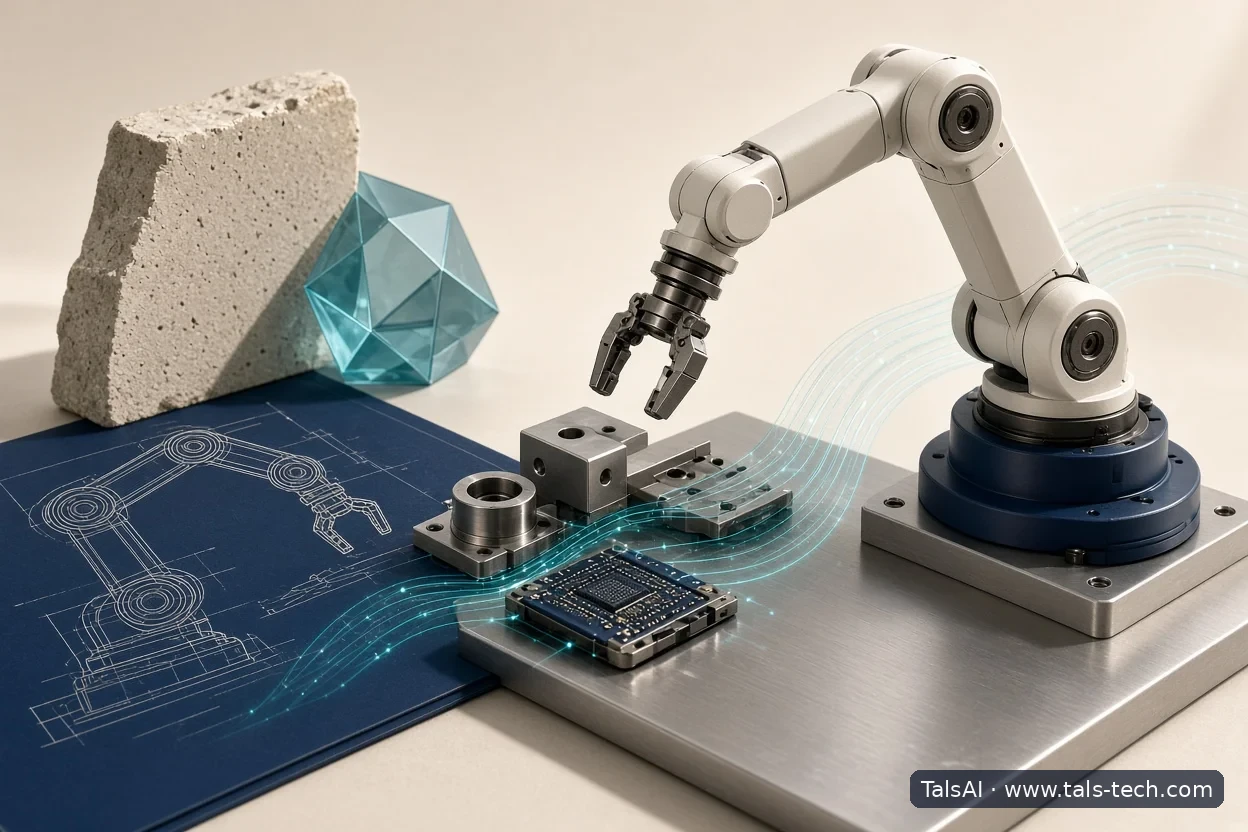
AI-generated industrial technology concept illustration, not a customer site or product screenshot.
The global robotics market is projected to expand at a 20.15% compound annual growth rate, driven by accelerating industrial automation, AI-driven robotics, and smart manufacturing adoption, according to Maximize Market Research. This expansion highlights a decisive shift from hard-coded mechanical cells toward adaptive, perception-capable systems on factory floors.
Evolution Beyond Static Automation
According to Maximize Market Research, the substantial 20.15% CAGR reflects expanding industrial automation needs reinforced by AI-powered robotics and integrated smart manufacturing frameworks. Historically, industrial robots excelled almost exclusively within rigid, repetitive envelopes where parts arrived in fixed orientations and cycle times remained strictly deterministic.
The convergence of neural-network inference at the edge and vision guidance allows contemporary robotic units to interpret variable environments and manipulate unaligned components. Consequently, manufacturing facilities are moving capital expenditure from dedicated mechanical hard tooling toward reprogrammable, intelligent assets that can absorb fluctuating production requirements across volatile product portfolios without manual re-engineering.
Latency and Contextual Gaps on the Shop Floor
While individual robotic workcells increasingly possess the computational power to optimize local pathing, their operational value collapses when decoupled from broader production orchestration. Autonomous mobile platforms and robotic handling arms frequently idle because upstream replenishment cycles, routing changes, or material staging queues fail to synchronize with rapid workstation throughput.
A subtle operational vulnerability emerges in product conformance management. When an AI-guided robot dynamically adjusts tool pressure or welding angles to accommodate raw material anomalies, those fine-grained micro-adjustments must be matched against strict engineering tolerances. Without deterministic contextualization against part IDs and quality parameters, autonomous adaptations risk generating hidden variance across completed work orders.
Interoperability Limits in Heterogeneous Fleets
Projected market growth masks severe field integration bottlenecks arising from proprietary communication standards and closed vendor ecosystems. Production environments rarely procure end-to-end robotics from a single supplier; they maintain a hybrid mix of six-axis articulated arms, collaborative cobots, and automated transit units operating under fragmented protocols.
Engineers face the complex task of harmonizing asynchronous robotic event telemetry with real-time shop-floor dispatch logic. If an enterprise lacks an overarching execution infrastructure capable of standardizing multi-vendor motion data into structured transactional records, managing fleet coordination transforms into an unmanageable web of custom middleware and escalating maintenance overhead.
Key Statistics
- Global robotics market projected to expand at a 20.15% CAGR (Maximize Market Research)
Outlook
To translate rapid robotics expansion into profitable factory output, TALS bridges the gap between autonomous machine perception and plant-wide operational governance, transforming raw robotic dexterity into reliable, auditable manufacturing execution.
Related product and scope
For this topic, explore TalsAI’s MES manufacturing execution system: work orders, shop-floor reporting and production progress; machine connectivity is project-specific. This is not an endorsement by the original news source.
Source date: 2026-10-12 07:00 UTC
Original source