
Shanghai Bets on Advanced Smart Manufacturing Clusters - TALS
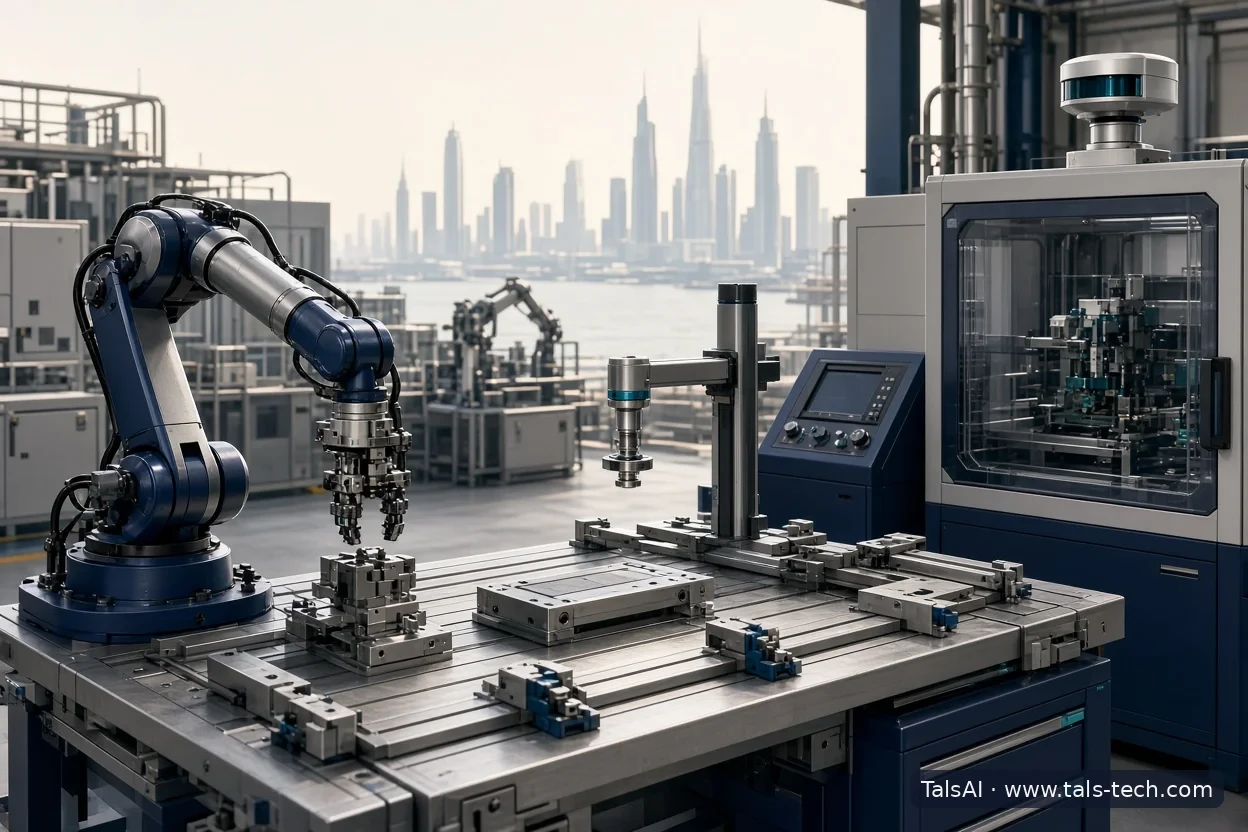
AI-generated industrial technology concept illustration, not a customer site or product screenshot.
According to reports from China Daily Global Edition, Shanghai is placing a strategic emphasis on accelerating its smart manufacturing sector. As China's primary commercial hub faces shifting demographic trends and rising operational costs, metropolitan industrial policy is pivoting toward high-value, digitally coordinated production.
Strategic Reorientation Toward High-Value Production
The public signaling around Shanghai's smart manufacturing commitment reflects a broader imperative for mature industrial hubs. As urban real estate and labor costs rise, traditional low-margin assembly cannot survive within municipal borders. Shanghai's industrial leadership is consequently targeting high-complexity sectors—such as semiconductor fabrication, automotive systems, and advanced robotics—where density and advanced logistics provide distinct competitive advantages.
This regional pivot requires manufacturers to abandon isolated automation projects in favor of interconnected digital architectures. Operational competitiveness in dense urban corridors hinges on synchronizing shop-floor telemetry directly with supply networks. When a metropolitan ecosystem commits to smart manufacturing, local suppliers must achieve end-to-end data interoperability to remain viable components of the municipal value chain.
Operational Realities of Urban Industrial Clusters
Operating smart plants within a dense metropolis presents unique logistical and infrastructural requirements. Unlike greenfield mega-facilities built on cheap rural land, urban industrial sites must maximize yield per square meter through hyper-dense layouts, multi-story automated warehousing, and unified execution software. Production planning must adapt to tight environmental regulations, strict energy caps, and just-in-time material flows running through congested transit corridors.
Consequently, smart manufacturing in this context demands unified visibility across quality management, energy monitoring, and plant execution. Disparate control systems and siloed legacy spreadsheets create bottlenecks that directly erode urban operational margins. Modernizing these operations involves deploying deterministic software layers that handle dynamic scheduling, predictive maintenance, and closed-loop quality control without requiring facility footprint expansion.
Implementation Hurdles and Brownfield Legacy Debt
Despite strong policy backing, regional transitions inevitably encounter severe brownfield integration friction. Established industrial corridors in Shanghai house decades of heterogeneous equipment, varying protocols, and entrenched operational practices. Upgrading these brownfield assets to modern digital execution standards requires extensive edge-layer re-engineering, which can disrupt active production cycles if not managed with modular precision.
Furthermore, the shortage of hybrid talent—engineers fluent in both industrial process engineering and enterprise software architecture—remains a major scaling bottleneck. Simply mandating smart factory adoption from a policy level does not resolve the complex task of harmonizing operational technology with corporate governance. Enterprises often struggle with escalating deployment expenses and protracted validation timelines before realizing tangible productivity gains.
Outlook
For industrial enterprises operating in modern industrial centers, municipal modernization initiatives underscore the necessity of agile software architectures. TALS continues to support manufacturers navigating complex brownfield transformations by integrating mission-critical MES and execution workflows that drive sustainable productivity in high-cost environments.
Related product and scope
For this topic, explore TalsAI’s MES manufacturing execution system: work orders, shop-floor reporting and production progress; machine connectivity is project-specific. This is not an endorsement by the original news source.
Source date: 2026-10-24 00:52 UTC
Original source