
Optical PPE and Machine Safety in Automated Intralogistics - TALS
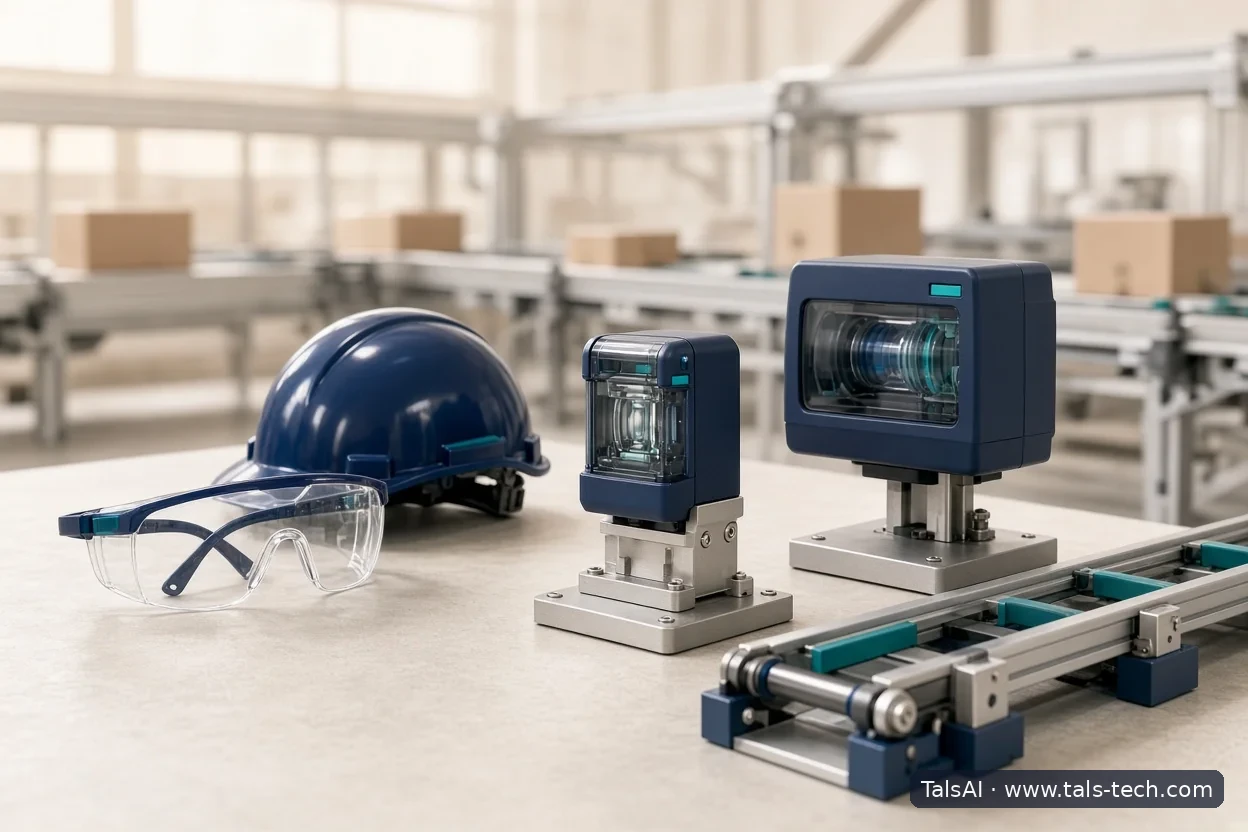
AI-generated industrial technology concept illustration, not a customer site or product screenshot.
As automated vehicles and robotic pickers increasingly share warehouse corridors with floor personnel, physical safety gear is evolving rather than disappearing. Industry analysis emphasizes that modern high-visibility personal protective equipment remains indispensable for sustaining human safety alongside autonomous material handling machinery.
The Persistence of Human Presence Amid Automation
According to recent industry reporting, logistics facilities have experienced more operational transformation over the past decade than during the preceding fifty years combined. Automated guided vehicles, automated sorters, and robotic pickers now routinely navigate the same physical aisles as warehouse workers, creating shared dynamic zones where collision avoidance relies on clear mutual detection. While handling technologies have advanced rapidly, human personnel remain essential for maintenance, irregular cargo management, and manual exception routing across the warehouse floor.
In these collaborative spaces, high-visibility clothing no longer exists merely to catch the attention of human drivers. Autonomous navigation systems—combining 2D and 3D LiDAR, stereoscopic machine-vision cameras, and optical proximity sensors—frequently depend on calibrated reflectivity and contrast thresholds to classify human forms. Substandard or degraded retroreflective material can degrade optical detection margins, creating unpredictable classification delays in crowded sorting hubs.
Operational Realities of Protective Wear Maintenance
Transitioning to automated handling often breeds an operational bias toward software-defined safety, yet compliant personal protective equipment forms the baseline passive barrier against mechanical impact. When automated guided vehicles execute rapid trajectory adjustments within confined racking aisles, ambient lighting variations and blind corners test vehicle braking envelopes. High-contrast, compliant workwear provides the baseline optical signature needed for both human supervisors and automated sensors to register perimeter breaches reliably.
However, logistics operations frequently fail to manage protective wear degradation systematically. Repeated industrial washing, grease contamination, and mechanical abrasion degrade microprismatic and glass-bead retroreflective materials over time. Without scheduled inspections or photometric verification protocols, floor operators may inadvertently enter automated zones wearing garments that present an inadequate signature to machine-vision safety scanners, defeating the purpose of the safety protocol.
Passive Signatures Versus Active Digital Telemetry
This operational shift introduces a critical engineering dilemma regarding whether passive optical gear remains sufficient for next-generation automated warehousing. Integrating active localized telemetry—such as ultra-wideband transponders or real-time tag beacons—into wearable garments improves machine awareness, yet it introduces battery recharge logistics, increased replacement costs, and harsh-environment durability concerns that many high-throughput facilities are hesitant to absorb.
Furthermore, warehouse management and dispatch layers rarely receive direct sensory feedback regarding individual pedestrian status, relying instead on static spatial exclusions. Bridging the operational gap between passive high-visibility standards and dynamic digital fleet dispatch remains an unresolved integration hurdle, requiring facility architects to balance gear simplicity against rigorous functional safety requirements.
Outlook
At TALS, we view warehouse safety not as an isolated equipment checklist, but as an integral link uniting shop-floor execution rules, sensor transparency, and human-centric operational workflows.
Related product and scope
For this topic, explore TalsAI’s WMS warehouse management: locations, stock movements and production material issues and returns. This is not an endorsement by the original news source.
Source date: 2026-10-22 20:03 UTC
Original source