
Infineon Robotics Challenge Signals Hardware Shift in Physical AI - TALS
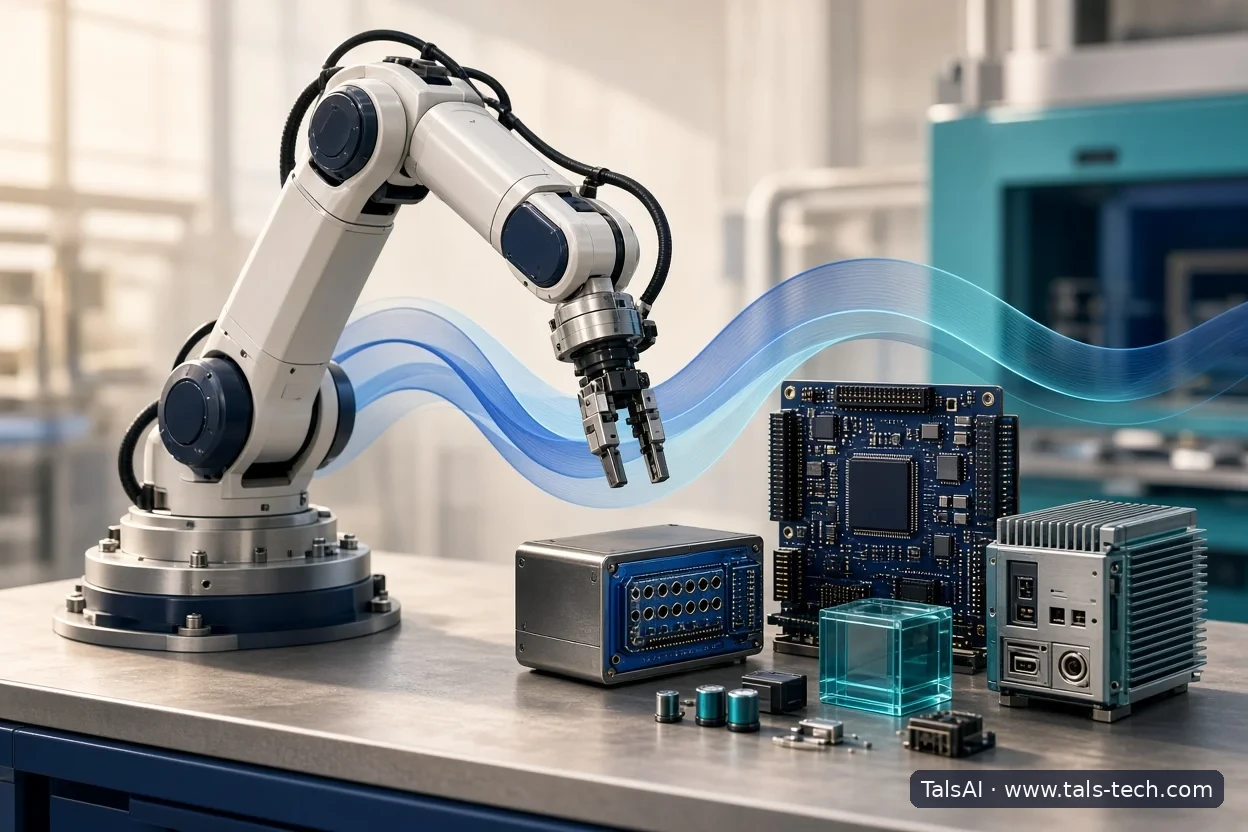
AI-generated industrial technology concept illustration, not a customer site or product screenshot.
Infineon has named Italian robotics firm AdapTronics as the winner of its 2026 Startup Challenge, highlighting an intensified industry push toward practical physical AI and humanoid hardware. The selection reflects how major semiconductor vendors are increasingly directing venture attention toward novel actuation and sensor technologies capable of surviving factory environments.
Semiconductor Giants Move Closer to Physical AI Hardware
According to the reported event details, the Infineon 2026 Startup Challenge centered explicitly on technologies for humanoid robots and physical AI, drawing entries from more than 100 startups across 29 countries. Among these contenders, 15 finalists were selected to develop and pitch their technical innovations during the competition Demo Day, culminating in AdapTronics securing top honors for its robotics developments.
This corporate initiative underlines a broader structural realignment across the industrial electronics tier. Upstream component suppliers recognize that general-purpose intelligence cannot scale without breakthroughs in power density, micro-actuation, and fine tactile feedback. By courting specialized robotics startups, chipmakers are securing early architectural influence over the physical interfaces where embedded silicon interacts directly with changing physical workloads.
Bridging Gripper Innovation and Shop-Floor Realities
Operational deployment of humanoid robots in manufacturing depends heavily on end-effector adaptability. In industrial environments characterized by high component mix and delicate assemblies, rigid mechanical grippers frequently fail or require costly re-engineering. Innovative actuation mechanisms, such as those pioneered by physical AI startups, offer the promise of dynamic payload accommodation, enabling machines to manipulate fragile, compliant, or non-uniform parts without extensive tooling changes.
When integrated into active assembly workflows, these advanced end effectors transform standard material handling into continuous data generation points. Every grasp, torque adjustment, and contact deflection can deliver telemetry directly into manufacturing operations management layers. This granular physical feedback allows line controllers to detect micro-defects during insertion or alignment phases long before finished subassemblies reach downstream quality inspection gates.
Reliability Bottlenecks in Demanding Production Cycles
Despite compelling demonstrations, translating novel robotics hardware into continuous production operations presents distinct engineering hurdles. Emerging physical AI actuators and tactile interfaces must demonstrate multi-million-cycle durability under severe thermal, mechanical, and electrical stresses. Prototype materials that function brilliantly under controlled conditions often experience accelerated degradation when exposed to lubricants, metallic dust, and repetitive shock loads on actual plant floors.
Systemic integration presents an equally formidable obstacle. Shop floors operate on deterministic communication buses, rigorous safety standards, and strict operational orchestration. Incorporating non-standardized humanoid limbs or proprietary adaptive grippers without established maintenance diagnostics risks creating maintenance bottlenecks. Without proven mean-time-between-failure metrics and drop-in integration protocols for plant execution architectures, manufacturers face elevated risks of intermittent downtime.
Key Statistics
- More than 100 startups entered the competition
- Entrants represented 29 countries
- 15 finalists were selected to develop and present technologies
Outlook
From the perspective of TALS, realizing the industrial promise of humanoid robotics requires anchoring breakthrough physical actuators within robust digital execution and quality architectures, turning adaptive shop-floor manipulation into reliable, traceable manufacturing output.
Related product and scope
For this topic, explore TalsAI’s MES manufacturing execution system: work orders, shop-floor reporting and production progress; machine connectivity is project-specific. This is not an endorsement by the original news source.
Source date: 2026-10-22 18:31 UTC
Original source