
AGCO Tests Humanoid Robots with Agility Robotics in Kansas Plant - TALS
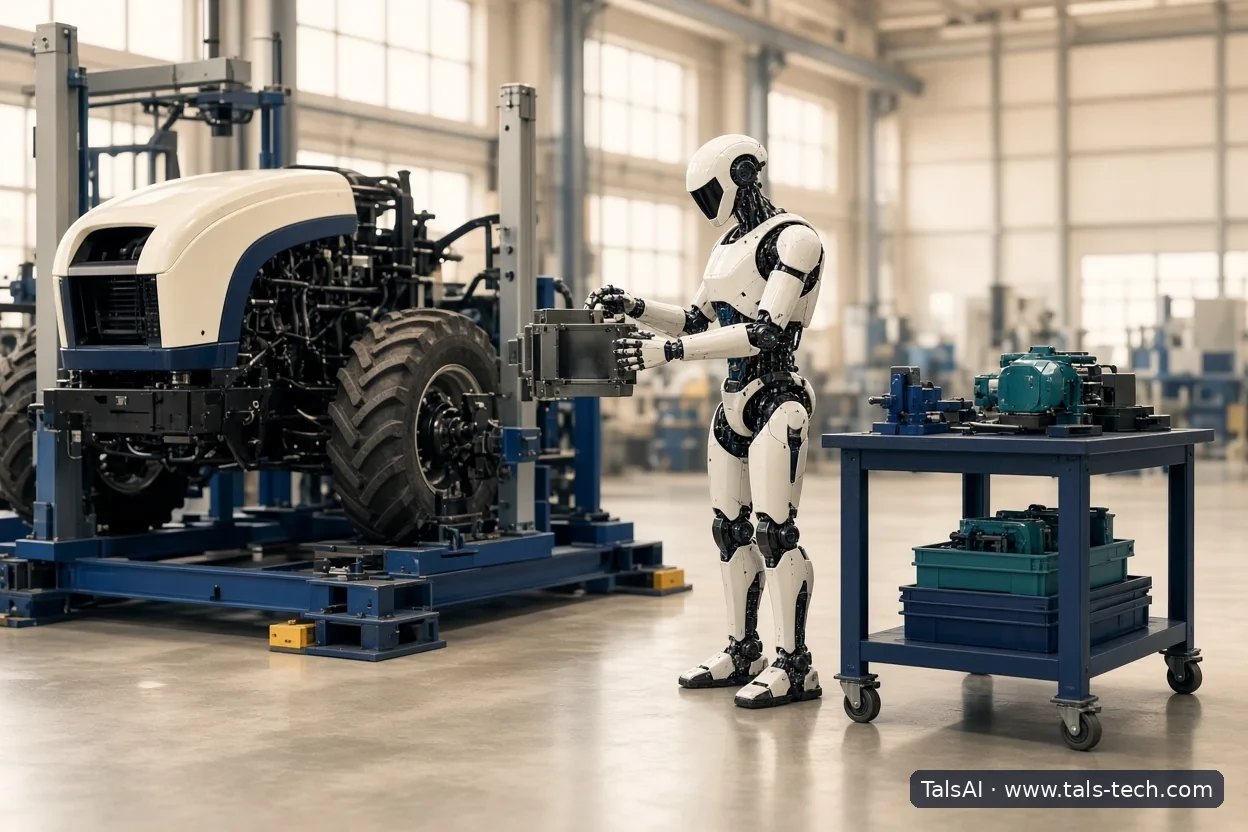
AI-generated industrial technology concept illustration, not a customer site or product screenshot.
AGCO has partnered with Agility Robotics to deploy humanoid robots in a pilot initiative at its agricultural machinery facility in Hesston, Kansas. The trial marks an important exploratory step in testing versatile bipedal platforms within heavy equipment manufacturing environments.
Field Validation in Heavy Assembly
According to announcements from PR Newswire, agricultural equipment manufacturer AGCO has launched an on-site pilot with Agility Robotics inside its Hesston, Kansas production plant. Hesston serves as a primary manufacturing hub for complex machinery such as balers and combines. The pilot focuses on deploying bipedal humanoid platforms into direct industrial settings to gauge operational viability and examine how mobile humanoids interact with standard factory assets.
Industrial plants have historically relied on stationary articulated arms or automated guided vehicles restricted to dedicated tracks. Agility Robotics represents a shift toward generalized physical agents capable of navigating facilities built specifically around human dimensions. Rather than redesigning manufacturing lines, this evaluation aims to measure how effectively mobile robots can operate within existing aisles, picking zones, and workstation clearances.
Material Handling and Ergonomic Trade-offs
Heavy machinery production involves high product variance and irregular material distribution across extensive shop floors. While automated storage and retrieval systems handle bulk logistics, the final leg of line-side replenishment often demands flexible, non-standard container handling. Humanoid robots offer a physical profile that matches human footpaths and shelf reaches, potentially solving intralogistics bottlenecks without necessitating invasive infrastructure overhauls.
Beyond logistics efficiency, operational safety and worker strain remain substantial drivers. Repetitive manual transport of mechanical subcomponents frequently contributes to physical fatigue and ergonomic injury risks. Transferring tedious transport and staging duties to robotic platforms allows plant managers to optimize human labor allocation toward intricate assembly processes, refining assembly cadence across extended shifts.
System Integration and Operational Boundaries
Despite the conceptual appeal, integrating humanoid hardware into an active assembly floor presents operational hurdles. Questions surrounding continuous battery runtime, payload capacities under rapid acceleration, and dependable fleet safety in shared human-machine corridors require rigorous testing. Industrial safety standards mandate clear zoning protocols, and ensuring collision-free coexistence amidst unpredictable heavy factory movement remains non-trivial.
Moreover, physical mobility yields limited return without precise digital orchestration. A humanoid robot cannot operate as an isolated novelty; it must consume real-time production orders, work-in-progress status, and bin-level replenishment triggers. Bridging robot fleet controls with core execution software is vital to ensure that robotic handling aligns tightly with dynamic assembly schedules.
Outlook
The pilot at Hesston demonstrates how heavy industry is testing next-generation physical automation. At TALS, we view advanced robotics as one half of the equation, requiring robust MES and operational data backbones to convert physical dexterity into measurable manufacturing efficiency.
Related product and scope
For this topic, explore TalsAI’s MES manufacturing execution system: work orders, shop-floor reporting and production progress; machine connectivity is project-specific. This is not an endorsement by the original news source.
Source date: 2026-10-20 12:15 UTC
Original source