
Overcoming Deployment Friction with AI-Assisted MES Configuration - TALS
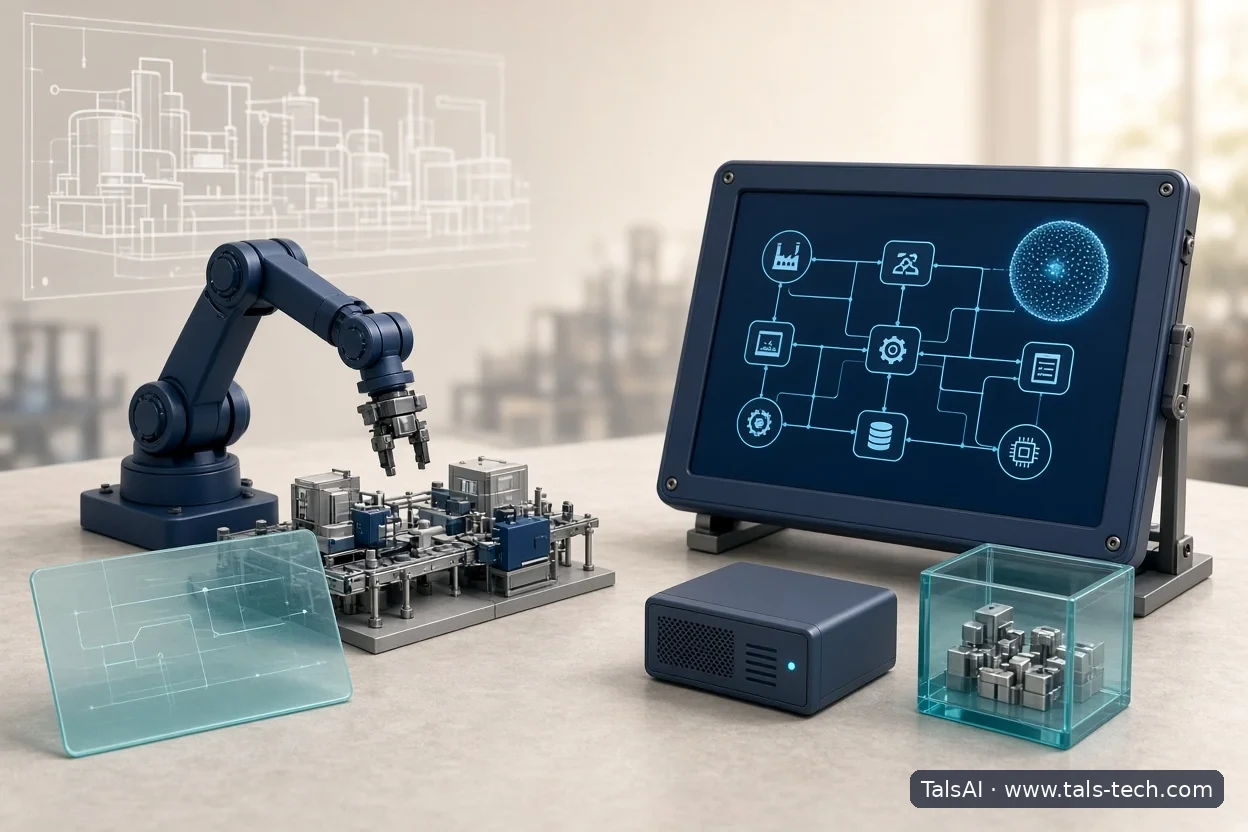
AI-generated industrial technology concept illustration, not a customer site or product screenshot.
Parsec Automation has officially introduced AI-assisted configuration capabilities for its flagship TrakSYS MES platform. This announcement signals a strategic shift in industrial software development, targeting upfront deployment bottlenecks rather than merely adding post-deployment analytics.
Targeting the Configuration Bottleneck
For decades, the primary hurdle in deploying Manufacturing Execution Systems has not been algorithmic sophistication, but the grinding friction of setup. Plant engineers routinely spend months mapping physical assets, standardizing legacy tag names, and mapping business rules between shop-floor controllers and enterprise databases. According to public announcements, Parsec is positioning AI assistance directly within the configuration lifecycle of TrakSYS, taking aim at the manual engineering overhead that historically delays time-to-value.
While industrial technology headlines frequently celebrate generative AI for predictive maintenance or autonomous scheduling, operational teams know that initial integration remains the deepest cost sink. Custom workflows, validation protocols, and integration logic consume substantial professional service budgets. Shifting automated assistance into the initial build and adaptation phases represents a pragmatic turn toward solving the genuine barriers of smart factory adoption.
Redefining the Plant Integration Workflow
Assisted configuration does not imply fully autonomous zero-touch deployment; instead, it redefines the role of implementation engineers from manual transcribers to critical validators. Conventional system commissioning involves reconciling disparate naming conventions and defining routing logic line by line, leaving room for subtle human error. With context-aware assistance, the configuration environment can interpret structural intent, propose operational templates, and draft mapping tables based on standard industrial schemas.
This shift becomes critical as modern facilities navigate shorter product lifecycles and frequent line changeovers. When production processes alter, waiting weeks for external integrators to rewrite routing and quality enforcement logic paralyzes operational agility. Empowering plant engineers with intelligent scaffolding allows shop floors to adapt their software environments alongside physical retooling, narrowing the persistent gap between mechanical reality and digital representations.
Deterministic Rigor Versus Algorithmic Drift
The operational challenge of embedding AI into system design lies in manufacturing's zero-tolerance policy toward ambiguity. In transactional enterprise IT, a minor deviation in an automated recommendation can be caught downstream without severe consequence. Within an execution environment regulating recipe enforcement, traceability, and equipment interlocking, a single hallucinated property or misconfigured route can trigger plant downtime or batch contamination. Assisted configuration systems must maintain strict deterministic verification boundaries.
Furthermore, governance and data sovereignty present clear operational questions. Industrial configurations reflect proprietary competitive advantages in tooling and workflow orchestration. Manufacturers evaluating these capabilities must scrutinize whether models operate locally or rely on cloud infrastructures, ensuring that core operational logic remains insulated from external exposure. Speed of commissioning can never compromise engineering auditability.
Outlook
At TALS, we believe real smart manufacturing transformation depends on collapsing the timeline between platform acquisition and daily floor execution; leveraging intelligent tooling to tame commissioning complexity is essential for delivering sustained operational resilience.
Related product and scope
For this topic, explore TalsAI’s MES manufacturing execution system: work orders, shop-floor reporting and production progress; machine connectivity is project-specific. This is not an endorsement by the original news source.
Source date: 2026-10-20 13:00 UTC
Original source