
Edge AI and Robotics Convergence Demands Real-Time Security - TALS
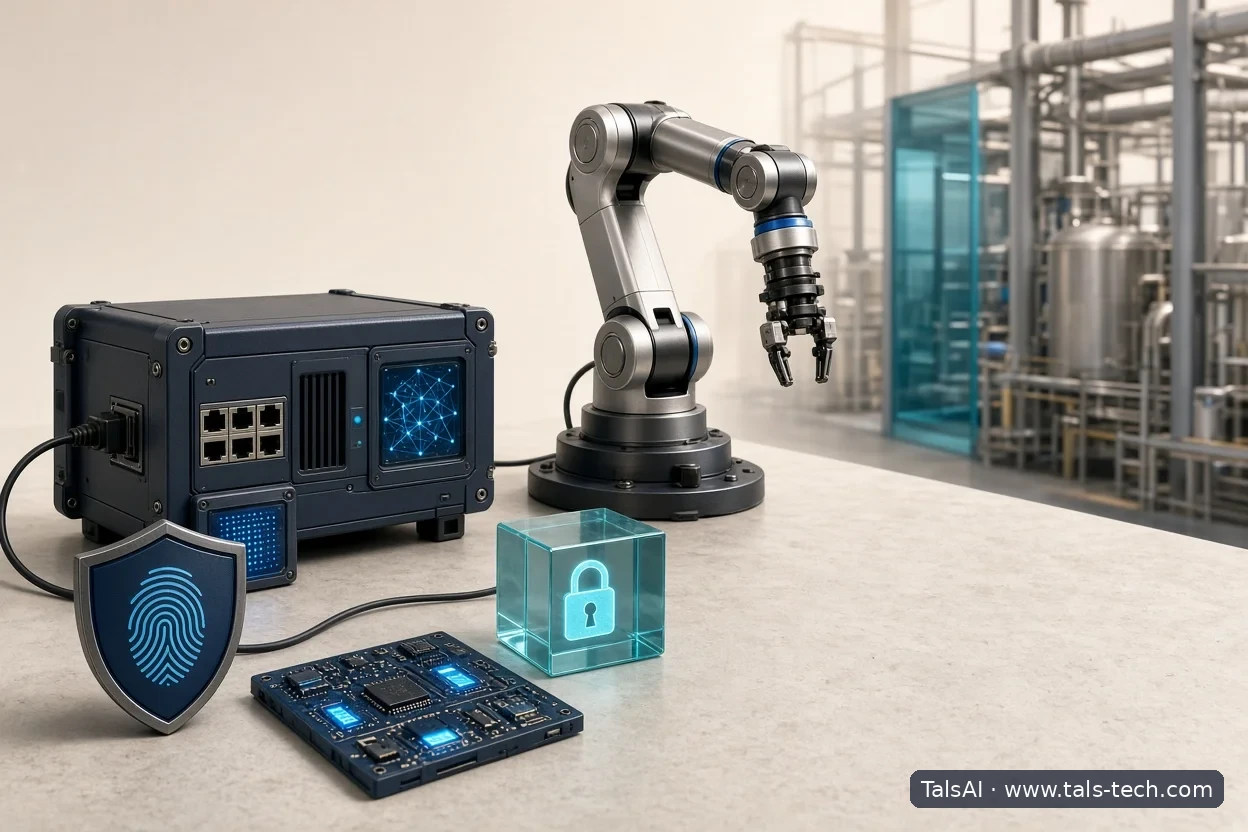
AI-generated industrial technology concept illustration, not a customer site or product screenshot.
At electronica 2026, the Industrial IoT Forum brought the critical intersection of Edge AI, embedded cybersecurity, and industrial robotics directly into focus. As discrete manufacturing cells demand sub-millisecond local processing, unifying physical robot control with hardened digital boundaries has become an operational necessity rather than a modular afterthought.
Triad Focus at Electronica 2026
Coverage from Embedded Computing Design highlights that the electronica 2026 IIoT Forum structured its industrial agenda around three core pillars: Edge AI deployment, OT cybersecurity architectures, and modern industrial robotics. Rather than treating machine vision, threat mitigation, and automated kinematic control as separate engineering disciplines, the forum positioned them as an interdependent technology stack operating directly at the production machine level.
By centering discussion on these specific vectors, industry leaders signal an essential architectural shift away from centralized cloud analytics in favor of deterministic compute deployed on the factory floor. While cloud platforms retain value for enterprise orchestration and long-term storage, real-time inspection and high-speed robotic trajectory adjustments must execute locally to satisfy stringent cycle times and eliminate vulnerability to wide-area network latency spikes.
Operational Realities of Local Intelligence
On the plant floor, introducing Edge AI alongside robotic manipulators fundamentally transforms how modern manufacturing workcells manage operational risk and process integrity. When intelligent algorithms govern high-speed robotic picking, precision welding, or complex assembly, inference models must execute directly on hardened embedded controllers without relying on persistent external connectivity to external networks.
However, this decentralized computing topology inherently expands the physical and digital attack surface across production facilities. Connecting high-performance edge inference gateways directly to programmable logic controllers and robotic workcells means that unverified firmware updates or unsegmented industrial network traffic can compromise mechanical safety systems, making embedded hardware security a non-negotiable prerequisite for any smart factory deployment.
Lifecycle Governance and Deterministic Limits
A pressing operational question confronting engineering teams is how to maintain long-term model governance across hundreds of dispersed robotic nodes without introducing unsustainable maintenance overhead. When machine learning models run on isolated factory controllers, auditing performance drift, applying urgent security patches, and synchronizing inference parameters with central execution platforms quickly strains plant engineering resources and manual maintenance workflows.
Furthermore, deploying machine learning inference inside safety-critical robotic cells forces plant architects to reconcile non-deterministic probabilistic models with strict deterministic functional safety standards. Industrial engineering teams must establish fail-safe operational boundaries, ensuring that any anomaly in edge processing instantly yields to hard-wired functional safety interlocks before equipment damage or catastrophic product defects occur.
Outlook
For smart manufacturing leaders, closing the gap between localized edge intelligence and plant-wide governance is vital, ensuring that TALS software architectures maintain end-to-end data integrity from edge robotics to top-floor orchestration.
Related product and scope
For this topic, explore TalsAI’s MES manufacturing execution system: work orders, shop-floor reporting and production progress; machine connectivity is project-specific. This is not an endorsement by the original news source.
Source date: 2026-10-16 17:17 UTC
Original source