
Infrared Sensors Expand Industrial Predictive Maintenance to 2035 - TALS
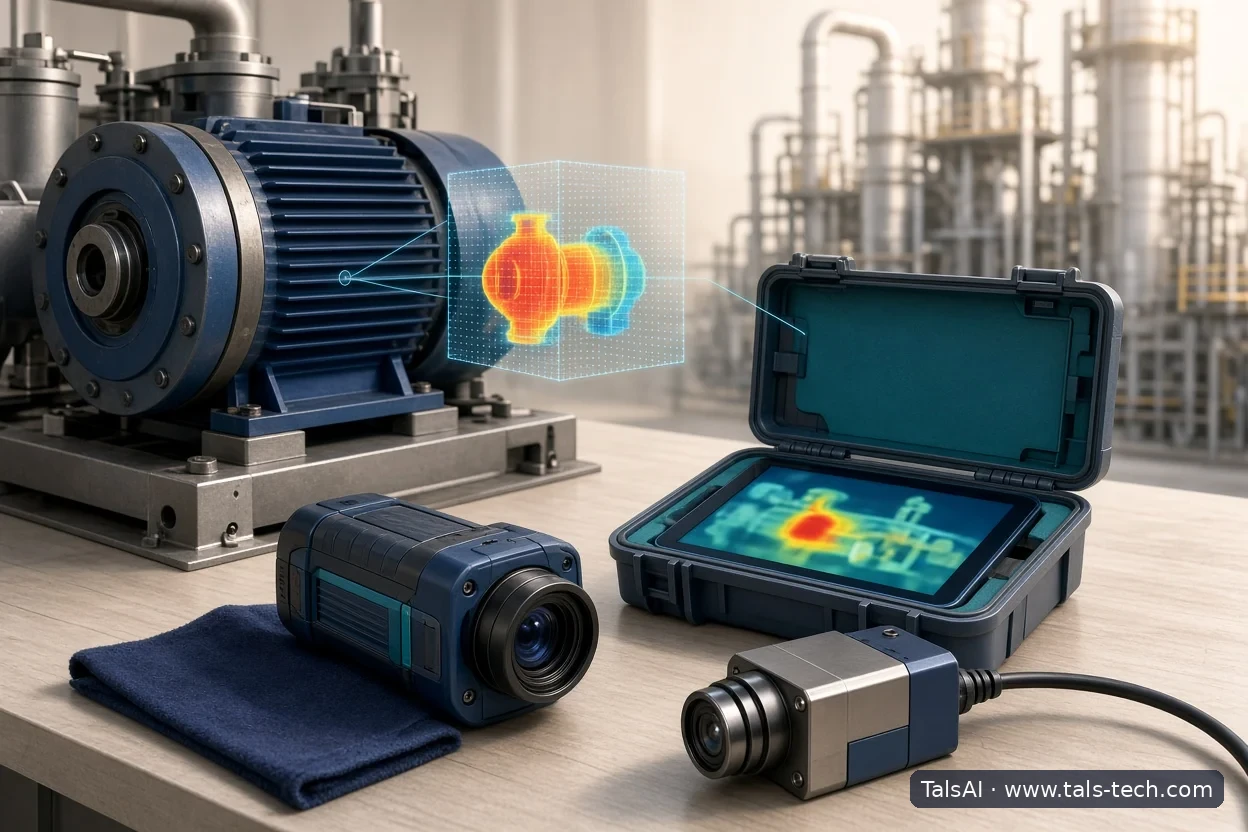
AI-generated industrial technology concept illustration, not a customer site or product screenshot.
Long-term market research by IndexBox indicates that industrial IoT integration and predictive maintenance are driving sustained expansion in infrared temperature sensors through 2035. This steady adoption reflects a structural manufacturing shift away from periodic manual thermography toward continuous edge-level temperature telemetry.
Predictive Telemetry as the Market Catalyst
The long-range trajectory highlighted by IndexBox positions predictive maintenance and IIoT deployment as the twin locomotives expanding the infrared temperature sensor market through 2035. Thermal anomalies are consistently among the earliest indicators of mechanical wear, bearing fatigue, electrical terminal loosening, and insulation breakdown. Conventional manual rounds using handheld infrared cameras typically leave wide temporal observation gaps, leaving fast-developing thermal overloads undetected until critical machinery suffers unrecoverable damage.
As non-contact infrared pyrometers and micro-bolometer arrays become more compact and cost-effective, plant engineers are installing them permanently across critical assets. This continuous instrumentation provides high-frequency thermal time-series data directly into plant monitoring architectures. Instead of relying solely on baseline vibration thresholds, maintenance engineers gain a correlated operational picture where thermal rise, mechanical load, and motor power curves are evaluated in unison to identify impending subsystem failure.
Operational Impact on Uptime and Quality
Non-contact infrared sensing solves critical operational constraints in harsh environments where contact probes are impractical, dangerous, or physically impossible. High-voltage switchgear, continuous rolling mills, automated welding cells, and web-converting rollers require non-intrusive monitoring that introduces zero frictional interference and zero electrical hazard. Millisecond-level thermal sampling allows automated systems to detect localized hot spots long before thermal energy disperses into machine casings.
Beyond asset protection, continuous thermal telemetry directly reinforces product consistency in heat-sensitive manufacturing processes. In processes such as thermoforming, glass processing, and metal heat treatment, transient surface gradients dictate metallurgical structure and dimensional tolerances. Incorporating inline infrared sensors into closed-loop execution systems enables real-time adjustments to burner outputs or cooling air delivery, safeguarding output quality while simultaneously minimizing scrap rates and thermal energy consumption.
Calibration, Emissivity Drift, and Optical Fouling
Deploying infrared sensor networks at industrial scale introduces significant maintenance and signal integrity challenges that plant teams must address early. Emissivity represents the foremost operational hurdle; surface oxidation, paint changes, oil films, and surface roughness continuously alter surface radiation characteristics. Without robust algorithmic compensation or reference surface modeling, emissivity shifts generate substantial measurement inaccuracies that trigger false alarms or mask genuine thermal distress.
Simultaneously, industrial atmosphere conditions threaten sensor optical paths through airborne particulates, oil vapor, and coolant mist. Even thin deposits on lens windows attenuate infrared transmission, causing false drift in calculated temperatures. Plant operators must integrate air-purge collars, automated optical check routines, and calibrated field protocols into their maintenance workflows to maintain absolute data integrity across prolonged sensor operating lifecycles.
Outlook
Infrared temperature sensors are rapidly transitioning from specialized inspection tools to core data assets within modern digital factories. TALS integrates continuous edge telemetry with shop floor execution and asset management systems, empowering manufacturers to turn raw thermal signals into verifiable machine reliability and sustained operational performance.
Related product and scope
For this topic, explore TalsAI’s MES manufacturing execution system: work orders, shop-floor reporting and production progress; machine connectivity is project-specific. This is not an endorsement by the original news source.
Source date: 2026-10-17 13:16 UTC
Original source