
Precision Load Cells Drive Tactile Control in Industrial Robotics - TALS
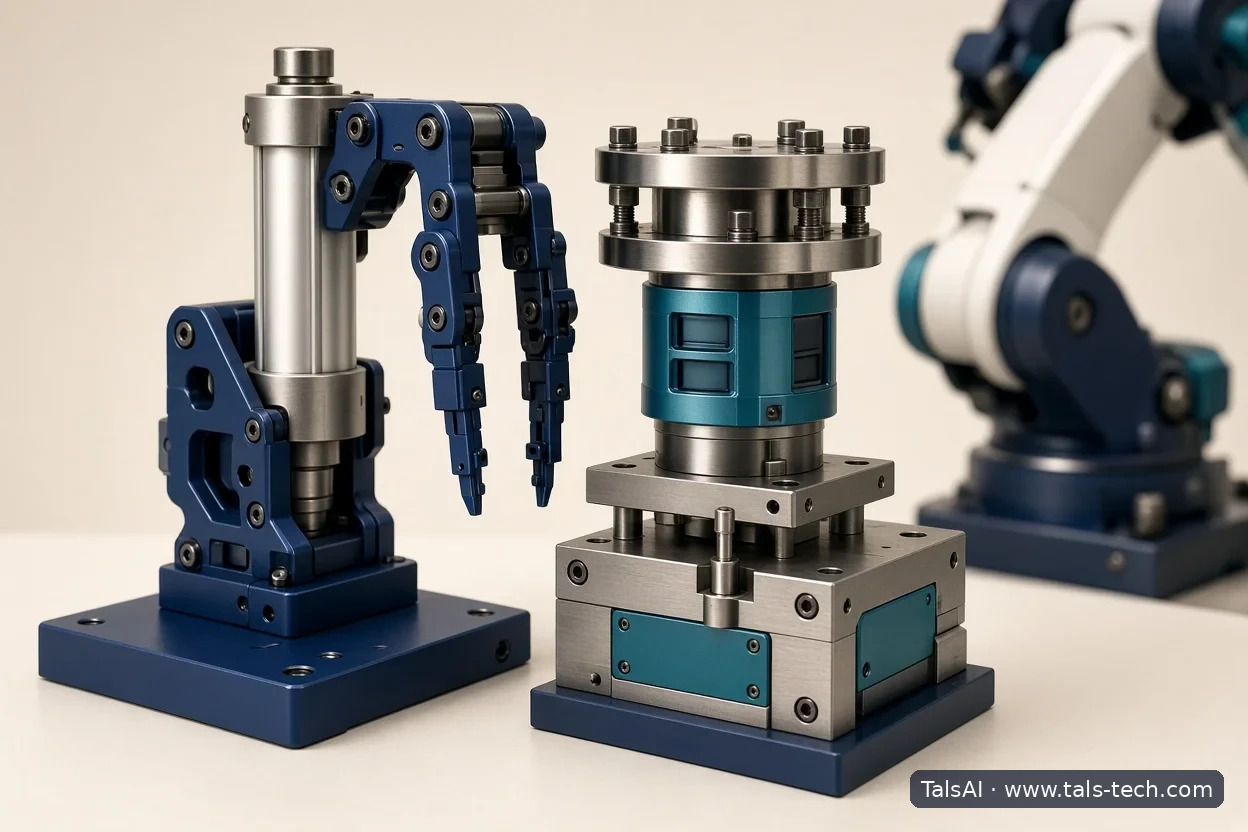
AI-generated industrial technology concept illustration, not a customer site or product screenshot.
Industrial robotics is rapidly transitioning from rigid kinematic positioning to adaptive, force-guided physical interaction. TechBullion highlights how precision load cells serve as the sensory bedrock enabling robots to execute delicate tasks within modern smart manufacturing environments.
Beyond Kinematics: The Shift to Force Feedback
Traditional robotic workcells rely heavily on deterministic spatial coordinates, assuming that parts and fixtures remain strictly identical across thousands of cycles. When dimensional variances, thermal expansion, or delicate materials enter the assembly flow, position-based automation encounters immediate limits. Precision load cells—measuring tension, compression, and multi-axis force vectors—convert structural mechanical loads into real-time feedback, enabling grippers and end-effectors to gauge contact dynamics instantaneously.
The publication points out that load cells are central to linking physical mechanics with smart factory intelligence. Rather than forcing a component into place until a motor stalls or a limit switch triggers, robotic systems equipped with dynamic force measurement can execute micro-adjustments on the fly. This capability is indispensable in aerospace riveting, battery pack assembly, and electronics insertion, where mechanical stress thresholds are tight and catastrophic failure is unacceptable.
Closed-Loop Execution and Edge-Level Integrity
From an operational perspective, integrating load cells into end-of-arm tooling fundamentally changes shop-floor quality assurance. When force signatures are logged in synchrony with robotic trajectory data, every mechanical interaction becomes a traceable quality inspection record. Manufacturing engineers can detect misalignment, thread stripping, or uneven adhesive bonding during assembly rather than relying solely on post-process vision inspection or destructive bench testing.
Furthermore, this physical tactile stream bridges the gap between field-level PLCs and manufacturing execution systems. Deviations in insertion forces serve as leading indicators of tooling wear, upstream component tolerance shifts, or inconsistent material hardness. By capturing strain-gauge signals directly at the point of action, automation architectures gain continuous visibility into process drift, enabling proactive adjustments before scrap parts are produced.
Calibration Drift and Dynamic Latency Challenges
Despite their advantages, deploying precision load cells in industrial robotics introduces distinct technical compromises. Factory floors are harsh environments characterized by thermal cycling, high-speed acceleration shocks, and electromagnetic interference from servo drives. Under continuous cyclic loading, strain gauges inevitably suffer from zero-point drift and fatigue, necessitating frequent recalibration routines that risk cutting into overall equipment effectiveness (OEE).
Moreover, closed-loop tactile feedback demands microsecond-level latency between the load cell amplifier and the robot motion controller. If the communication bus introduces jitter, the force-control loop risks oscillation or instability, potentially damaging delicate assemblies. Plant operators must carefully balance the compliance of filtering algorithms against real-time reaction speed, ensuring that physical measurement gains do not degrade cell throughput.
Outlook
For smart manufacturing architectures, precision load cells turn mechanical contact into actionable digital signals; TALS connects these granular edge force profiles directly into operational workflows to establish true closed-loop process governance.
Related product and scope
For this topic, explore TalsAI’s MES manufacturing execution system: work orders, shop-floor reporting and production progress; machine connectivity is project-specific. This is not an endorsement by the original news source.
Source date: 2026-10-14 14:26 UTC
Original source