
LTTS Opens NVIDIA AI Lab to Bridge Industrial Prototyping Gaps - TALS
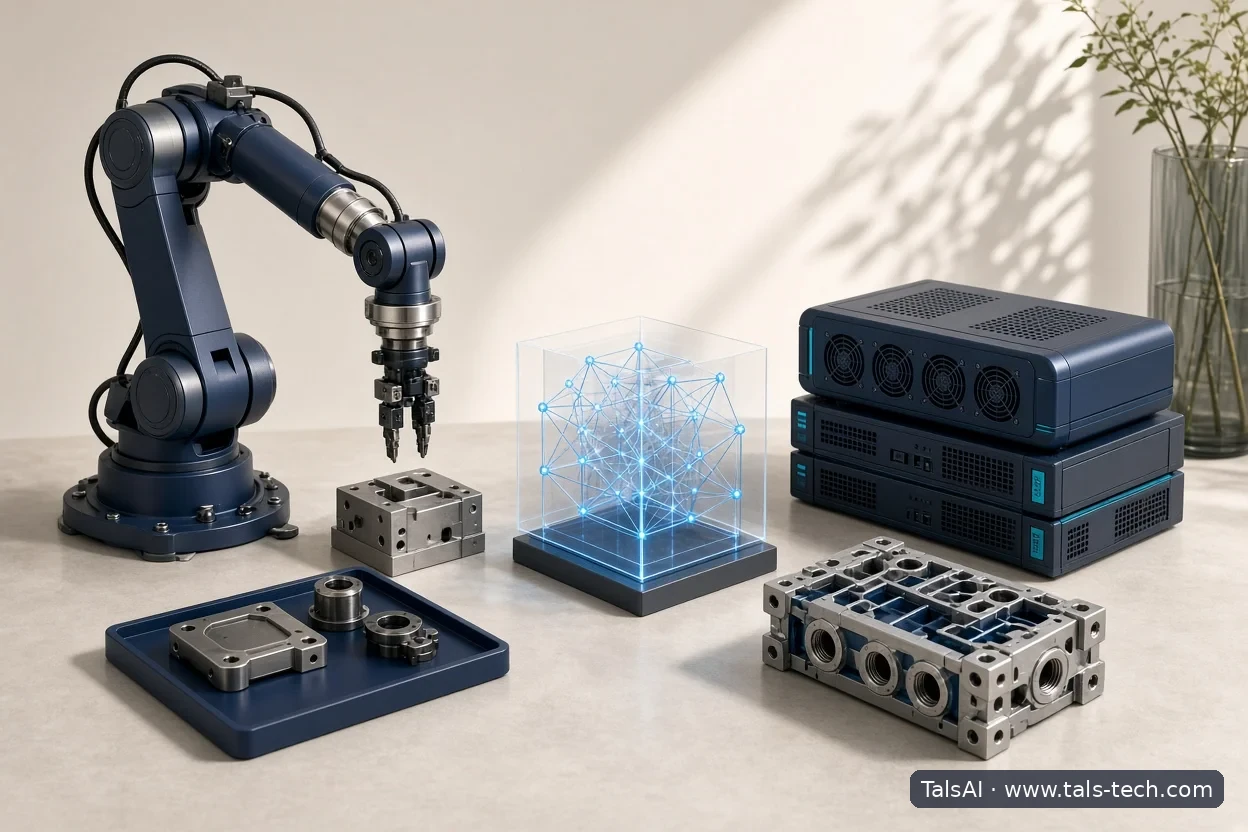
AI-generated industrial technology concept illustration, not a customer site or product screenshot.
Engineering services firm LTTS has launched an NVIDIA-powered AI laboratory dedicated to smart manufacturing use cases. The initiative underscores an ongoing industry shift toward pairing high-performance compute architectures with specialized engineering sandboxes to derisk industrial software deployment.
Accelerated Compute Meets Industrial Engineering
According to reported industry developments, L&T Technology Services has unveiled a dedicated artificial intelligence laboratory powered by NVIDIA computing infrastructure. The center is designed to support smart manufacturing initiatives, providing an engineering environment where accelerated computing, simulation tools, and physical AI workloads can be evaluated for industrial clients before facing live operations.
Historically, industrial organizations have struggled to adopt modern deep learning models due to the heavy capital requirements of specialized hardware and the complexity of training pipelines. By establishing a dedicated facility built on industry-standard acceleration frameworks, LTTS positions itself as an operational proving ground. This allows industrial clients to evaluate algorithmic solutions such as machine vision, automated inspection, and simulation pipelines within an isolated sandbox rather than risking downtime on active production lines.
From Server-Grade Sandboxes to Deterministic Edge Execution
While data-center class GPUs excel at training dense neural networks and running complex multi-agent physics simulations, factory floors demand extreme operational determinism. High-throughput server architectures running inside a test facility must somehow translate to ruggedized edge systems operating within strict thermal, electrical, and latency envelopes. Validating a model in a controlled laboratory does not automatically solve the challenges of execution jitter on a high-speed packaging or assembly line.
Furthermore, industrial machine learning requires deterministic interoperability with operational technology. An advanced vision model developed on high-end hardware must interface directly with fieldbus networks, programmable logic controllers, and real-time middleware. If the inference cycle cannot guarantee consistent execution cycles within millisecond tolerances, the operational value of high-tier computing collapses into an architectural bottleneck that factory automation engineers cannot safely adopt.
Brownfield Realities and the Cost of Replication
A fundamental hurdle for any industrial AI initiative lies in the stark contrast between sanitized test data and the messy reality of brownfield factories. In an innovation center, network pipelines and sensor arrays are uniformly optimized. In real-world facilities, however, engineering teams encounter inconsistent sampling frequencies, legacy fieldbus limitations, and drift across disparate machinery vintages. A vision or control model perfected on uniform training data frequently degrades when exposed to real-world industrial noise.
Economic viability also presents a formidable boundary condition. Enterprise-grade AI accelerators represent substantial hardware investments that many mid-market manufacturers cannot justify without immediate proof of payback. For LTTS and its industrial clients, the core test will not be whether an algorithm can run inside an advanced lab, but whether the architecture can be lightweighted, hardened, and replicated across diverse factory footprints without requiring continuous, high-cost custom integration for every operational asset.
Outlook
Laboratory initiatives illustrate where computational capabilities are heading, but industrial viability ultimately depends on embedding verified models directly into core execution layers like MES and plant floor controls to deliver dependable returns.
Related product and scope
For this topic, explore TalsAI’s MES manufacturing execution system: work orders, shop-floor reporting and production progress; machine connectivity is project-specific. This is not an endorsement by the original news source.
Source date: 2026-10-12 10:22 UTC
Original source