
DigiKey Expands Access to TDK SensEI Industrial Edge AI Kits - TALS
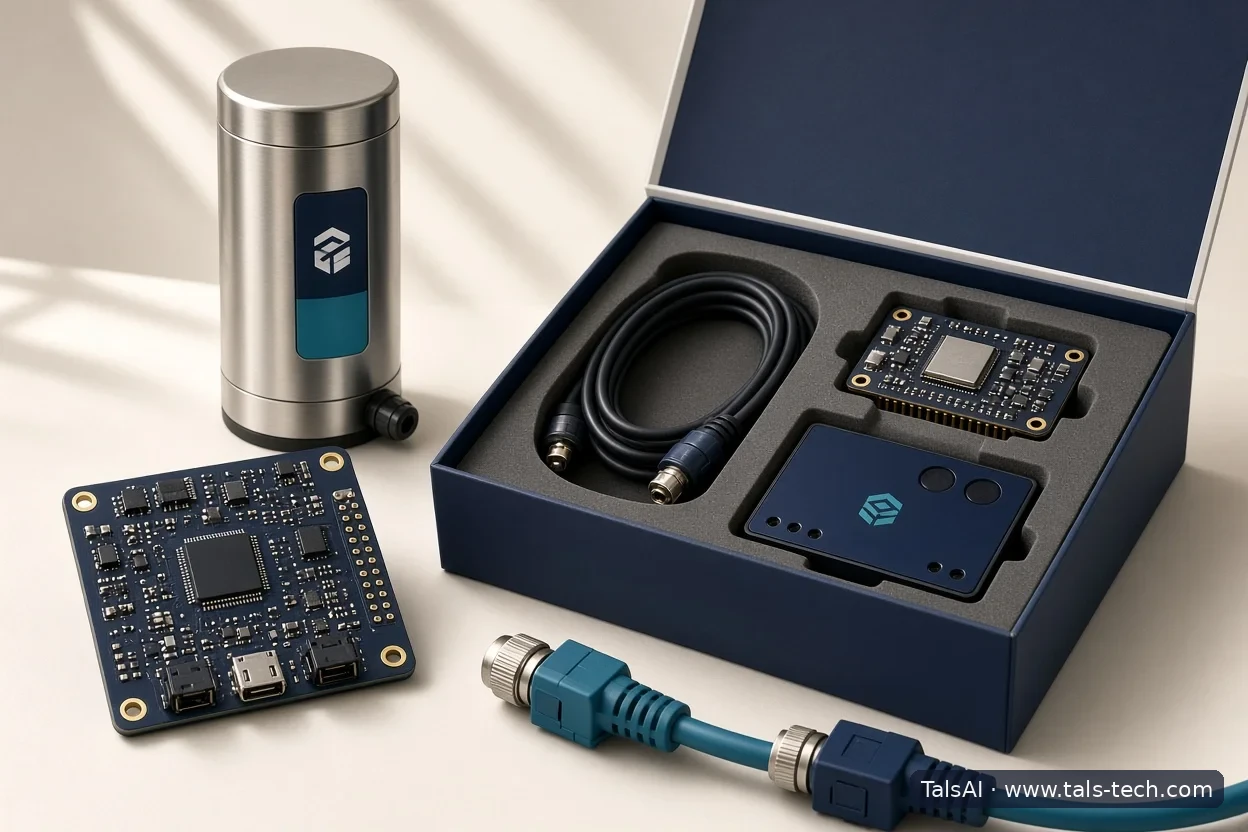
AI-generated industrial technology concept illustration, not a customer site or product screenshot.
Electronic components distributor DigiKey has expanded access to TDK SensEI's edgeRX starter solution, targeting accelerated adoption of industrial artificial intelligence and predictive maintenance. The distribution move reflects an ongoing industry effort to lower initial procurement barriers for operational technology teams experimenting with condition monitoring at the machine edge.
Commercial Distribution Lowers the Entry Threshold
According to industry reporting, DigiKey is now stocking the edgeRX starter solution developed by TDK SensEI to streamline hardware acquisition for predictive maintenance applications. By leveraging established catalog distribution networks, component vendors are enabling factory automation engineers and maintenance specialists to bypass lengthy vendor qualification cycles and acquire pre-packaged edge AI sensing packages with standard off-the-shelf purchasing procedures.
Traditionally, evaluating smart sensor nodes required direct engagement with specialized automation vendors, minimum order commitments, and prolonged integration support. Providing immediate commercial availability allows reliability engineers to quickly procure individual kits for rapid prototyping, assessing baseline signal acquisition and vibration or thermal monitoring directly on critical rotating assets without significant upfront capital commitments.
Translating Edge Inference into Actionable Operations
Deploying compact edge diagnostic hardware directly on physical equipment offers clear operational benefits by filtering raw high-frequency sensor streams before they leave the asset. Onboard microcontrollers can run targeted inference models to detect harmonic anomalies, mechanical looseness, or bearing wear, eliminating the need to transmit gigabytes of unstructured vibration waveforms over constrained factory networks to the cloud.
However, local anomaly detection represents only the initial phase of effective equipment maintenance. If edge anomaly scores remain trapped within local vendor dashboards, plant managers gain limited actionable value. Real operational gains occur when localized health scores automatically trigger spare part reservations, schedule preventive work orders during planned tooling changeovers, and alert quality inspectors to correlate mechanical drift with downstream surface defects.
Addressing the Scalability Gap in Pilot Hardware
A primary implementation dilemma with off-the-shelf starter solutions lies in bridging the divide between single-machine validation and multi-line fleet deployment. Starter kits frequently excel in controlled lab environments or on single pilot pump stations, but managing hundreds of disparate battery-powered or retrofitted sensor pods introduces severe lifecycle maintenance overhead, including secure firmware updates, fleet calibration, and model retraining.
Industrial organizations must verify that introductory edge kits adhere to standardized communication protocols such as MQTT or OPC UA rather than proprietary local utilities. Without open API interfaces and rigorous device management governance, ad-hoc procurement of starter hardware risks establishing fragmented pockets of edge data that complicate plantwide operational technology governance and undermine enterprise asset reliability programs.
Outlook
At TALS, we see edge sensing hardware as an essential building block, yet sustained shop-floor resilience depends entirely on bridging local machine intelligence into enterprise execution systems to orchestrate closed-loop maintenance workflows.
Related product and scope
For this topic, explore TalsAI’s MES manufacturing execution system: work orders, shop-floor reporting and production progress; machine connectivity is project-specific. This is not an endorsement by the original news source.
Source date: 2026-10-09 09:08 UTC
Original source