
Commercial Distribution Speeds Edge AI Hardware Adoption - TALS
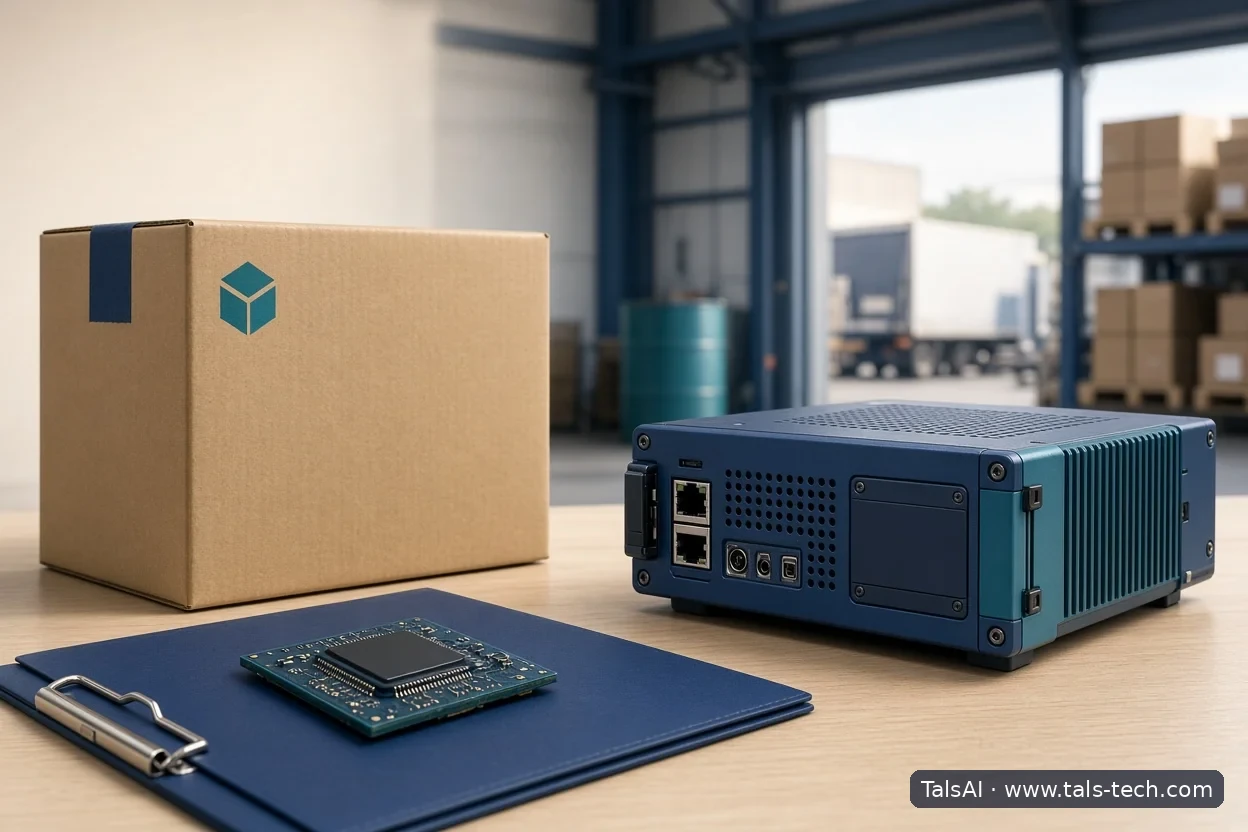
AI-generated industrial technology concept illustration, not a customer site or product screenshot.
Electronics distributor DigiKey has widened access to TDK SensEI's edgeRX starter solution, targeting accelerated deployment of industrial AI and predictive maintenance. This move highlights how frontline condition-monitoring hardware is rapidly shifting from protracted vendor sales engagements toward catalog-driven availability.
Distribution Shifts Edge Sensing Accessibility
DigiKey's distribution rollout of TDK SensEI's edgeRX starter kit focuses squarely on simplifying procurement for predictive maintenance engineers and system integrators. Historically, piloting industrial vibration sensors and localized inference hardware required protracted interactions with component manufacturers, restrictive minimum order quantities, and custom delivery timelines. Making such toolkits available via mainstream component distributors democratizes early-stage experimentation across manufacturing plants.
This operational shift enables factory engineers to procure evaluation hardware on demand, attach sensing nodes to rotating machinery, and validate signal processing in near real time. By bypassing traditional enterprise procurement bottlenecks, plants can accelerate the critical first phase of assessing machine degradation markers, drastically shortening the runway between maintenance hypothesis and physical bench testing.
The Operational Divide Between Kits and Workflows
While immediate hardware availability accelerates rapid prototyping, moving from a distributor evaluation kit to an enterprise predictive maintenance strategy exposes significant operational hurdles. Starter solutions typically validate that an anomaly detection algorithm functions locally on targeted physical parameters. However, surviving continuous industrial ambient noise, high temperatures, and electrical interference over years requires ruggedized mechanical integration that standard bench kits rarely solve on their own.
Furthermore, predictive insights remain inert without automated enterprise handoffs. A localized alert indicating mechanical bearing wear generates little business value if it remains trapped in a standalone dashboard. Unless machine health scores trigger automated spare-part reservations, technician scheduling, and production-line rebalancing, frontline operators risk alert fatigue rather than tangible uptime protection.
Scale-Out Complexities and Fleet Lifecycle Gaps
Manufacturing leaders evaluating catalog-sourced edge AI hardware must assess the systemic limitations of scaling from five trial units to hundreds of critical production assets. Standard starter kits often lack the enterprise-grade device management infrastructure required for bulk firmware patching, cryptographic identity verification, and synchronized sensor calibration across diverse manufacturing lines.
Equally challenging is the ongoing maintenance of the underlying edge inference models. Production environments constantly shift as tooling wears, ambient seasonal temperatures fluctuate, and manufacturing recipes change. Without standardized north-facing interfaces that integrate these distributed sensors into plant-wide management platforms, organizations risk creating unmanageable islands of orphaned sensing nodes that fail to deliver predictable returns.
Outlook
At TALS, we view accessible edge sensing hardware as a vital catalyst for smart manufacturing, provided enterprises bridge raw localized anomalies directly into unified production scheduling and execution workflows.
Related product and scope
For this topic, explore TalsAI’s MES manufacturing execution system: work orders, shop-floor reporting and production progress; machine connectivity is project-specific. This is not an endorsement by the original news source.
Source date: 2026-10-08T14:09:00+00:00
Original source