
Charm Care Backs Donut Robotics to Anchor Humanoids in Care - TALS
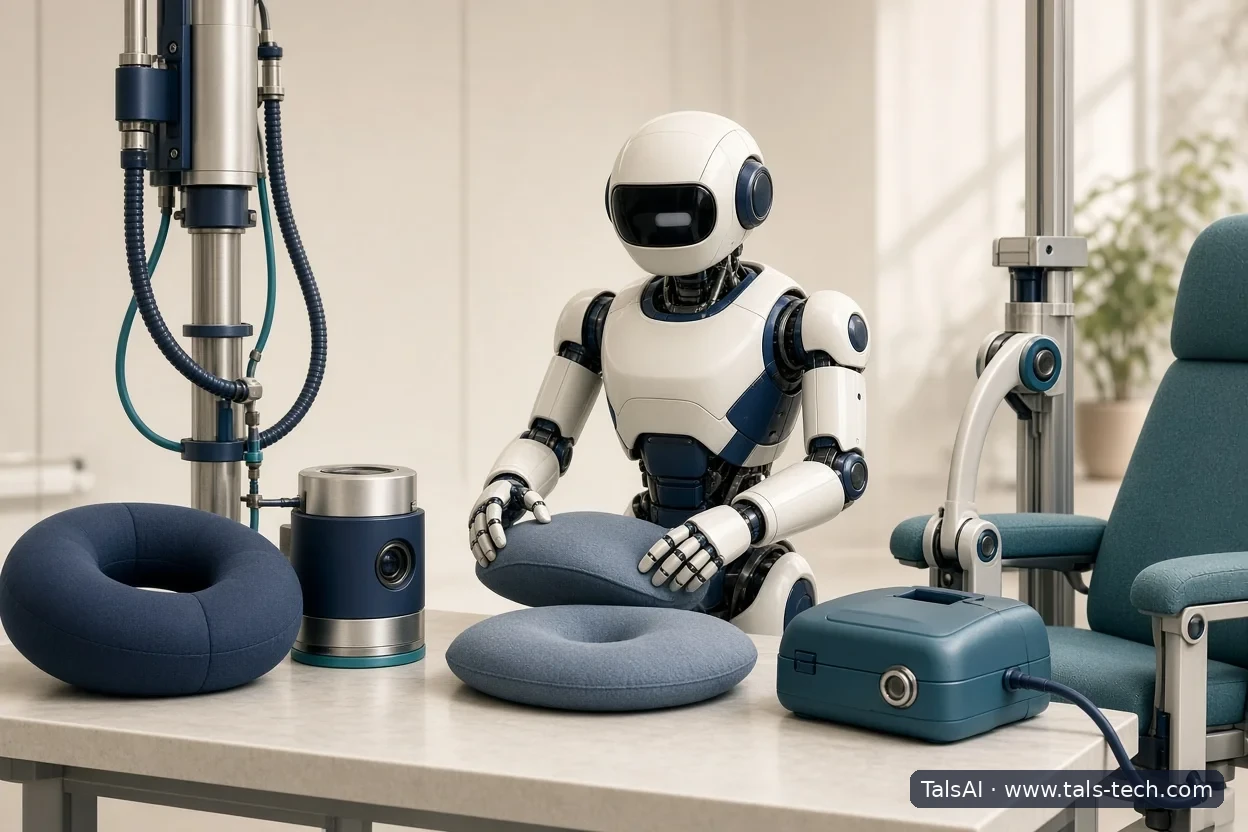
AI-generated industrial technology concept illustration, not a customer site or product screenshot.
Japanese eldercare operator Charm Care Corporation has forged a capital and business alliance with Donut Robotics, injecting ¥300 million to co-develop humanoid systems for nursing environments. The transaction signals a strategic shift in robotics commercialization, moving capital from speculative general-purpose platforms into direct vertical deployment pipelines.
Anchoring Prototype Testing in Production Environments
According to reported details, Charm Care operates more than 100 private nursing facilities across Kansai and Greater Tokyo, investing approximately $2 million through a share subscription to secure access to specialized hardware development. Unlike industrial robots engineered for structured factory cells, eldercare machines operate alongside frail individuals in continuously shifting physical layouts. This alliance directly grants engineering teams daily access to frontline eldercare environments, converting ambient operational feedback into immediate mechanical and algorithmic revisions.
The persistent bottleneck for advanced robotics ventures remains the friction between controlled lab demonstrations and uncontrolled field reality. By integrating directly with an established service operator, the development team can capture nuanced operational requirements early—including exact torque limits during physical assistance, surface decontamination constraints, and non-verbal spatial etiquette—substantially curtailing the redesign cycles that routinely derail hardware startups.
Manufacturing Realities of Human-Centric Actuation
Scaling humanoids for physical care presents profound manufacturing and quality assurance dilemmas. Actuators, compliant joints, and load-bearing chassis must maintain industrial-grade precision while ensuring inherent mechanical safety around vulnerable humans. For equipment manufacturers and system integrators, fabricating systems that feature whisper-quiet gearboxes, force-sensitive tactile skin, and redundant safety brakes demands rigorous tolerance management and specialized sub-assembly inspection workflows.
However, heavy operational specialization threatens unit economics. If the mechanical architecture becomes overly bespoke to satisfy nursing protocols, suppliers risk losing the economies of scale achieved by modular industrial components. Production planners must therefore decouple high-volume modular chassis manufacturing from application-specific end-effectors, preventing bill-of-materials inflation before volume manufacturing commences.
Capital Thresholds and Field Reliability Barriers
While the partnership bridges the gap to physical testing grounds, significant systemic hurdles persist before humanoids can achieve widespread site deployment. Operating within senior living quarters leaves negligible margin for kinematic error; a sensor glitch or actuator lockup in proximity to patients carries severe physical and legal consequences. Ensuring mean time between failures matches industrial standards requires fail-safe firmware architectures and hardware-level interlocks rarely perfected in initial pilot hardware.
Furthermore, a ¥300 million commitment represents modest capital against the immense multi-year expenditures required for tooling, regulatory compliance, and factory scaling. Donut Robotics and Charm Care will need to validate sustained productivity improvements and regulatory safety clearances before this specific alliance translates into an economically viable, deployable manufacturing blueprint.
Key Statistics
- Charm Care Corporation operates more than 100 private nursing homes in the Kansai and Greater Tokyo areas.
- Charm Care will invest ¥300 million (approximately $2 million) in Donut Robotics through a subscription.
Outlook
The migration of humanoid robotics into high-stakes service industries highlights the critical role of end-to-end manufacturing traceability. At TALS, we see this convergence as proof that durable robotics scaling depends fundamentally on linking rigorous factory floor execution with operational field metrics.
Related product and scope
For this topic, explore TalsAI’s MES manufacturing execution system: work orders, shop-floor reporting and production progress; machine connectivity is project-specific. This is not an endorsement by the original news source.
Source date: 2026-10-05T21:15:33+00:00
Original source