
Cambridge and CityUHK Launch Centre for Advanced Manufacturing - TALS
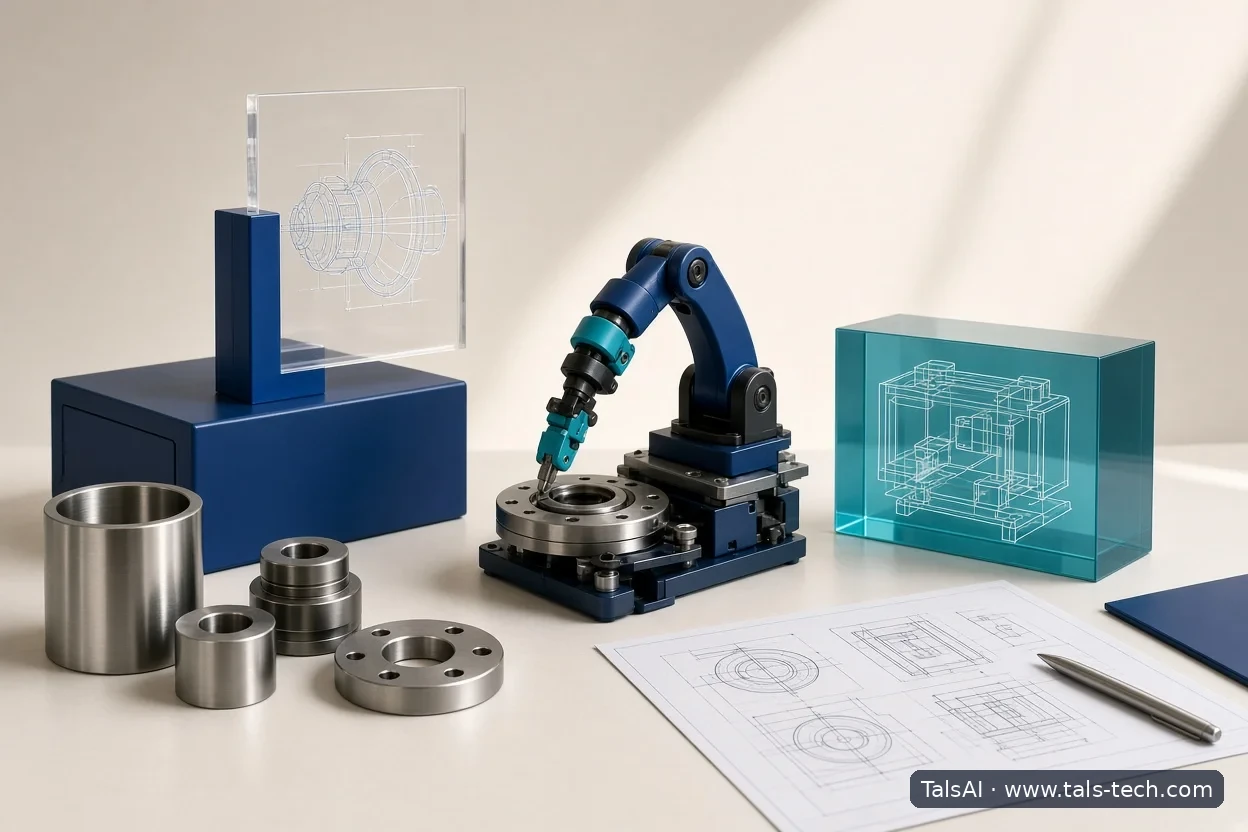
AI-generated industrial technology concept illustration, not a customer site or product screenshot.
The City University of Hong Kong and the University of Cambridge have established a joint Centre for Advanced and Smart Manufacturing to drive the region’s Industry 5.0 agenda. The cross-border academic partnership aims to anchor advanced engineering and human-centric automation within high-value urban production models.
Cross-Border Research Targets Next-Generation Manufacturing
Public industry notices confirm that City University of Hong Kong (CityUHK) and the University of Cambridge have joined forces to create the Centre for Advanced and Smart Manufacturing. Operating at the intersection of deep-tech research and applied engineering, the initiative is positioned to shape Hong Kong’s transition toward Industry 5.0. By pooling institutional expertise from two leading global research hubs, the center sets out to explore advanced production paradigms that go beyond baseline automation, prioritizing sustainability, resilience, and advanced physical-digital workflows.
While Industry 4.0 largely centered on sensor telemetry, cloud aggregation, and autonomous cyber-physical coordination, Industry 5.0 introduces human-centric ergonomics and adaptive responsiveness into the factory core. Cambridge’s longstanding pedigree in advanced manufacturing policy and precision engineering complements CityUHK’s specialized capabilities in electronics, smart sensing, and rapid prototyping. Together, their shared platform represents an effort to support regional economic strategies that prioritize compact, high-value industrial specialization over high-footprint assembly.
Operational Requirements in High-Density Urban Environments
For space-constrained manufacturing economies like Hong Kong, revitalizing industrial capacity cannot rely on conventional high-volume, low-margin factory footprints. Instead, viable production models demand micro-factories, precision instrumentation, and highly flexible pilot-line fabrication. Deploying Industry 5.0 in such contexts requires deterministic edge processing, ultra-reliable low-latency networking, and tight feedback loops that allow skilled technicians to collaborate safely alongside adaptive robotics and vision-guided tooling.
Translating these advanced concepts into daily operations requires rigorous alignment between operational workflows and shopfloor software backbones. As product life cycles compress and engineering change orders multiply, human operators must be augmented with contextual production data rather than overburdened by fragmented dashboards. Research initiatives targeting intelligent manufacturing must directly address how algorithmic recommendations interact with dynamic line balancing, scrap reduction protocols, and real-time genealogy tracking.
Bridging the Chasm Between Academic Pilots and Production Scale
Despite the high caliber of the institutional partners, significant hurdles persist when migrating university-developed prototypes into continuous operational environments. Academic algorithms often excel in pristine laboratory testbeds with clean inputs and controlled lighting or ambient temperatures. In industrial plants, however, systems encounter legacy serial protocols, electrical interference, asynchronous machine states, and rigorous uptime constraints where even minor software exceptions trigger costly line halts.
Furthermore, achieving true human-machine symbiosis requires standardized safety validations and audit trails that comply with strict regulatory frameworks. Industrial enterprises cannot risk operational stability on experimental frameworks without validated determinism and enterprise-grade maintainability. The ultimate success of the joint center will depend on its capacity to convert theoretical innovations into ruggedized, maintainable protocols that standard manufacturing IT and OT teams can deploy without bespoke re-engineering.
Outlook
Realizing the promise of Industry 5.0 requires bridging academic breakthroughs with mission-critical factory architectures; TALS empowers modern manufacturers to turn advanced industrial research into robust, scalable execution on the shop floor.
Related product and scope
For this topic, explore TalsAI’s MES manufacturing execution system: work orders, shop-floor reporting and production progress; machine connectivity is project-specific. This is not an endorsement by the original news source.
Source date: 2026-09-23T02:03:07+00:00
Original source