
IoT Chip Expansion to 2035: How Edge Silicon Reshapes Factory Edge - TALS
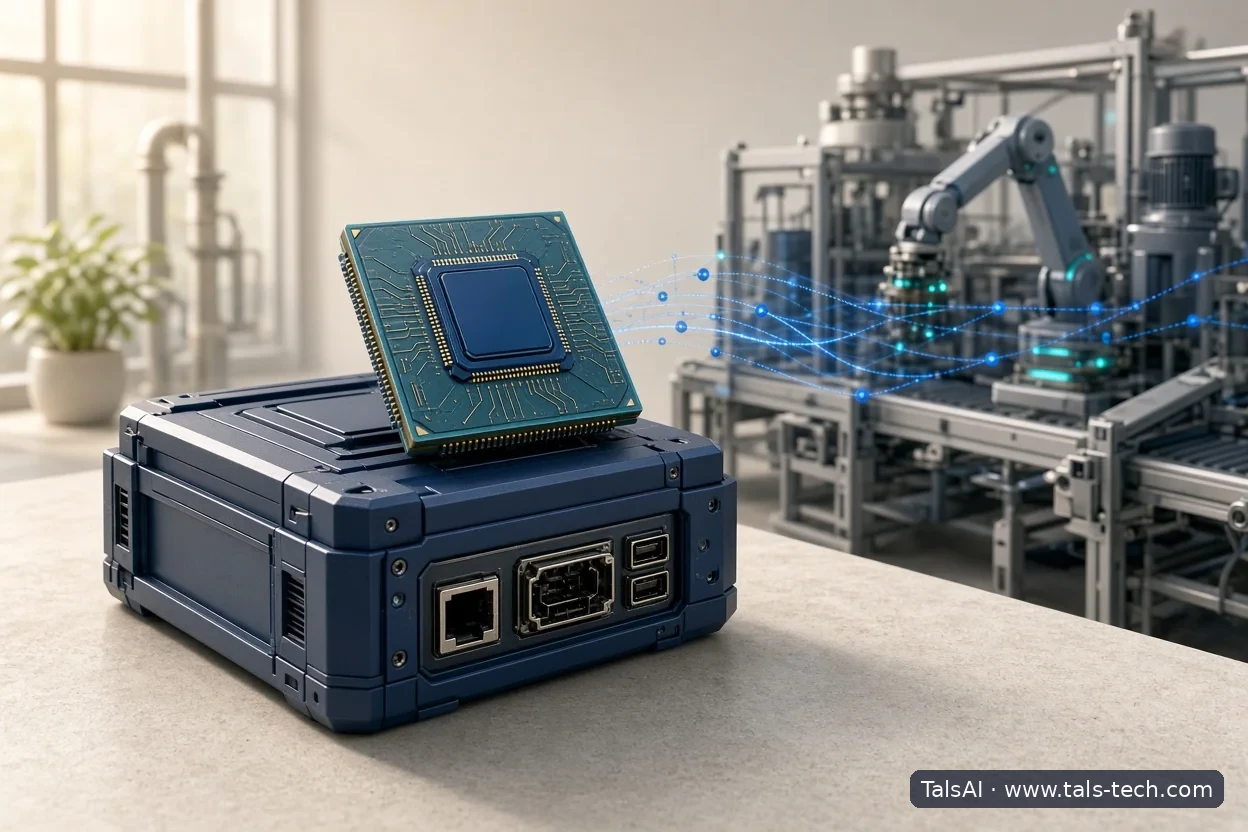
AI-generated industrial technology concept illustration, not a customer site or product screenshot.
According to research published by IndexBox, the global IoT chip market is entering an extended growth phase through 2035, propelled by edge artificial intelligence and accelerating industrial automation. This structural development highlights a decisive evolution on the shop floor, shifting field sensors from passive data collection terminals into autonomous edge-computing nodes.
From Centralized Ingestion to Local Silicon Inference
The long-range market outlook from IndexBox identifies industrial automation and edge AI as twin pillars sustaining chip demand over the next decade. Historically, industrial telemetry networks operated on a rigid capture-and-forward architecture, transmitting raw machine metrics back to remote servers or enterprise clouds for batch evaluation. As operational technology architectures scale up connectivity across thousands of production assets, transmitting continuous high-frequency time-series data creates severe bandwidth overhead and exposes time-critical operations to intolerable latency risks.
The steady infusion of dedicated neural acceleration cores into low-power IoT microcontrollers directly reconfigures this operational equation. When sensory hardware executes lightweight inference locally—processing mechanical vibration signatures or pneumatic variance directly at the component boundary—plants gain real-time deterministic reactivity. Rather than overwhelming fieldbus networks with baseline operational noise, edge silicon filters and surfaces curated operational flags, radically improving signal-to-noise ratios across the plant infrastructure.
Operational Orchestration Across Heterogeneous Edge Assets
The proliferation of intelligent silicon throughout manufacturing cells creates urgent integration requirements for higher-level execution software. Production environments rarely feature homogeneous hardware; facilities typically run modern intelligent tooling alongside legacy mechanical systems retrofitted with diverse microcontroller architectures. If manufacturing execution layers fail to ingest edge-computed inference outputs consistently, these distributed processors risk creating fragmented islands of isolated data rather than a unified operational fabric.
Industrial software must adapt by functioning as an active edge orchestrator rather than a passive chronological database. Execution architectures need to interpret edge-generated operational states directly against open work orders, quality inspection plans, and active dispatch queues. When an edge device detects micro-tolerances drifting out of specification, the system must trigger immediate line-balancing or corrective workflows before systemic scrap accumulates, converting raw silicon calculations into tangible throughput optimization.
The Friction of Industrial Longevity Versus Chip Lifecycles
Projecting technological architecture out to 2035 exposes a chronic tension between commercial semiconductor lifecycles and the operational realities of heavy machinery. Industrial production machinery routinely maintains productive lifespans exceeding ten or fifteen years. Conversely, embedded chipsets and edge AI acceleration frameworks evolve rapidly, presenting profound challenges around hardware durability under sustained thermal stress, continuous electrical interference, and unyielding mechanical vibration.
Furthermore, maintaining distributed embedded software over multi-year operational horizons introduces significant risk. Without hardened over-the-air firmware update standards and hardware-agnostic container layers, thousands of edge-enabled sensor chips can quickly degenerate into unserviceable technical debt when target models require retraining. Industrial engineers must implement rigorous vendor lifecycle guarantees and design open interfacing protocols, ensuring that long-term hardware deployments do not fall victim to obsolescence or vendor-locked component dependencies.
Outlook
At TALS, we view the proliferation of edge-enabled IoT chips not as a hardware replacement race, but as the foundation for responsive, distributed factory intelligence. Success relies on bridging silicon-level inference with resilient manufacturing execution systems to deliver measurable agility on the factory floor.
Related product and scope
For this topic, explore TalsAI’s MES manufacturing execution system: work orders, shop-floor reporting and production progress; machine connectivity is project-specific. This is not an endorsement by the original news source.
Source date: 2026-10-03T12:11:04+00:00
Original source