
Specialized Metallurgical MES in Heavy Industry Deployments - TALS
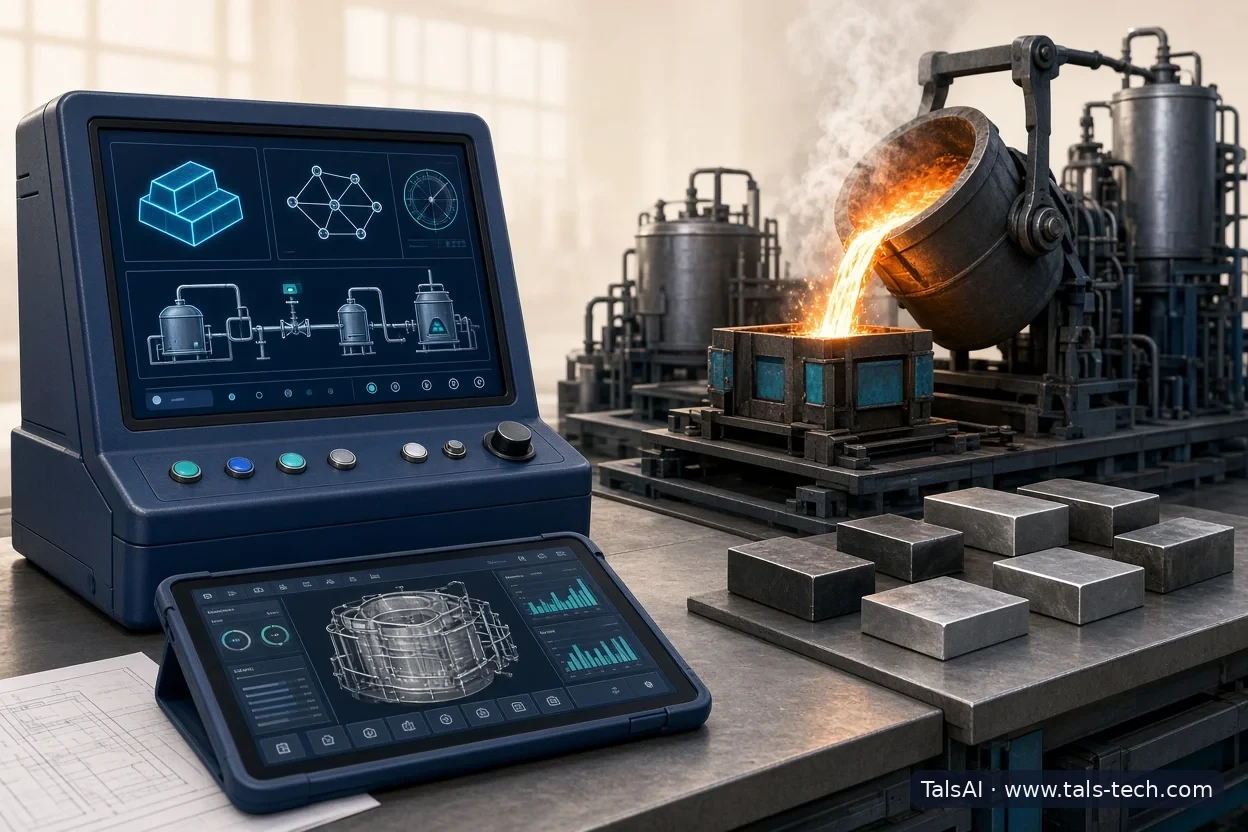
AI-generated industrial technology concept illustration, not a customer site or product screenshot.
According to industry outlet Machine Maker, Danieli Automation has been selected to supply its Manufacturing Execution System (MES) platform for the Ezz Flat Steel plant. This deployment highlights the critical role of domain-specific execution platforms in heavy process manufacturing, where raw metallurgical physics dictate operational scheduling.
Metallurgical Process Complexity Demands Specialized Architecture
The reported supply contract reflects the unique nature of flat steel production, where execution systems must manage tightly coupled continuous and semi-continuous operations. Unlike discrete assembly lines where cycle times and work-in-progress inventories are decoupled, flat rolling mills operate under strict thermodynamic and sequence dependencies spanning melt shops, continuous casters, and rolling mills.
In this operating environment, scheduling decisions are bound by steel grade metallurgy, ladle transit times, and thermal conservation. A generic MES platform lacks the pre-configured domain logic required to calculate optimal slab sequencing or dynamically adapt to in-line metallurgical defects without extensive custom engineering. Danieli Automation's domain footprint positions the software to mirror specific mechanical and thermal constraints from day one.
Integration Frictions Between Level 2 Controls and Enterprise Systems
Deploying a plant-wide execution platform in a steel rolling complex requires bridging the persistent divide between high-speed Level 2 process automation and top-tier Level 4 enterprise systems. Flat steel lines generate massive volumes of high-frequency telemetry covering roll gaps, hydraulic pressures, and strip cooling profiles that must be reconciled against commercial sales orders.
An operational challenge in such implementations is avoiding operational latency across legacy field devices. If data pipelines between Level 2 mathematical models and the Level 3 execution layer are brittle, tracking coil genealogy and heat-level chemical compositions becomes compromised, creating blind spots in downstream surface inspection and mechanical testing verification.
Balancing Vendor Domain Expertise with Long-Term System Flexibility
While sourcing an MES directly from an industrial equipment and automation provider accelerates initial domain alignment, it introduces strategic trade-offs around long-term architectural agility. Steel producers are increasingly tasked with dynamic energy management and carbon intensity accounting, requiring execution platforms to digest varied cross-functional data inputs.
Plants must carefully evaluate whether heavily tailored, equipment-aligned execution software can expose open APIs and support decoupled microservices. If proprietary control layers tightly govern scheduling heuristics, subsequent adaptations to alternative scrap ratios, third-party analytics engines, or flexible order promises may carry significant engineering overhead and vendor dependency.
Outlook
At TALS, we view vertical domain integration as essential for heavy industry execution, provided the core digital architecture retains open interfaces to balance strict metallurgical operational physics with enterprise flexibility.
Related product and scope
For this topic, explore TalsAI’s MES manufacturing execution system: work orders, shop-floor reporting and production progress; machine connectivity is project-specific. This is not an endorsement by the original news source.
Source date: 2026-09-23T04:44:37+00:00
Original source