
Apple Pushes Physical AI and Industrial Robotics in Korea - TALS
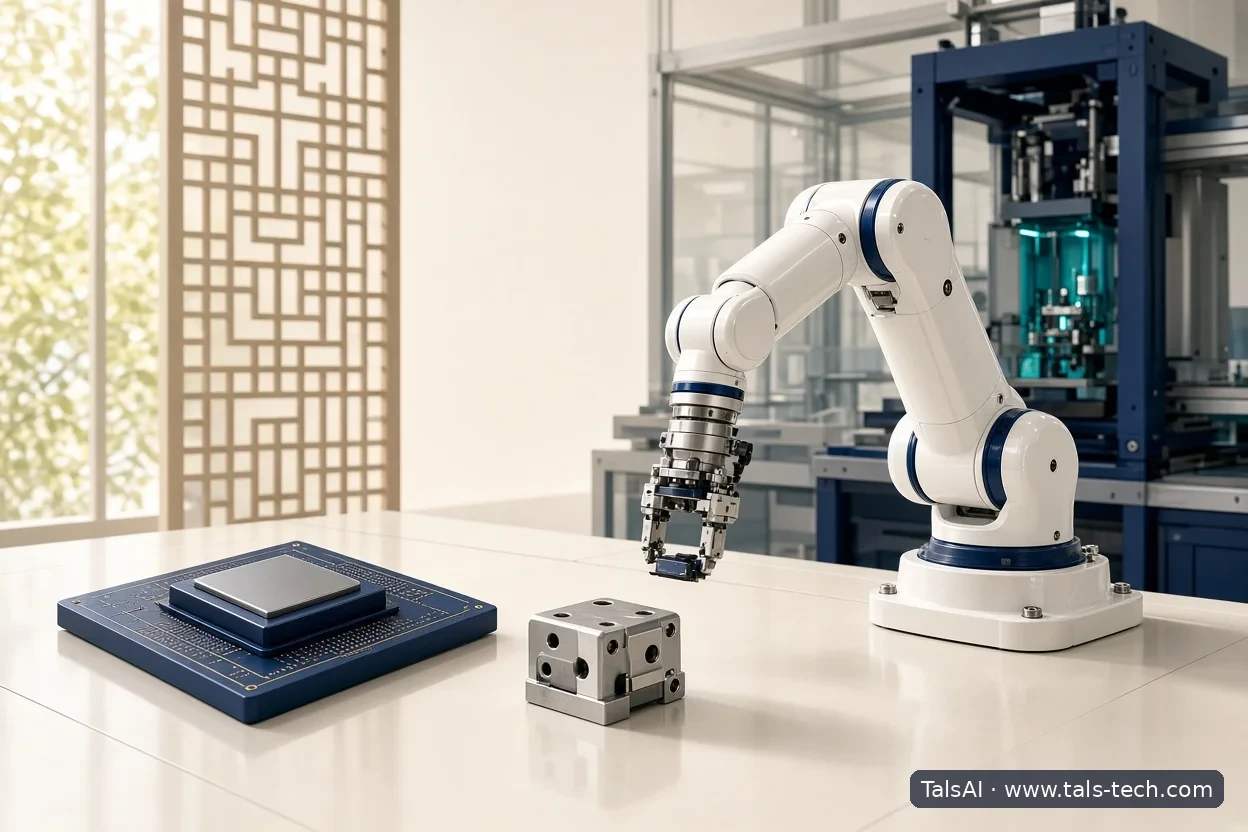
AI-generated industrial technology concept illustration, not a customer site or product screenshot.
Reports from South Korea indicate that Apple is accelerating smart manufacturing initiatives by introducing physical artificial intelligence and advanced robotics into local production environments. This strategic push underscores an industry-wide transition where leading device orchestrators demand high-precision autonomous systems directly embedded within component supply tiers.
Autonomous Physical Interaction Replaces Scripted Automation
Reporting from Korean media outlets highlights Apple's engagement with physical AI and industrial robotics to advance local smart manufacturing capabilities. Rather than relying on traditional robotic automation governed by rigid, pre-programmed kinematics, physical AI frameworks incorporate dynamic perception, environmental modeling, and adaptive force feedback. In high-density electronics manufacturing, where micro-tolerances define component yields, conventional automation often struggles to absorb natural material variances and rapid engineering change orders.
By driving physical AI into assembly and handling processes, manufacturing operations shift toward systems that make autonomous mechanical adjustments in real time. Instead of relying on static vision inspection at the end of the line, robots equipped with physical reasoning adjust assembly grip, trajectory, and insertion pressure on the fly. This operational shift converts unpredictable shop-floor micro-disturbances into controlled, repeatable production cycles without requiring manual engineering interventions.
Supplier Integration Pressures and Millisecond Data Loops
For Korean component suppliers deeply integrated into high-volume consumer hardware ecosystems, adopting physical AI mandates an overhaul of line-level architectures. Suppliers cannot simply treat robotic workcells as isolated islands; machines must exchange telemetry, mechanical stress vectors, and process states with millisecond precision. The integration requires factory networks and operational platforms capable of synchronizing deterministic control networks with higher-level execution data without introducing processing latency.
Operationally, the stakes around process transparency escalate sharply. If a physical AI controller makes localized micro-adjustments during a critical bonding or fastening sequence, that operational context must be registered against the unit serial number and work order. Failure to integrate dynamic robotic decisions into the broader operational execution landscape makes defect containment virtually impossible, turning localized machine learning into an untraceable compliance risk for tier suppliers.
Proprietary Architecture Silos and Validation Complexity
A pivotal engineering obstacle in this rollout lies in the balance between client-specific robotics architectures and vendor line flexibility. Component manufacturers rarely produce exclusively for a single brand, yet OEM-driven physical AI standards frequently require dedicated edge compute hardware, proprietary training pipelines, and custom sensory harnesses. Suppliers face the financial and operational challenge of investing in specialized robotics setups that cannot easily be repurposed for other production runs.
Furthermore, bridging the sim-to-real gap remains a persistent operational limitation in industrial environments. Reinforcement learning models that operate flawlessly within virtual physics simulations frequently encounter unexpected mechanical friction, sensor drift, and thermal expansion on the actual factory floor. Without rigorous shop-floor execution guardrails, unconstrained autonomous robotics risk causing costly line halts or tooling damage before yield improvements can ever be realized.
Outlook
From the TALS perspective, physical AI and industrial robotics can only deliver lasting factory value when linked directly to governed execution platforms. Grounding autonomous edge mechanics within deterministic tracking systems ensures that high-speed adaptability never compromises total operational traceability.
Related product and scope
For this topic, explore TalsAI’s MES manufacturing execution system: work orders, shop-floor reporting and production progress; machine connectivity is project-specific. This is not an endorsement by the original news source.
Source date: 2026-09-27T01:18:00+00:00
Original source