
Digital Twins and Automation Enable Autonomous Manufacturing - TALS
Digital Twins and Automation Enable Autonomous Manufacturing
Digital twins and intelligent automation are converging to enable autonomous manufacturing, but success hinges on seamless integration with MES and industrial software to close the loop from simulation to execution.
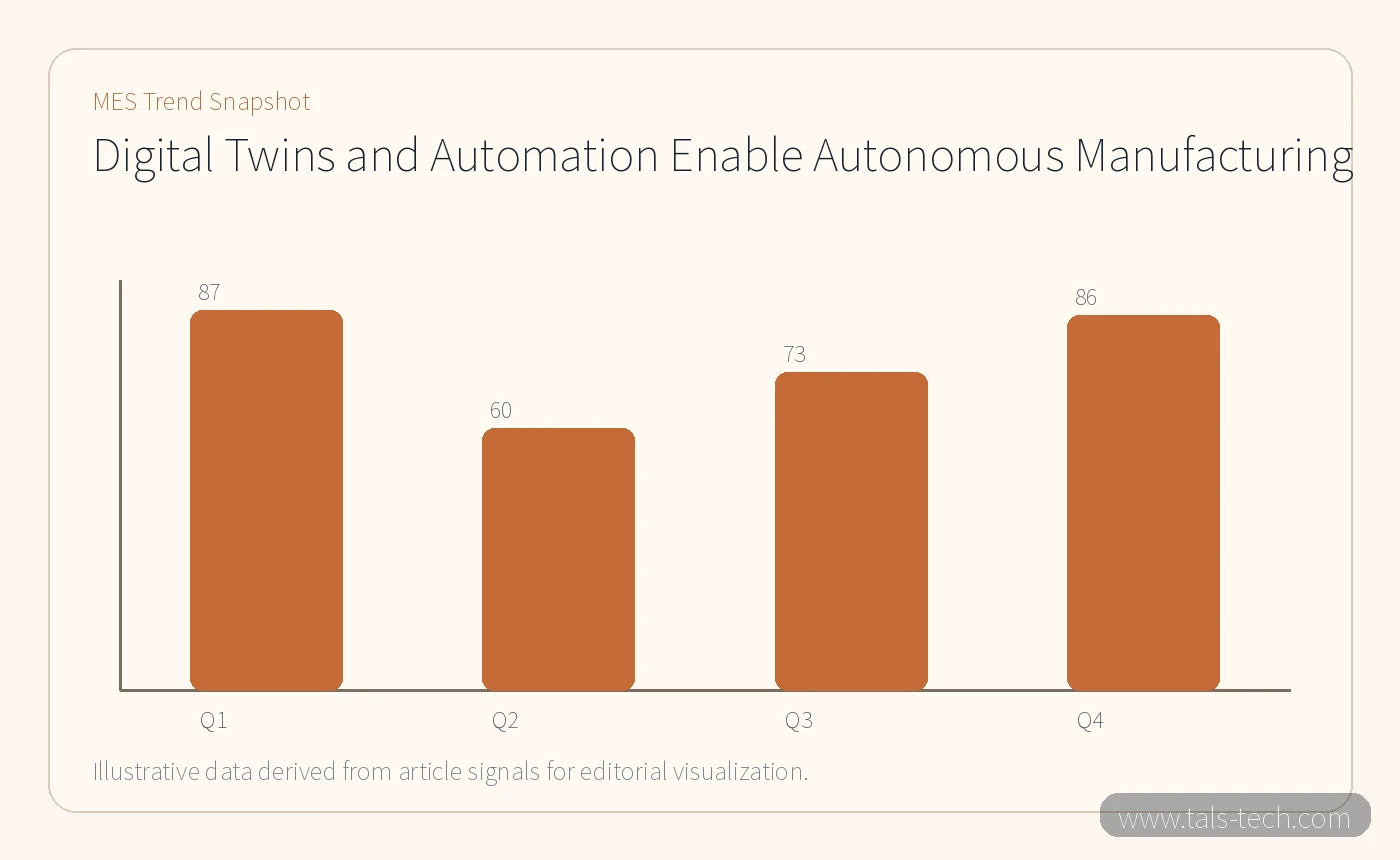
The convergence of digital twins and intelligent automation is propelling manufacturing toward full autonomy. MES serves as the critical bridge between virtual simulation and physical execution, making this vision a reality.
Beyond Design: Digital Twins in Operations
Digital twins are no longer confined to product design. They now extend into production operations, enabling real-time synchronization between the virtual and physical worlds. By feeding live data into MES, manufacturers can dynamically adjust schedules, predict maintenance needs, and reduce unplanned downtime. This operational shift transforms digital twins from a design tool into a core component of smart manufacturing strategies.
Closing the Loop with MES and Automation
Intelligent automation requires a central nervous system to orchestrate actions. MES provides that layer, integrating with PLCs, robots, and sensors to execute autonomous decisions. When combined with ERP and QMS, MES ensures quality and traceability. The result is a closed-loop system where simulation informs execution, and execution refines simulation, driving continuous improvement.
The Industrial Software Stack for Autonomy
Achieving autonomous manufacturing demands a robust industrial software stack. ERP manages resources, MES controls production, and QMS ensures quality. These systems must interoperate seamlessly, sharing data in real time. Cloud and edge computing further enable scalability and low-latency responses. Without this integrated foundation, digital twins and automation remain isolated islands, unable to deliver true autonomy.
Key Statistics
- Gartner predicts that by 2026, 50% of large manufacturers will use digital twins to improve operational efficiency.
- Digital twins can reduce unplanned downtime by up to 30%, according to industry benchmarks.
- Autonomous operations require real-time data integration across ERP, MES, and QMS.
Outlook
TALS empowers manufacturers to harness digital twins and intelligent automation through its integrated MES, ERP, and QMS solutions. By building a unified data backbone, we help factories evolve from automated to truly autonomous operations.