
MES Market Surges Toward $44.67 Billion as Smart Manufacturing Goes… - TALS

MES Market Surges Toward $44.67 Billion as Smart Manufacturing Goes…
The exponential growth of the MES market underscores the critical role of real-time production execution systems in enabling smart manufacturing, quality management, and digital transformation across industries.
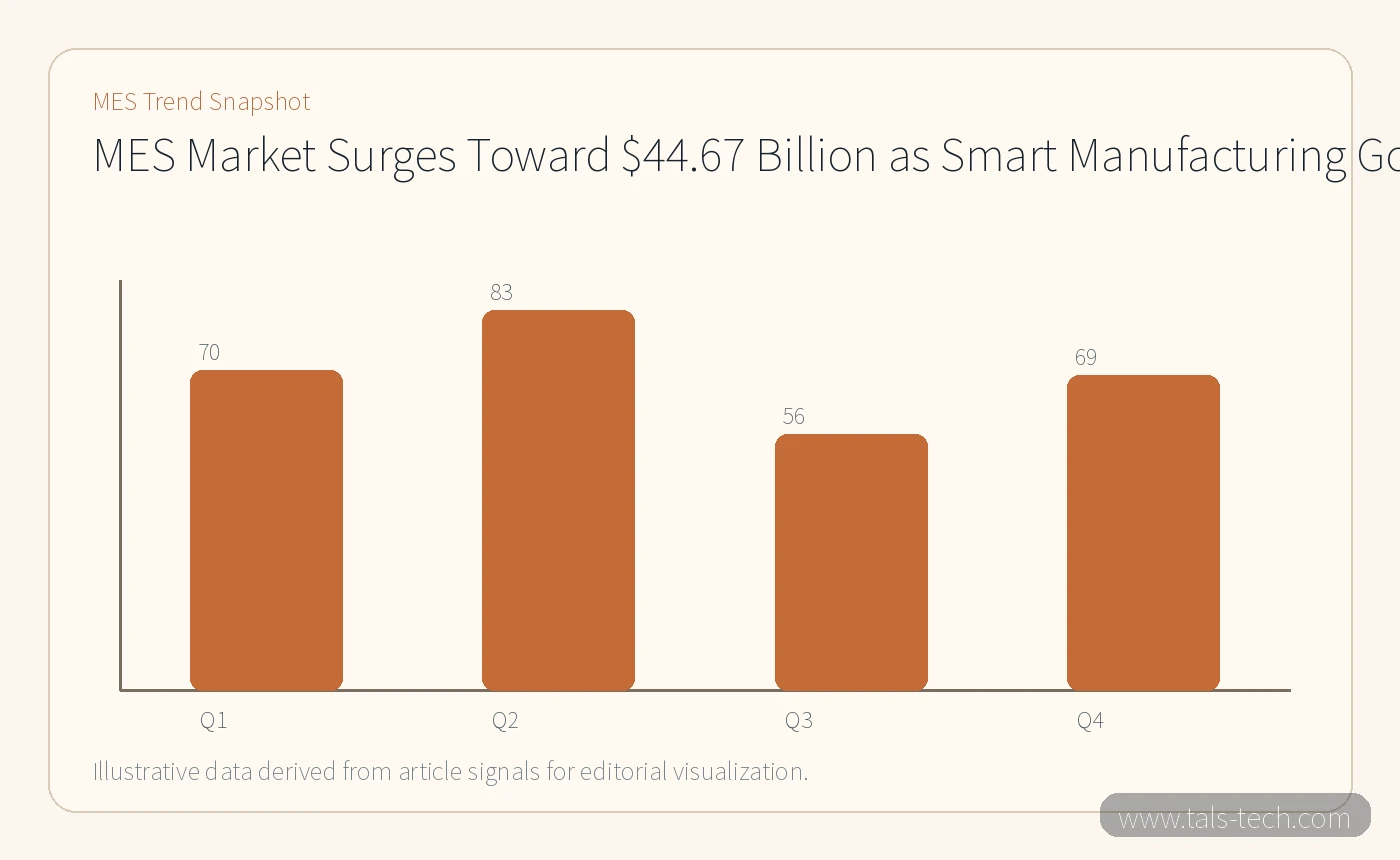
The global Manufacturing Execution System (MES) market is projected to reach $44.67 billion by 2034, growing at a robust 13.3% CAGR, according to a new market study. This explosive growth is fueled by manufacturers' urgent need for real-time production visibility, traceability, and lean operations — making MES the indispensable engine of the smart factory.
Industry Pain Points and Opportunities
Traditional manufacturing has long suffered from production black boxes, data silos, and slow responsiveness. For instance, over 60% of automotive and electronics companies still rely on paper work orders or Excel to manage production, resulting in average defect rates of 8-12%. As labor costs rise and customers demand mass customization, manufacturers urgently need an execution layer that bridges ERP and plant-floor equipment. MES addresses this by capturing real-time workstation data, reducing production cycle times by 20-30% and cutting scrap rates by over 15%.
Policy tailwinds further accelerate adoption. China's '14th Five-Year Plan' for smart manufacturing mandates that 70% of large enterprises adopt digital R&D tools by 2025, with MES as a key enabler. Europe's Industry 5.0 roadmap emphasizes human-centric, data-driven resilient production. These forces are turning MES from a nice-to-have into a must-have, especially in high-value discrete manufacturing and process industries where MES is the first step toward digital transformation.
Technology Evolution and Functional Upgrades
Modern MES has evolved from simple production tracking into a comprehensive platform covering scheduling, quality, equipment, materials, and performance analytics. Based on the ISA-95 standard, today's MES seamlessly integrates with ERP (e.g., SAP, Oracle) and PLC/SCADA systems, creating a closed loop from order to delivery. Cloud-native deployments and edge computing allow small and medium enterprises to subscribe to MES functionalities on demand, slashing upfront investment.
Artificial intelligence and machine learning are game-changers. A leading MES vendor uses deep learning to predict equipment failures 48 hours in advance, reducing unplanned downtime by up to 40%. Digital twin technology enables managers to simulate production changes in a virtual environment, avoiding costly disruptions. These innovations elevate MES from a transaction system to a strategic data hub that powers continuous improvement.
Regional Markets and Competitive Landscape
Geographically, Asia-Pacific is the fastest-growing MES market, with China accounting for about 35% of new demand, driven by electric vehicles, photovoltaics, and semiconductors. Europe and North America see steady growth from plant modernization, with food & beverage and pharmaceuticals pushing MES penetration above 50% due to regulatory compliance requirements.
Competitively, Siemens, Rockwell Automation, and Dassault Systèmes lead, but local champions like Huawei and Yonyou are catching up with cloud MES offerings. Vertical-specific solutions (e.g., MES for lithium battery manufacturing) are becoming key differentiators, requiring deep process knowledge rather than generic features. The market is fragmenting as vendors specialize, offering both challenge and opportunity for implementers.
Key Statistics
- MES market projected to reach $44.67B by 2034 at 13.3% CAGR
- MES reduces production cycle time by 20-30% and scrap by 15%+
- Over 60% of automotive/electronics firms still use paper-based production (industry benchmark)
- Cloud MES lowers upfront investment by 40-60% for SMEs (industry benchmark)
Outlook
The MES market's meteoric rise signals a paradigm shift toward data-driven real-time decision-making in manufacturing. For enterprises, choosing a scalable MES that deeply integrates with existing systems is critical. TALS's smart manufacturing suite — covering MES, ERP, and QMS — is purpose-built for this transition, delivering production transparency and end-to-end quality traceability at lower cost. In the next five years, early adopters of intelligent MES will seize the competitive edge in Industry 4.0.