
Massachusetts Awards $2M to Robotics Firms for Digital Twin-Driven… - TALS

Massachusetts Awards $2M to Robotics Firms for Digital Twin-Driven…
Digital twins serve as a critical bridge between robotics hardware innovation and smart manufacturing execution systems, enabling faster commercialization and operational excellence.
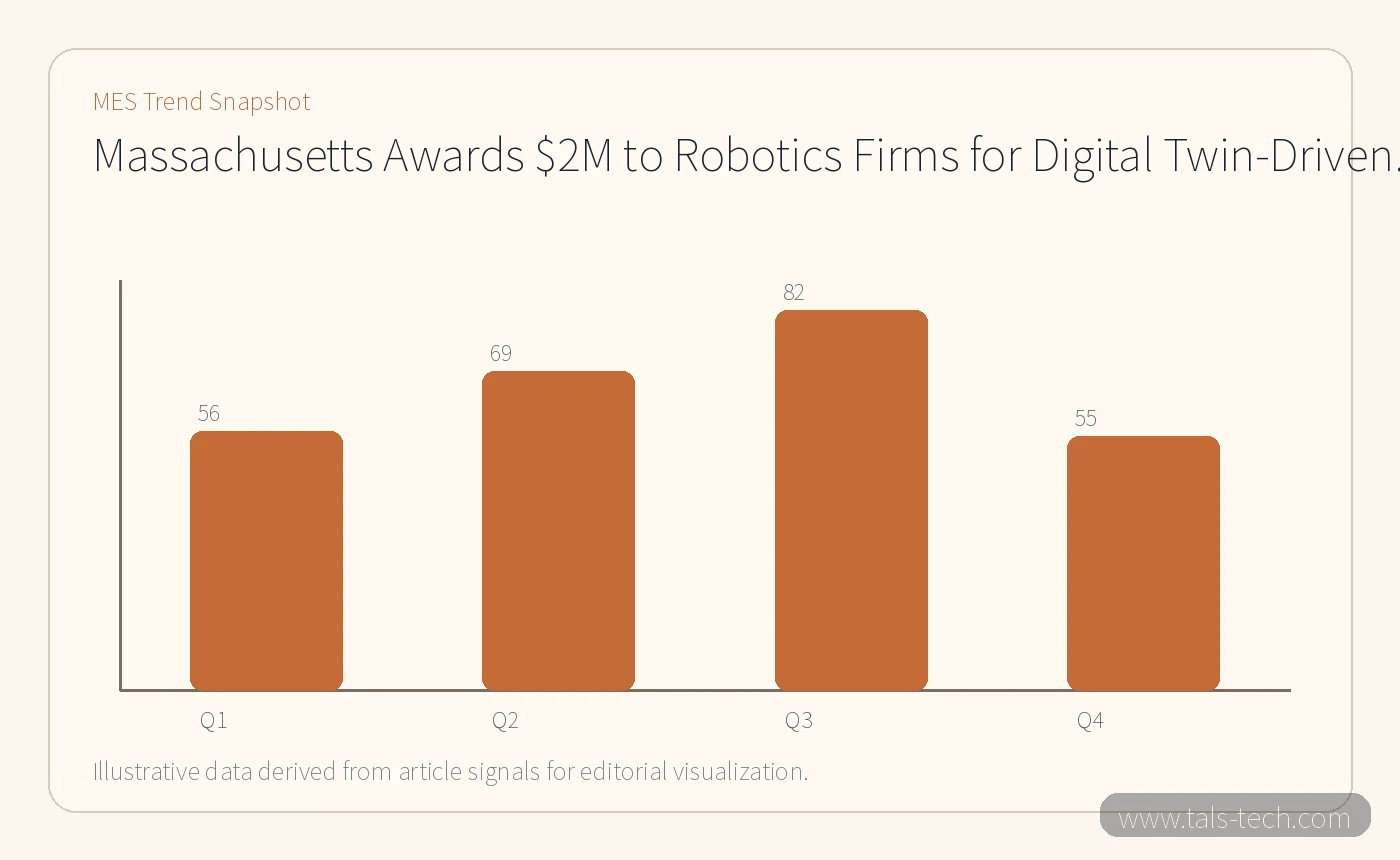
In June 2026, the Healey-Driscoll Administration and MassTech's Innovation Institute awarded nearly $2 million to six Massachusetts-based robotics companies through the state's Robotic Digital Twin Initiative. This funding aims to accelerate commercialization by bridging the gap between robotics hardware and digital twin technology—a critical enabler for smart manufacturing execution systems (MES).
Strategic Investment in Robotics Commercialization
The $2 million grant targets early-stage robotics hardware developers who face a 'digital chasm' between prototype validation and production deployment. Traditional physical testing cycles cost an average of $150,000 per iteration and delay time-to-market by 8–12 months. By contrast, digital twin simulations can reduce physical prototyping by 70% and compress validation cycles to 3–4 months. The six awardees span sectors such as logistics automation, surgical robotics, and collaborative robots, each leveraging the funding to build high-fidelity virtual replicas for kinematics simulation, control logic testing, and failure prediction.
Massachusetts currently hosts over 200 robotics-related firms, but its commercialization rate hovers around 18%—well below Silicon Valley’s 32%. This gap stems largely from limited access to advanced simulation infrastructure. The Robotic Digital Twin Initiative addresses this by providing shared digital twin platforms—essentially a 'robotics-as-a-service' model where companies pay only for simulation compute time. Such models have proven to cut capital expenditure for startups by 60% while enabling faster iterative design. The state expects this investment to directly contribute to a 15–20% increase in regional robotics patent-to-product conversion within three years.
Digital Twins as the Bridge to MES and Industry 4.0
Digital twin technology has evolved from static 3D models into real-time, bidirectional communication layers with manufacturing execution systems. Under the ISA-95 framework, a robot’s digital twin can feed simulated performance data directly into MES scheduling modules, enabling 'virtual first-run' validation before any physical change on the shop floor. For example, a welding robot's digital twin can simulate different path strategies to minimize cycle time without stopping production—a capability critical for high-mix, low-volume manufacturers.
Leading industrial software vendors now embed digital twin connectors within their MES platforms. Siemens Opcenter, Rockwell Emulate3D, and Dassault Systèmes DELMIA all support live data synchronization via OPC UA. When paired with an MES, the digital twin becomes a predictive tool: it can forecast tool wear based on simulated loads and trigger automatic maintenance work orders. Studies show this closed-loop integration improves Overall Equipment Effectiveness (OEE) by 12–18% and reduces unplanned downtime by 30–35%. The Massachusetts cohort will directly apply such integrations, creating a replicable blueprint for mid-sized manufacturers.
Actionable Insights for Manufacturers Adopting Digital Twins
Manufacturers evaluating smart factory upgrades should take three lessons from Massachusetts’ initiative. First, prioritize 'actionable digital twins'—models that exchange data with existing MES and ERP systems, not isolated design tools. Second, assess suppliers’ ecosystem compatibility: robots from ABB, Fanuc, or Kuka now offer pre-built digital twin connectors for major MES platforms, cutting integration costs by up to 40%. Third, leverage shared infrastructure where possible: consortium-based digital twin marketplaces (e.g., through MassTech or similar state programs) allow companies to access high-performance simulation without owning the hardware.
According to IDC, the global digital twin market will reach $48 billion by 2028, with manufacturing accounting for 35% of spending. While Massachusetts’ $2 million grant may seem modest, its strategic multiplier effect—nurturing a regional digital twin ecosystem—offers a template for government-industry collaboration. For plant managers and CTOs, the message is clear: digital twin integration with MES is no longer a luxury but a competitive necessity to handle supply chain volatility and increasing product customization.
Key Statistics
- Grant amount: $2 million
- Number of recipient companies: 6
- Global digital twin market forecast: $48 billion by 2028 (IDC)
- OEE improvement with closed-loop digital twin: 12–18% (industry benchmark)
Outlook
Massachusetts’ $2 million investment in robotic digital twins signals a paradigm shift: digital twins are now infrastructure, not optional add-ons. For manufacturers, the winning strategy is to connect these twins directly to a robust MES, turning simulation into execution. TALS, with deep expertise in MES and digital twin convergence, helps companies bridge this exact gap—ensuring that every robot, line, and process runs virtually before it runs physically. The race to smart manufacturing is no longer about buying new hardware; it’s about wiring digital and physical worlds seamlessly together.