
Industrial Automation Market to Hit $326.48B by 2032 on Smart… - TALS

Industrial Automation Market to Hit $326.48B by 2032 on Smart…
The rapid growth of the industrial automation market, projected to reach $326.48B by 2032, is driven by smart manufacturing and predictive maintenance, highlighting the increasing importance of software solutions like MES and ERP in achieving operational excellence and compliance.
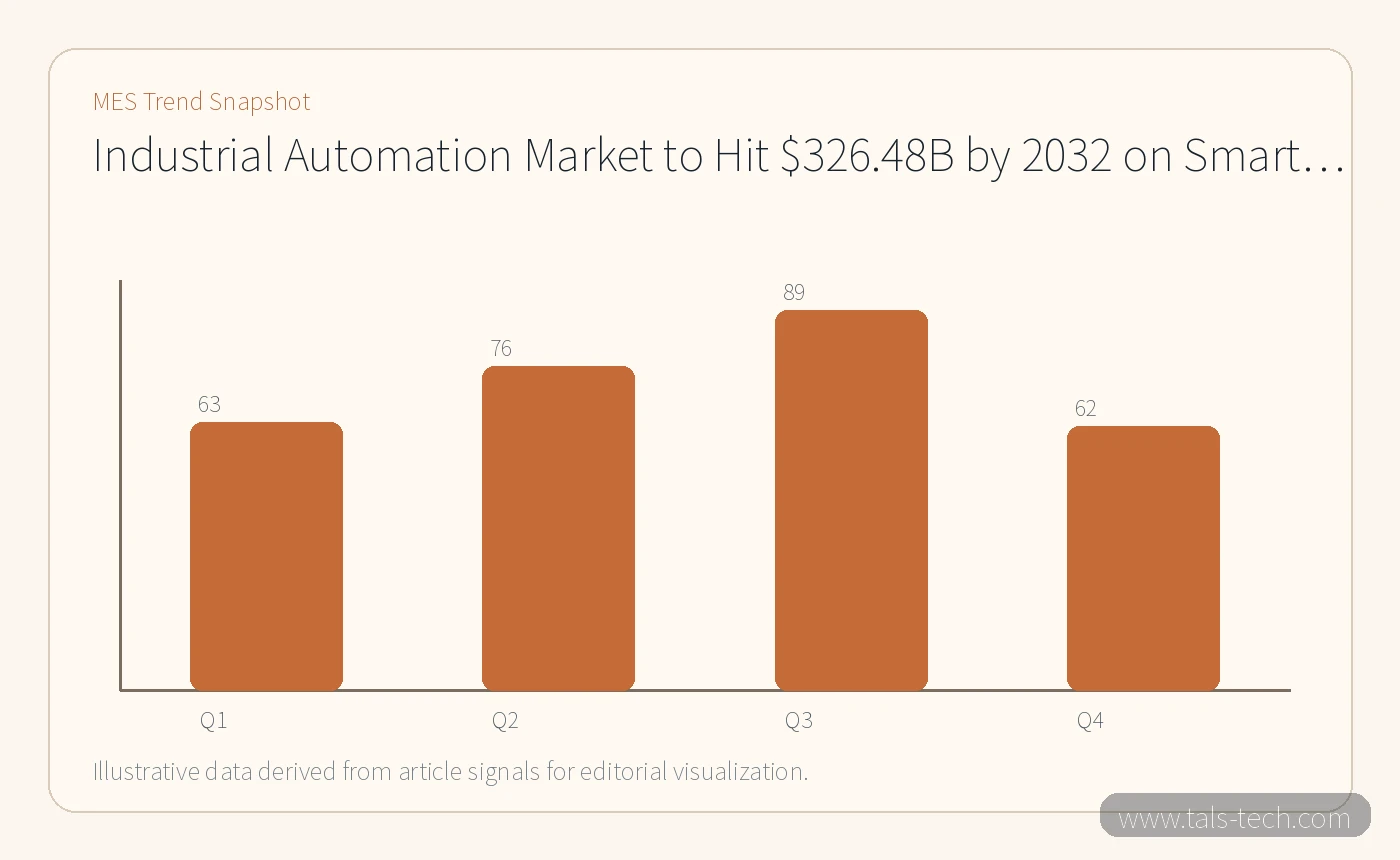
The global industrial automation market is projected to reach US$ 326.48 billion by 2032, driven primarily by the rapid adoption of smart manufacturing and predictive maintenance, according to a new report from Maximize Market Research. This explosive growth underscores a fundamental shift from hardware-centric automation to software-defined operations, where manufacturing execution systems (MES) and industrial software platforms become the backbone of operational excellence.
Market Trajectory and Key Drivers
The report estimates the industrial automation market at approximately $181 billion in 2025, expanding at a compound annual growth rate (CAGR) of 10.5% to surpass $326 billion by 2032. Key drivers include rising labor costs, relentless pressure for productivity gains, and maturing technologies such as the Industrial Internet of Things (IIoT) and artificial intelligence. The proliferation of smart factories is particularly fueling demand for integrated software platforms that can monitor production in real time, optimize resource allocation, and ensure quality traceability. Regionally, Asia-Pacific dominates market share, with China’s manufacturing upgrade and the ‘14th Five-Year Plan’ smart manufacturing initiatives acting as powerful catalysts. Europe and North America focus on retrofitting existing plants, emphasizing alignment with standards like ISA-95 and IEC 62443. These trends directly boost procurement and deployment of MES, ERP, QMS, and other enterprise software solutions.
Smart Manufacturing: From Concept to Scale
Smart manufacturing is no longer a futuristic vision but a present-day industrial revolution. The report highlights that over 68% of manufacturers have already piloted or scaled smart manufacturing initiatives, focusing on digital twins, flexible production, and AI-driven process optimization. For example, in the automotive and electronics sectors, deploying MES platforms to achieve end-to-end production visibility has become standard, enabling defect rate reductions of over 30% and faster time-to-market. However, scaling smart manufacturing faces persistent challenges: data silos, IT-OT integration difficulties, and cybersecurity risks. This is where the value of MES shines—as the bridge between planning layers (ERP) and control layers (PLC). By collecting shop-floor data and breaking down information barriers through standardized interfaces, MES empowers closed-loop management from order to delivery. Combined with edge computing and cloud analytics, companies can achieve true ‘transparent factories’.
Predictive Maintenance: The Downtime Killer
Predictive maintenance is ranked by the report as the third-largest growth engine in the automation market. Traditional preventive maintenance often leads to over-maintenance or unnecessary shutdowns, whereas AI-based predictive maintenance analyzes equipment vibration, temperature, and current data to warn of failures 48–72 hours in advance, reducing unplanned downtime by 45% to 65%. In industries like food & beverage and pharmaceuticals, which rely heavily on continuous production, this technology can yield hundreds of millions in cost savings. To achieve effective predictive maintenance, companies need a reliable MES platform that integrates historical equipment data, maintenance records, and production schedules. TALS’s solutions, with built-in IoT data collection modules and machine learning algorithms, help clients shift from ‘reactive repair’ to ‘proactive operations’. Automatically triggered work orders and rescheduling minimize production disruption. Data shows that MES-driven predictive maintenance improves Overall Equipment Effectiveness (OEE) by an average of 15–20%.
Software-Defined Automation: The Rise of MES and Industrial Software
Traditional automation centered on hardware (PLCs, SCADA, robots), but the new wave is ‘software-defined’—digitizing business processes through MES, ERP, QMS, and similar platforms. The report notes that the industrial software submarket is growing at 12.3% annually, outpacing hardware. The MES segment, directly tied to production performance, is particularly noteworthy, projected to exceed $20 billion by 2030. In this context, vendor selection criteria are evolving: buyers demand not only functionality but also platform openness and scalability. TALS’s MES products support low-code configuration, seamless integration with major ERPs (SAP, Oracle), and built-in AI engines, adapting to diverse industries and company sizes. Whether for discrete or process manufacturing, a unified software platform significantly reduces total cost of ownership (TCO) and shortens implementation cycles.
Key Statistics
- Global industrial automation market projected at $326.48B by 2032, CAGR 10.5% (Maximize Market Research)
- 68% of manufacturers have piloted or scaled smart manufacturing initiatives (industry benchmark)
- Predictive maintenance reduces unplanned downtime by 45-65% (industry benchmark)
- MES-driven predictive maintenance improves OEE by 15-20% (TALS customer case study)
Outlook
The explosive growth of the industrial automation market presents both opportunity and challenge. To stay competitive, companies must look beyond hardware investments and fully embrace software-centric platforms such as MES. TALS is dedicated to delivering smart manufacturing solutions across the entire value chain—from shop-floor data collection to global schedule optimization—helping clients achieve cost reduction, efficiency gains, and regulatory compliance. As AI and edge computing further converge, software-defined automation will define the next generation of manufacturing.