
Industrial Automation Market to Reach $326.48B by 2032: Smart… - TALS

Industrial Automation Market to Reach $326.48B by 2032: Smart…
The industrial automation market's growth to $326.48 billion by 2032 is fueled by smart manufacturing and predictive maintenance, highlighting the critical role of MES and industrial software in enabling data-driven operations, reducing downtime, and improving OEE.
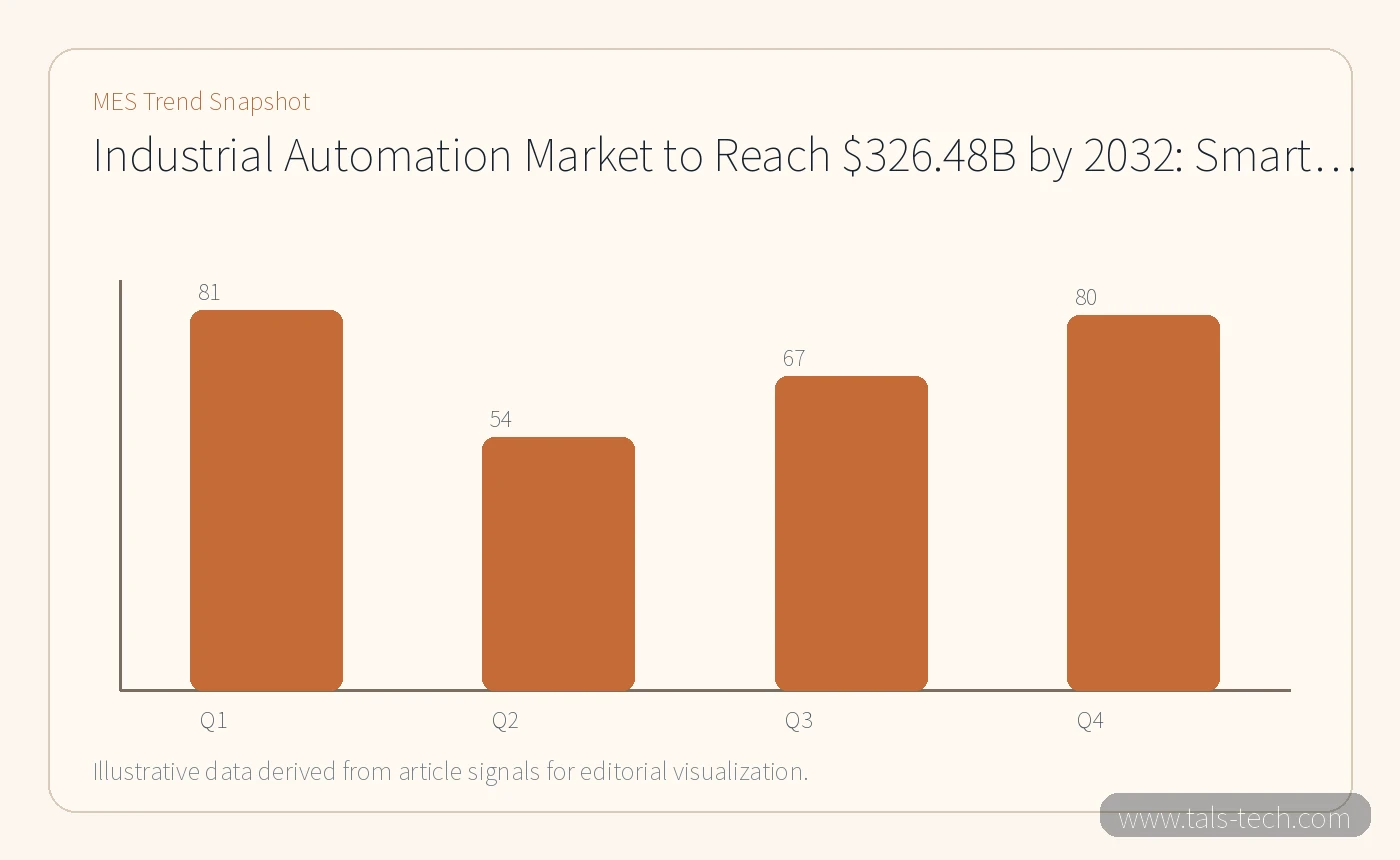
The global industrial automation market is projected to surge to $326.48 billion by 2032, fueled by the rapid adoption of smart manufacturing and predictive maintenance technologies. This unprecedented growth underscores a paradigm shift where manufacturers are leveraging data-driven systems to achieve operational excellence. For businesses still relying on legacy processes, the message is clear: digital transformation is no longer optional—it is the key to survival in an increasingly competitive landscape.
Smart Manufacturing: The Engine of Growth
Beyond productivity gains, smart manufacturing enables mass customization and rapid response to market changes. For example, automotive manufacturers using digital twins and real-time MES data can reconfigure production lines in hours rather than weeks. This agility is crucial in industries like electronics, where product lifecycles are shrinking. The convergence of IT and OT (operational technology) further amplifies these benefits, but it also requires standardized data models (ISA-95) and cybersecurity frameworks (IEC 62443) to ensure reliability and safety.
Predictive Maintenance: Reducing Downtime and Costs
The economic impact is substantial: For a mid-sized manufacturing plant, unplanned downtime can cost upwards of $250,000 per hour. Predictive maintenance not only saves these costs but also extends machine life and reduces energy consumption. Companies like Siemens and ABB are embedding AI directly into drives and controllers, creating 'self-diagnosing' equipment. However, the true value is unlocked when maintenance data is fed back into MES for continuous improvement loops, enabling root cause analysis and process optimization.
The Critical Role of MES and Industrial Software
Industrial software also extends to simulation and digital twin applications, which allow manufacturers to test scenarios without disrupting production. For example, a food and beverage company used a digital twin coupled with MES data to optimize cleaning cycles, reducing changeover time by 15%. The synergy between MES, ERP, and PLM (product lifecycle management) creates a comprehensive digital thread, enabling faster time-to-market and better collaboration across the supply chain.
Navigating the Implementation Journey
To maximize ROI, manufacturers should align MES deployment with Lean and Six Sigma initiatives. For instance, combining MES real-time data with Kaizen events can accelerate waste reduction. Change management is equally important: involving floor operators early in the design process ensures higher adoption rates. With TALS, customers receive not just software but also consulting services to map their digital roadmap, ensuring that each step builds toward a fully integrated smart factory.
Key Statistics
- $326.48 billion projected industrial automation market size by 2032
- 50% or more reduction in unplanned downtime with predictive maintenance (industry benchmark)
- 20–35% improvement in OEE and 40% defect rate reduction from MES implementation (industry benchmark)
- 70% of digital transformation initiatives fail due to poor planning (industry benchmark)
Outlook
The trajectory of industrial automation points toward an interconnected, intelligent factory floor where every machine, sensor, and system communicates seamlessly. As the market expands, the winners will be those who invest in robust MES and quality management platforms today. TALS’s suite of manufacturing execution and quality solutions provides the foundation for this transformation, enabling manufacturers to capture the full value of smart manufacturing and predictive maintenance.