
How AI Makes Predictive Maintenance Work for Automotive Robots - TALS
How AI Makes Predictive Maintenance Work for Automotive Robots
How AI-driven predictive maintenance transforms automotive robotics uptime and quality, with MES as the data backbone for real-time decision-making and Industry 4.0 integration.
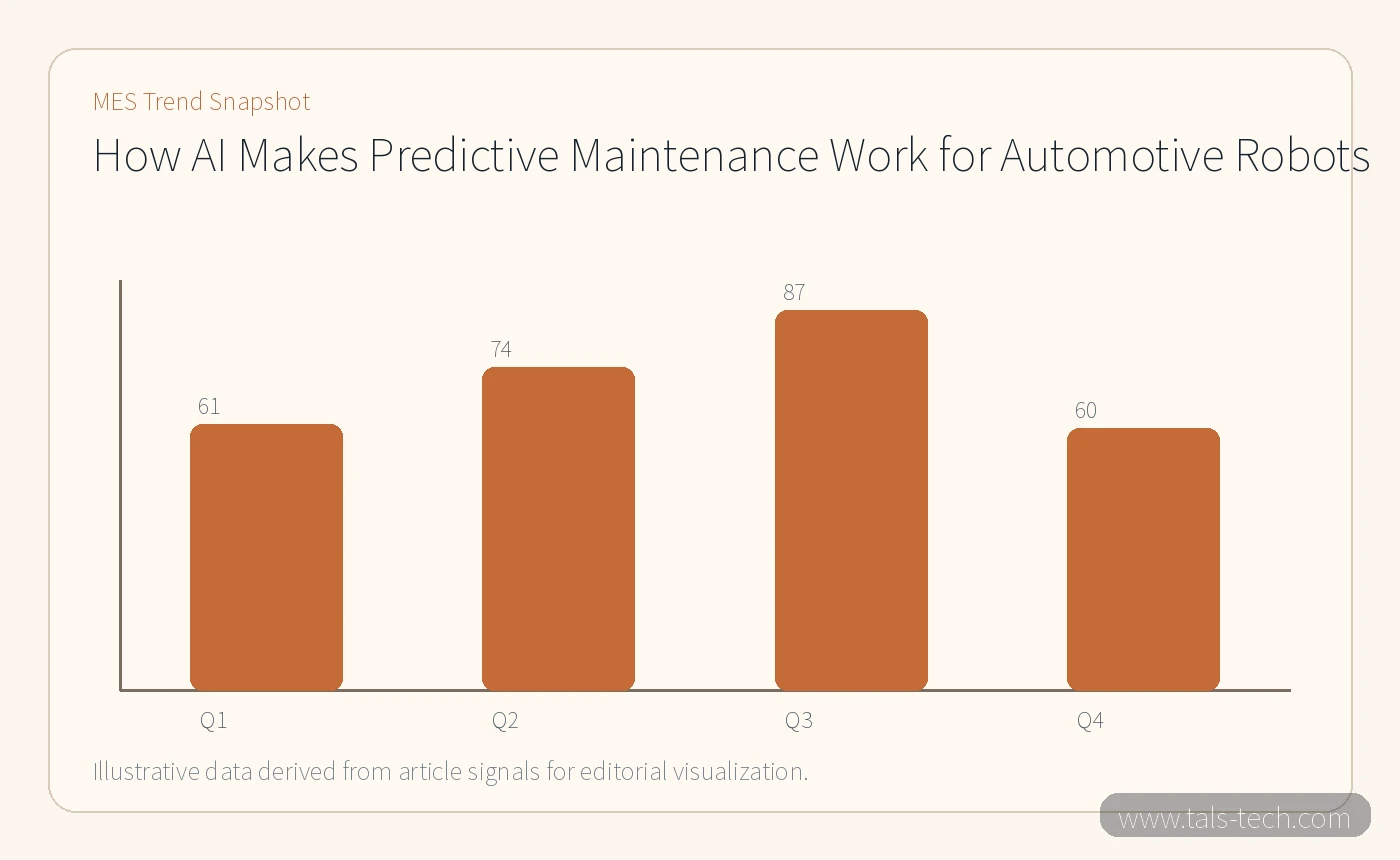
In automotive factories, unplanned robot downtime costs millions annually. AI-powered predictive maintenance is flipping the script: by analyzing vibration, temperature, and current data in real time, it can forecast failures weeks in advance, cutting unplanned downtime by over 50%. An MES platform acts as the central nervous system, turning predictions into actionable maintenance orders—making zero-downtime production a tangible reality.
Industry Pain Points: From Firefighting to Fire Prevention
A practical example: a premium German automaker deployed AI predictive maintenance in its paint shop. The results? Robot downtime fell 62% and maintenance costs dropped 35%. A Japanese supplier used torque-curve analysis on collaborative robots to detect a screwdriver drift 48 hours in advance, averting a potential $2 million recall. These successes underscore that predictive maintenance is not a plug-and-play gadget—it requires deep domain adaptation and closed-loop execution, which only a sophisticated MES can provide.
How AI Makes Predictive Maintenance Work in Practice
Edge computing amplifies these capabilities. With 5G, lightweight inference models can run locally on the robot controller, sending only anomalies to the cloud. Latency drops to milliseconds, enabling real-time interventions like speed throttling or vibration damping. The MES orchestrates edge decisions with historical data and global optimization, creating a hybrid intelligence that scales across hundreds of robots.
From Single-Point Intelligence to System-Wide Intelligence: The MES Hub
The ultimate goal of predictive maintenance is not individual robot health but line-wide manufacturing intelligence. When an AI model flags abnormal joint temperature on one robot, the MES must dynamically assess production impact: should the line stop immediately, or can the batch be completed? Is a spare part in stock? Is an alternate process route feasible? This requires real-time scheduling (RTS) and digital twin simulation. At Siemens’ Electronics Works, integrating predictive maintenance data into the MES enabled dynamic dashboards that automatically optimized maintenance crew schedules, improving spare-parts inventory turnover by 28%. TALS’s MES natively integrates with major robot brands (FANUC, KUKA, ABB), offering out-of-the-box connectors and pre-trained AI models that cut deployment time by 60%. The future lies in closed-loop autonomous maintenance: the AI detects anomaly, the MES creates a work order, the robot self-adjusts parameters to mitigate risk, and the spare parts are delivered by an AGV—all without human intervention. This vision aligns with the RAMI 4.0 reference architecture, where MES is the central enabler.
Key Statistics
- Unplanned downtime reduced by over 50% (industry benchmark)
- 90%+ accuracy in predicting bearing wear 14 days in advance
- 62% downtime reduction and 35% cost reduction at a German luxury automaker
- 28% improvement in spare-parts inventory turnover (Siemens case)
Outlook
AI-driven predictive maintenance has moved from proof-of-concept to scalable deployment, especially in high-stakes automotive robotics. But it is not a standalone fix—only when tightly integrated with an MES can it close the loop from alert to autonomous action. TALS empowers manufacturers to turn AI insights into executable manufacturing intelligence, helping automotive plants stay ahead in the zero-downtime, zero-defect race. When every robot’s heartbeat is listened to by the MES, the zero-downtime factory is no longer a distant dream—it’s an engineered reality.