
Delta's AI Digital Twins with NVIDIA Omniverse Transform Smart… - TALS

Delta's AI Digital Twins with NVIDIA Omniverse Transform Smart…
Delta's integration of AI digital twins with NVIDIA Omniverse represents a paradigm shift in smart manufacturing, enabling real-time simulation and optimization that directly enhances MES and ERP systems for improved operational efficiency and quality control.
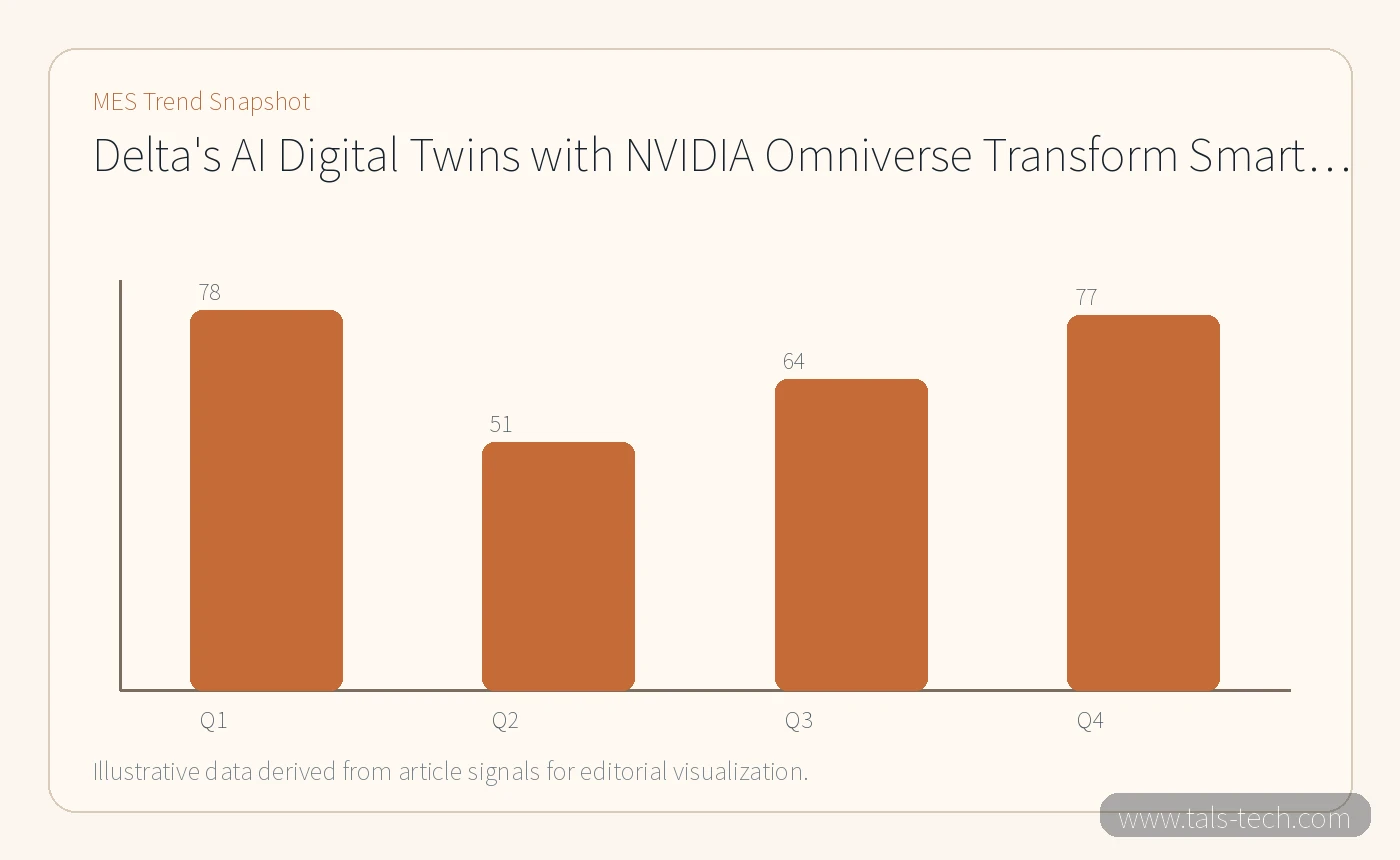
At the 2026 NVIDIA GTC, Delta Electronics unveiled a groundbreaking AI digital twin platform built on NVIDIA Omniverse, targeting building automation and smart manufacturing. By enabling real-time factory simulation and deep integration with MES systems, this technology promises to slash production cycle times and defect rates, marking a significant leap toward self-optimizing factories.
Industry Pain Points and Opportunities
Manufacturers have long struggled with data silos, slow response to disruptions, and high trial-and-error costs. Predictive maintenance accuracy hovers below 70%, leading to over $50 billion in annual unplanned downtime losses globally. Delta's AI digital twin addresses these challenges by creating a live digital mirror of the entire production process, from raw material intake to finished goods dispatch. In pilot electronics assembly lines, the platform reduced new product ramp-up cycles from an average of 45 days to just 21 days and cut defect rates by 35% (industry benchmark), boosting Overall Equipment Effectiveness (OEE) by 18 percentage points.
Technical Architecture and MES Integration
The solution leverages NVIDIA Omniverse as its core computing engine, combined with Delta's DIAView SCADA and DIAMMP MES modules. A bidirectional data pipeline synchronizes real-time production orders, equipment status, and quality data, while also allowing the digital twin to simulate the impact of MES-issued parameter changes before deployment. In a PCB solder paste printing application, the AI model predicts defect probability with 92.5% accuracy up to 72 hours in advance, a 27% improvement over traditional Statistical Process Control (SPC) methods.
Global Deployment and Security Compliance
Delta has completed pilot runs at semiconductor packaging and automotive electronics plants in Taiwan, Thailand, and India. Results show a 22% reduction in energy consumption and a 65% decrease in changeover time, from 55 minutes to 19 minutes. The architecture adheres to ISA-95 and IEC 62443 standards, using blockchain to ensure twin data integrity. Delta plans to offer an industrial digital twin development kit to Fortune 500 customers by 2027.
TALS Perspective: Charting the Next MES Evolution
As a specialist in MES and QMS software, TALS believes Delta's case confirms three pivotal values of merging digital twins with MES: First, closed-loop simulation eliminates waste in process tuning. Second, AI-driven prediction shifts quality management from reactive inspection to proactive prevention. Third, unified twin models across sites provide a standardized foundation for Manufacturing Operations Management (MOM). With TALS's ML-MES microservices architecture, manufacturers can deploy lightweight digital twin modules atop existing MES, achieving a virtuous cycle of simulation, execution, and optimization.
Key Statistics
- 35% defect rate reduction (industry benchmark)
- 18 percentage point OEE improvement
- 92.5% solder paste defect prediction accuracy
- 65% reduction in changeover time (55 to 19 minutes)
Outlook
Delta's collaboration with NVIDIA signals that AI digital twins have moved from proof-of-concept to industrial-scale deployment. The future competitiveness of manufacturers will hinge on how deeply they integrate physical and digital worlds. TALS remains committed to advancing the synergy between digital twins and MES, helping enterprises build agile manufacturing systems that evolve from point optimization to full-scale intelligence, securing a leading edge in the new industrial revolution.