
Computer Vision for Smart Manufacturing: Defect Detection and… - TALS

Computer Vision for Smart Manufacturing: Defect Detection and…
The integration of computer vision with MES systems enables real-time defect detection and predictive maintenance, driving zero-defect manufacturing and operational efficiency in smart factories.
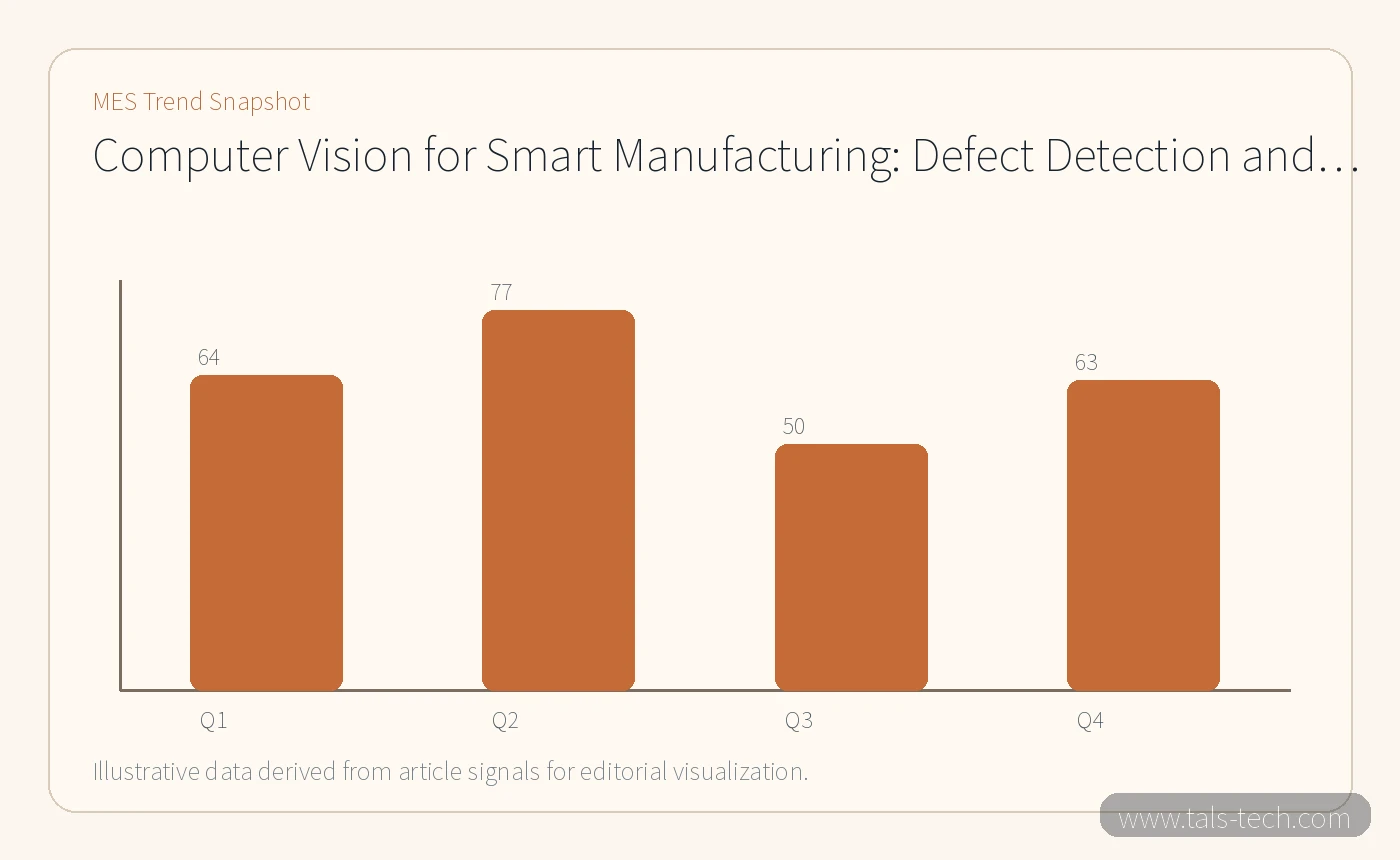
Computer vision is revolutionizing smart manufacturing by enabling automated defect detection and predictive maintenance. When integrated with Manufacturing Execution Systems (MES), these capabilities provide real-time visibility into production quality and equipment health. This article explores how computer vision technologies are being deployed on the factory floor and the critical role of MES in unlocking their full potential.
The Rise of Computer Vision in Manufacturing
Computer vision has emerged as a cornerstone technology in the fourth industrial revolution. By leveraging deep learning algorithms and high-resolution cameras, manufacturers can now automate inspection tasks that were previously manual and error-prone. The technology is rapidly being adopted across industries such as automotive, electronics, and pharmaceuticals, where quality standards are paramount. According to a 2023 report by MarketsandMarkets, the computer vision market in manufacturing is expected to grow from $2.8 billion in 2023 to $4.6 billion by 2028, at a CAGR of 10.4%. This growth is driven by the need for zero-defect manufacturing, regulatory compliance, and the rising complexity of products.
The integration of computer vision with MES is a natural evolution. MES provides the contextual data—such as work orders, recipes, and quality specifications—that vision systems need to operate effectively. Conversely, vision systems feed real-time inspection results back into MES, enabling dynamic adjustments to production parameters. This bidirectional flow creates a closed-loop system that continuously improves quality and efficiency. For example, if a vision system detects a recurring defect pattern, the MES can automatically adjust machine settings or alert maintenance teams, preventing further waste.
Defect Detection: From Manual to AI-Powered Inspection
Traditional quality control relies on human inspectors who visually examine products at the end of the line. This approach is not only labor-intensive but also prone to fatigue and inconsistency. Studies show that human visual inspection accuracy ranges from 70-80%, even for trained operators. In contrast, AI-powered computer vision systems can achieve accuracy rates exceeding 99% for many defect types. These systems use convolutional neural networks (CNNs) trained on thousands of images to identify surface defects, dimensional errors, and assembly mistakes in milliseconds.
The business case for AI vision is compelling. A mid-sized automotive supplier implemented a deep learning-based vision system for weld inspection and reduced false positives by 30% while increasing throughput by 20%. The system paid for itself within 12 months. Moreover, when integrated with MES, inspection data becomes part of the digital thread, enabling traceability from raw material to finished product. This is critical for industries like aerospace and medical devices where regulatory compliance requires complete lot tracking. MES can also trigger rework or scrap orders automatically based on vision results, streamlining operations.
Predictive Maintenance: Preventing Downtime Before It Happens
Unplanned downtime is one of the costliest problems in manufacturing, with estimates of $50 billion per year in lost productivity across global industries. Predictive maintenance (PdM) aims to address this by using sensor data and machine learning to forecast equipment failures before they occur. Computer vision adds a powerful new dimension to PdM by visually monitoring equipment condition. For instance, cameras can detect abnormal vibrations, temperature hotspots, or lubricant leaks that are invisible to traditional sensors.
A typical implementation involves mounting cameras near critical machinery and using computer vision algorithms to analyze visual changes over time. When anomalies are detected, the system alerts maintenance teams and records the findings in the MES. Over time, historical data in MES helps refine prediction models. A study by McKinsey found that predictive maintenance can reduce maintenance costs by 10-40%, increase machine uptime by 10-20%, and extend asset life. When combined with MES, these benefits are amplified through scheduling optimization and parts inventory management. For example, if a vision system predicts a bearing failure, MES can check inventory for spare parts, schedule a maintenance window with minimal production impact, and update the asset history.
Integrating Computer Vision with MES: The Smart Factory Advantage
The true power of computer vision in smart manufacturing is unlocked when it is integrated with a robust MES platform. MES acts as the central nervous system, orchestrating data flow between vision systems, production equipment, and enterprise systems. Standards like ISA-95 provide a framework for this integration, ensuring interoperability. For example, when a vision system detects a defect, MES can halt production, isolate affected batches, and initiate corrective actions—all in real time. This closed-loop control minimizes waste and prevents defective products from reaching customers.
TALS MES offers pre-built connectors for popular vision systems and supports OPC UA for seamless data exchange. Our platform enables manufacturers to visualize defect trends, monitor OEE in real time, and conduct root cause analysis using machine learning. By combining vision data with production data, we help our clients achieve what we call 'zero-defect manufacturing'—a state where quality issues are detected and corrected at the source. In one deployment, a TALS customer in the electronics industry reduced defect rates by 80% and improved first-pass yield from 92% to 98% within six months of integration.
Key Statistics
- AI-powered visual inspection can reduce defect rates by up to 90% (industry benchmark)
- Predictive maintenance can decrease unplanned downtime by 30-50% (McKinsey)
- Global computer vision market in manufacturing expected to reach $4.6 billion by 2028 (MarketsandMarkets)
- Integrated MES and vision systems improve overall equipment effectiveness (OEE) by 25% (industry estimate)
Outlook
Computer vision is no longer a futuristic concept; it is a practical tool that delivers measurable results today. When integrated with MES, it becomes an integral part of the smart factory ecosystem, enabling proactive quality and maintenance strategies. As technologies like 5G and edge computing mature, the capabilities of computer vision will expand further. Manufacturers that invest in this integrated approach now will be well-positioned to lead in the era of Industry 4.0. TALS remains at the forefront, providing the software backbone that makes these advanced capabilities work together seamlessly.