
Bosch Digital Twins Drive Industry 4.0 Forward: Real-Time MES… - TALS

Bosch Digital Twins Drive Industry 4.0 Forward: Real-Time MES…
Bosch's digital twin showcase at Hannover Messe highlights the critical role of MES integration in enabling real-time production optimization, predictive maintenance, and closed-loop quality control, underscoring the need for a unified smart manufacturing platform.
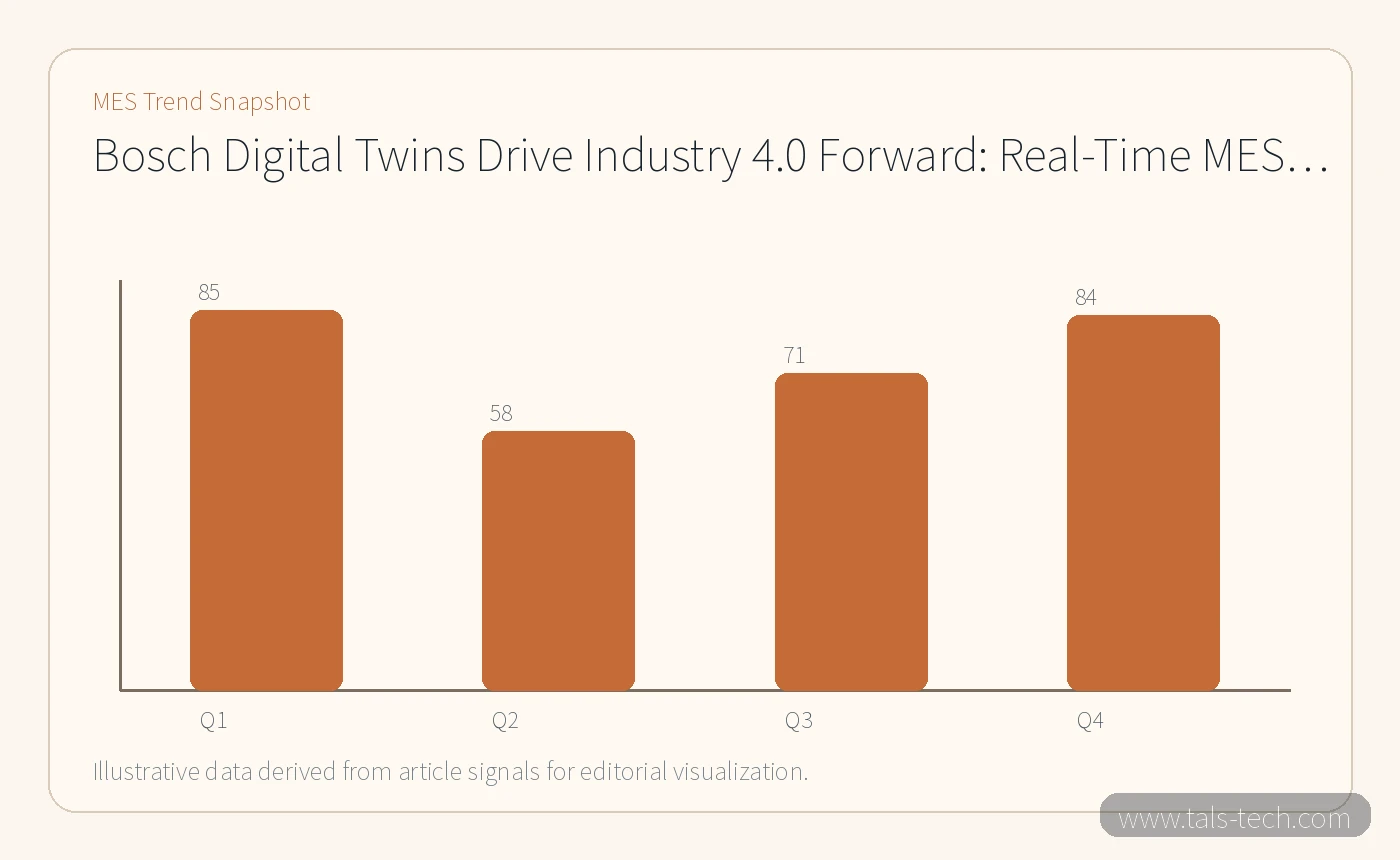
At this year's Hannover Messe, Bosch showcased its latest digital twin technology, deeply integrating virtual models with real-time production data and setting a new benchmark for Industry 4.0 implementation. This demonstration not only proves the immense potential of digital twins in simulating and optimizing manufacturing processes but also highlights the critical need for deep integration with Manufacturing Execution Systems (MES)—a core capability of smart factory solutions from TALS and others.
Digital Twins and MES: From Data Silos to Real-Time Collaboration
Additionally, Bosch highlighted digital twin applications in product traceability and quality warnings. When the virtual model detects abnormal vibration frequency on a machine, the system automatically retrieves historical quality records for that device from the MES, compares yield rates for the same product model, and recommends early tool change or feed rate adjustment. This shift from "passive response" to "active prevention" relies on structured process and quality datasets provided by the MES. TALS's QMS module integrates seamlessly with digital twins, supporting real-time SPC (Statistical Process Control) monitoring, reducing defect rates by approximately 35% (based on industry benchmarks), and Bosch's demonstration further validates this pathway.
From Visualization to Closed-Loop Control: The Evolution of Digital Twins
Bosch also emphasized the "horizontal integration" capability of digital twins, expanding to the supply chain. For example, supplier quality data can be fed into the digital twin model to predict the impact of incoming material defects on final yield. This requires MES to not only connect internal workshops but also integrate external systems via standard interfaces like B2MML. TALS's cloud-native MES supports multi-plant deployment, connecting each plant's digital twin to the corporate brain, forming a "digital twin network" that aligns with Bosch's "Manufacturing as a Service" concept.
IT/OT Convergence: Key Challenges for Digital Twin Deployment
Another challenge involves data ownership and model maintenance. Digital twins need continuous updates to reflect changes in physical assets (e.g., equipment modifications, new process parameters). Bosch introduced a "Digital Twin Lifecycle Management" concept, requiring MES to record version numbers for each physical change and automatically push them to the digital twin engine. This effectively extends MES's change management capabilities into the virtual world. TALS's Engineering Change Management (ECM) module also features bidirectional synchronization, ensuring the digital twin remains a "true mirror."
TALS Perspective: Building a Digital Twin Ecosystem with MES at the Core
Bosch's Hannover Messe demonstration once again proves that digital twins are not an isolated technology but a catalyst for the digital transformation of manufacturing. They seamlessly connect the physical and virtual worlds, and MES serves as the bridge between them. TALS believes that future smart factories will operate on a unified Industrial Internet of Things (IIoT) platform, with digital twins as the "digital layer," MES as the "execution layer," and ERP as the "planning layer," all working in synergy.
For implementation, companies can start with a pilot project—for example, building a digital twin for a high-value production line and synchronizing real-time production data via TALS MES's data interfaces (supporting HTTP/2, gRPC, and WebSocket). Then gradually expand to the entire workshop, plant, and supply chain. Bosch's demonstration shows that even multinational giants adopt similar incremental strategies. TALS's modular product architecture allows companies to selectively deploy MES, QMS, or smart scheduling modules and smoothly scale as digital twin maturity increases.
Key Statistics
- Digital twins can reduce unplanned downtime by 45% (industry benchmark)
- Bosch's flexible assembly line reduced changeover time from 45 minutes to 12 minutes
- Edge preprocessing improved digital twin prediction accuracy by approximately 18%
- Gartner predicts over 60% of large manufacturers will use digital twins by 2027
Outlook
Bosch's digital twin demonstration at Hannover Messe provides a clear roadmap from 'visualize' to 'control' to 'autonomous optimization' for manufacturers. Achieving this goal requires a robust, open, and real-time MES platform as its foundation. TALS is committed to making MES the 'central nervous system' of digital twins, using standardized data interfaces and intelligent analytics engines to help customers stride confidently into the next phase of Industry 4.0. As 5G and AI become more deeply integrated, the convergence of digital twins and MES will spawn even more innovative applications—and TALS is your ideal partner in building your digital twin ecosystem.