
Digital Twin in MES: Transforming Manufacturing Execution Systems - TALS

Digital Twin in MES: Transforming Manufacturing Execution Systems
The integration of digital twins with MES is revolutionizing manufacturing by enabling real-time simulation, predictive analytics, and closed-loop optimization, driving unprecedented efficiency and quality gains.
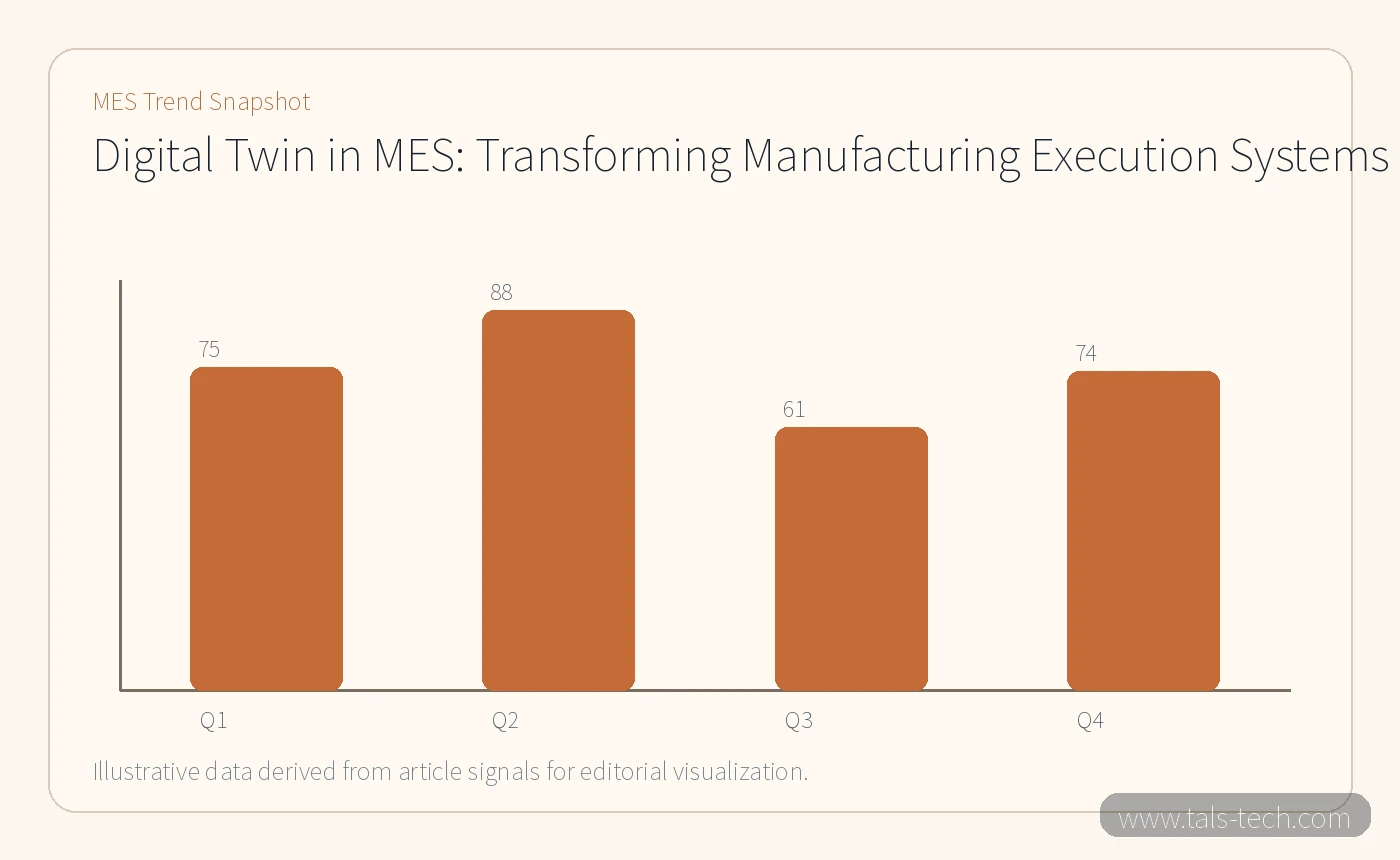
The convergence of digital twins and Manufacturing Execution Systems (MES) is reshaping the factory floor. No longer just a passive monitoring tool, MES empowered by digital twins becomes a predictive, self-optimizing nerve center that bridges physical production with virtual simulation. This article explores how this synergy drives measurable gains in quality, efficiency, and agility.
The Data-Driven Leap from Reactive to Predictive
Traditional MES excels at recording what happened—tracking work orders, capturing downtime, and generating shift reports. But it struggles to answer ‘what if’ scenarios in real time. Digital twins fill this gap by creating a live, virtual replica of every workstation, conveyor, and robot. Sensors stream real-time data—temperature, vibration, cycle times—into the twin, which continuously updates its model. When the twin detects a deviation, it can simulate corrective actions before the physical line is affected.
For example, a semiconductor fab using digital twin-enhanced MES reduced wafer scrap by 28% by predicting chemical bath depletion and adjusting process parameters autonomously. The key enabler is edge computing: data is processed locally to minimize latency, with the twin running at millisecond intervals. According to industry benchmarks, such setups reduce unplanned downtime by 35% on average.
TALS's MES platform natively integrates digital twin engines through standardized APIs (REST, OPC UA). Manufacturers can deploy pre-built twin templates for common equipment classes—CNC machines, assembly stations, test cells—and link them to production orders. This plug-and-play approach eliminates custom coding, allowing even mid-sized plants to adopt digital twin capabilities within weeks.
Closed-Loop Quality Control with Real-Time Simulation
Quality in manufacturing has long been a retrospective affair: inspect after the fact, sort defects, and adjust for the next batch. Digital twins invert this paradigm. By embedding simulation within the MES workflow, each unit can be virtually tested before physical production begins. A aerospace parts manufacturer, for instance, uses digital twins to simulate the thermal stress of turbine blades during heat treatment. The twin predicts grain growth and phase transformation, enabling engineers to fine-tune furnace profiles, resulting in a 22% increase in first-pass yield.
Moreover, digital twins enable adaptive process control. If incoming material properties vary—say, a batch of steel has different hardness—the twin can recompute optimal cutting speeds and feed rates, then update the CNC program via the MES. This closed-loop adjustment happens in under 500 milliseconds, keeping the line within specification without manual intervention. Data from leading automotive OEMs shows that such adaptive control cuts defect rates by 50% or more.
TALS's QMS module integrates directly with the digital twin, providing a single source of truth for quality data. When the twin flags a potential non-conformance, the system automatically generates an SPC alert, triggers an andon, or even stops the line. This integration aligns with IEC 62443 cybersecurity standards, ensuring that twin-driven controls do not compromise plant safety.
Transforming Production Scheduling and Asset Management
Production scheduling is perhaps where digital twins deliver the most tangible ROI. Traditional finite scheduling assumes static constraints, but real factories are dynamic: machines degrade, orders change, material arrives late. A digital twin of the entire production system—including inventory buffers, transport robots, and operator availability—can simulate hundreds of scenarios in seconds. A consumer goods company used this approach to optimize changeover sequences, reducing total changeover time by 26% and increasing overall equipment effectiveness (OEE) by 14%.
Asset management also benefits. Digital twins facilitate predictive maintenance by comparing real-time vibration and thermal data against expected behavior. When a motor's signature deviates, the twin estimates remaining useful life (RUL) and schedules maintenance precisely when needed—not too early (wasting parts) or too late (causing breakdowns). This data-driven strategy reduces maintenance costs by 30% while extending asset lifespan.
TALS's Smart Factory Suite includes a digital twin workspace for modeling end-to-end production flows. Users can drag and drop equipment icons, define failure distributions, and run Monte Carlo simulations. Outputs are directly fed into the MES scheduling engine, creating a continuous optimization loop. This capability is especially powerful for ‘High Mix, Low Volume’ environments, where traditional scheduling rules fail to capture complexity.
Key Statistics
- 28% reduction in wafer scrap (semiconductor example)
- 35% reduction in unplanned downtime (industry benchmark)
- 22% increase in first-pass yield (aerospace)
- 26% reduction in changeover time, 14% OEE improvement (consumer goods)
Outlook
Digital twins are no longer a futuristic concept—they are a pragmatic upgrade to MES that delivers measurable, data-backed improvements in quality, efficiency, and agility. As manufacturing moves toward autonomous operations, the twin-MES integration will serve as the digital backbone, enabling real-time collaboration between humans, machines, and software. TALS remains at the forefront of this evolution, providing scalable digital twin solutions that transform MES from a record keeper into a strategic profit driver.