
Industrial Automation Market to Hit $541.2B by 2035, MES Becomes… - TALS

Industrial Automation Market to Hit $541.2B by 2035, MES Becomes…
The explosive growth of the industrial automation market, driven by AI and IIoT, highlights the increasing importance of manufacturing execution systems (MES) and smart factory software in capturing and analyzing data to optimize production.
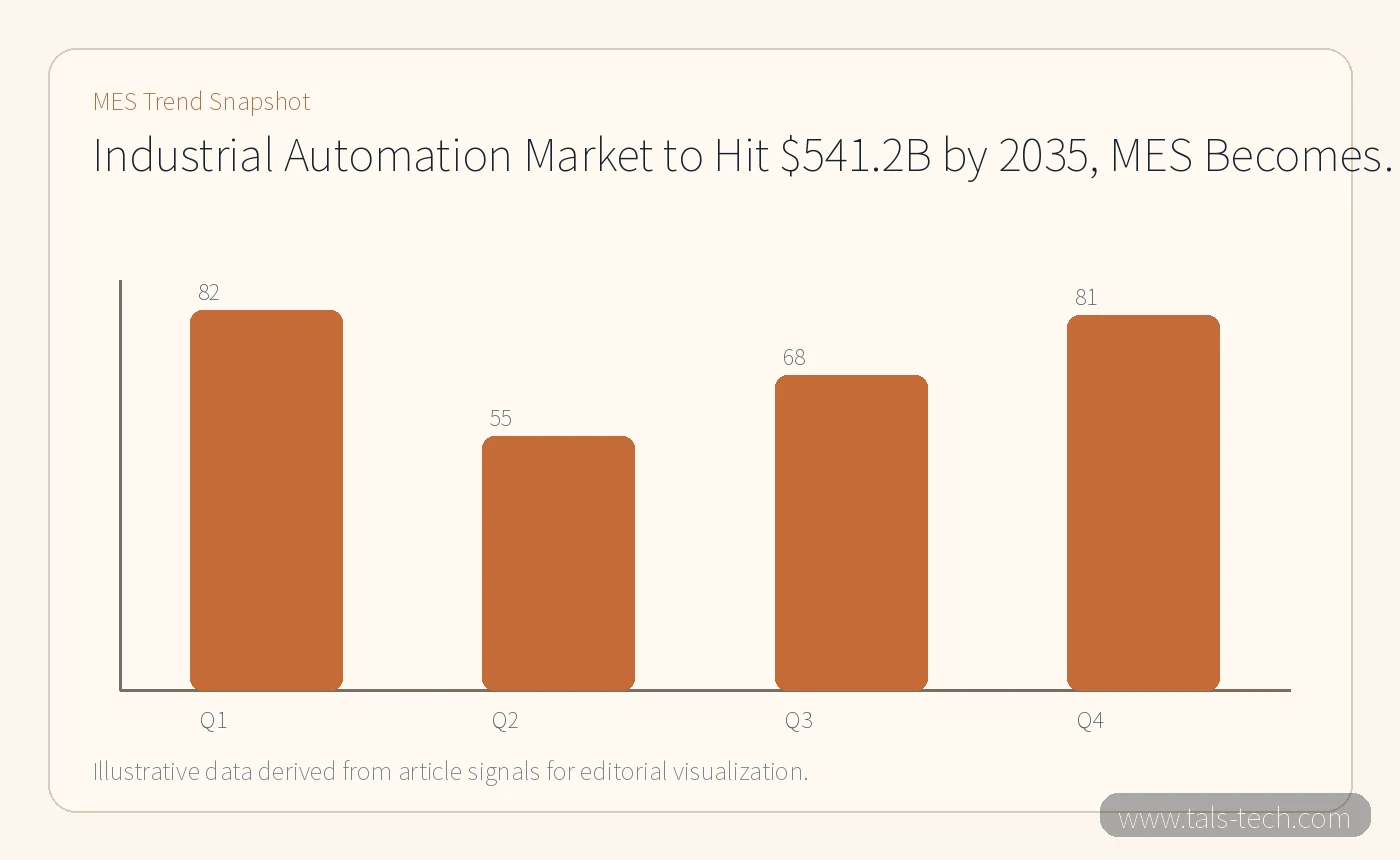
The global industrial automation market is on a rapid growth trajectory, projected to reach $541.2 billion by 2035, driven by the convergence of artificial intelligence (AI), the Industrial Internet of Things (IIoT), and smart manufacturing. In this wave, Manufacturing Execution Systems (MES) have evolved from a nice-to-have to a strategic necessity, enabling manufacturers to bridge the gap between shop-floor hardware and data-driven decisions. For enterprises aiming to stay competitive, MES is no longer optional—it is the core engine of digital transformation.
Market Growth Drivers and the MES Imperative
According to recent market analyses, the industrial automation sector is expected to grow at a CAGR of over 6.8% from roughly $280 billion in 2025 to $541.2 billion by 2035. Three key forces are fueling this expansion: AI-powered predictive maintenance and quality inspection, IIoT-enabled real-time monitoring across vast device networks, and the proven ROI of smart manufacturing initiatives. For instance, AI-driven visual inspection can reduce defect rates by more than 35%, while IIoT platforms improve overall equipment effectiveness (OEE) by 15–20%.
Supply chain volatility and labor shortages have further accelerated automation investments. However, hardware alone cannot deliver agility—software systems, particularly MES, are essential to orchestrate production, track quality, and optimize resources. This is where TALS MES steps in, translating raw data into actionable insights that drive continuous improvement.
MES as the Digital Bridge: From Data to Decisions
Within the factory automation stack, MES acts as the central nervous system, connecting SCADA, PLCs, and ERP systems. The ISA-95 standard defines the integration points, ensuring that production orders flow seamlessly from planning to execution. TALS MES goes beyond basic data collection: it incorporates AI algorithms for capacity forecasting and anomaly detection, enabling manufacturers to reduce lead times by an average of 20%.
A case in point: an automotive parts supplier implemented TALS MES and achieved a 40% reduction in changeover time and a 25% drop in work-in-process inventory. Moreover, MES provides the granular traceability required by stringent regulations in automotive, aerospace, and life sciences. As IIoT sensors proliferate, MES becomes the platform that turns a flood of data into a symphony of efficiency.
Addressing Pain Points with Integrated Smart Manufacturing
Manufacturers today face three critical challenges when pursuing automation: system integration complexity, data silos, and unclear return on investment. Many have invested heavily in automated machinery but lack the software layer to coordinate operations. Successful MES deployment requires deep domain expertise and a flexible architecture. TALS addresses this with a microservices-based MES platform that can be rapidly configured for different industries, along with low-code tools for customizations.
Additionally, TALS offers integrated QMS and ERP modules, creating a closed-loop digital thread from order to delivery. Industry benchmarks show that such integrated smart manufacturing solutions can reduce overall operating costs by 12–18%. TALS customers report a 60% faster response to equipment anomalies and annual maintenance savings exceeding six figures.
The Future of Automation: Software-Defined, Secure, and Intelligent
Looking ahead to 2035, the competitive edge in automation will shift from hardware performance to software intelligence. Edge computing, digital twins, and generative AI will redefine production paradigms. MES must evolve to handle real-time analytics with minimal latency. TALS is investing in digital twin-based virtual commissioning, allowing manufacturers to validate line changes in a simulated environment before deployment, reducing downtime risks.
Cybersecurity is another cornerstone. With IEC 62443 standards gaining traction, TALS MES embeds security features to comply with global regulations. As 5G networks enable millisecond-level synchronization, MES will orchestrate truly lights-out factories. TALS is committed to being the trusted partner for manufacturers navigating this journey, providing the software backbone for the smart factories of tomorrow.
Key Statistics
- Industrial automation market projected to reach $541.2 billion by 2035
- AI visual inspection reduces defect rates by 35% or more
- TALS MES cuts lead times by 20% on average
- Integrated smart manufacturing solutions lower operating costs by 12–18%
Outlook
The industrial automation market's meteoric rise underscores a fundamental truth: hardware is the foundation, but software is the differentiator. MES, as the digital backbone of the smart factory, transforms raw data into strategic assets. TALS, with its deep industry expertise and innovative MES, QMS, and ERP solutions, empowers manufacturers to capture the full value of automation. As we race toward 2035, the choice of a software partner will define which companies lead the next industrial revolution—and TALS is built to enable that leadership.