
Industrial Automation Boom: AI, IoT, and Industry 4.0 Fuel MES… - TALS

Industrial Automation Boom: AI, IoT, and Industry 4.0 Fuel MES…
The projected surge in the industrial automation market, fueled by AI, IoT, and Industry 4.0, is directly increasing demand for advanced MES and smart manufacturing software to integrate these technologies, optimize operations, and ensure cybersecurity.
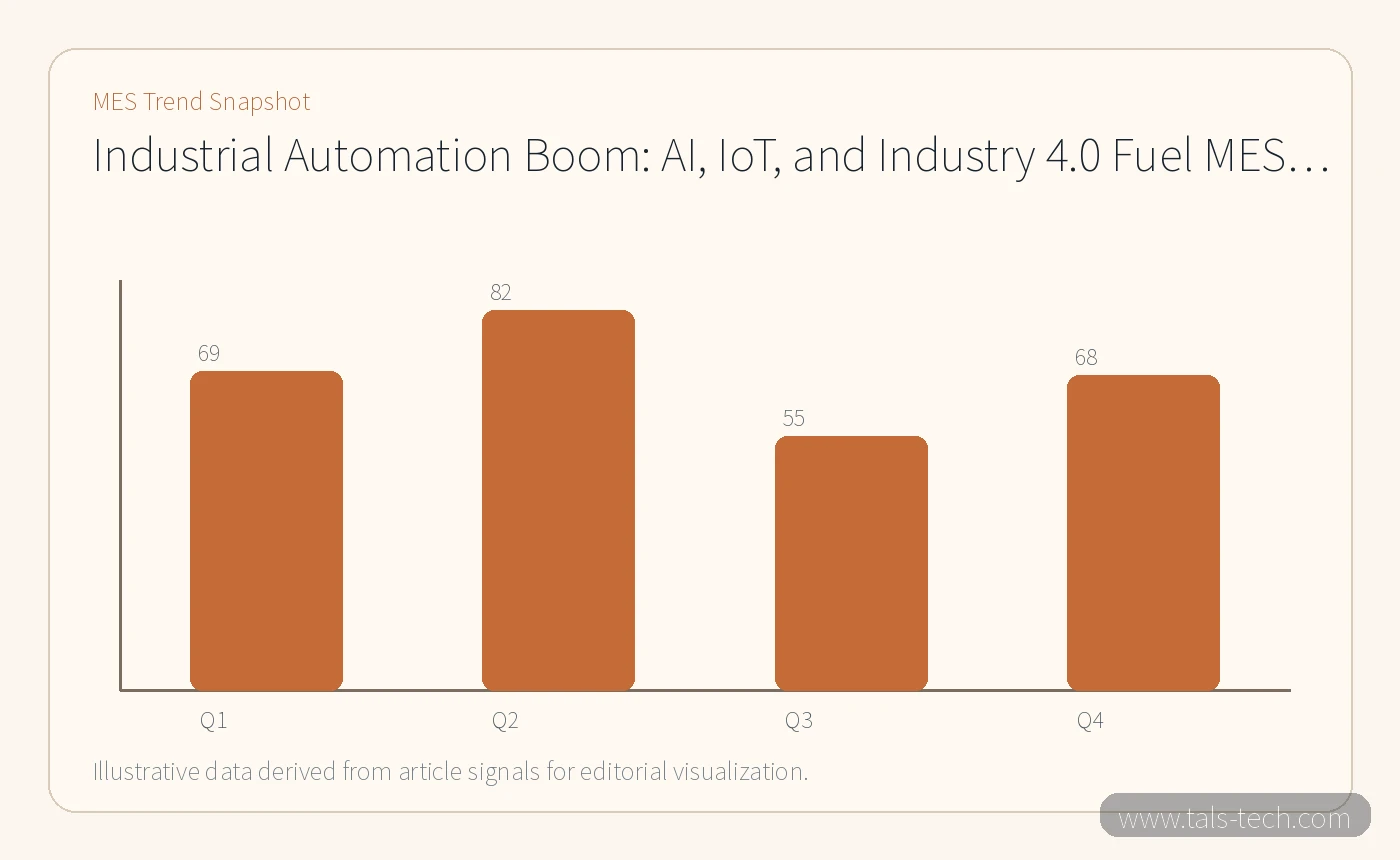
The global industrial automation market is set to surge by 2030, driven by the convergence of artificial intelligence (AI), the Internet of Things (IoT), and Industry 4.0 principles. This transformation is not only reshaping factory floors but also intensifying the demand for sophisticated manufacturing execution systems (MES) and smart manufacturing software to integrate, optimize, and secure these technologies.
Market Growth and Key Drivers
According to multiple industry forecasts, the global industrial automation market, valued at over $200 billion in 2024, is expected to exceed $350 billion by 2030, growing at a compound annual growth rate (CAGR) of approximately 9%. The primary accelerants include AI-powered predictive maintenance and quality inspection, IoT sensor networks enabling real-time asset tracking, and the full adoption of Industry 4.0 philosophies across discrete and process manufacturing. For instance, automotive and electronics manufacturers deploying AI vision systems report defect rate reductions of up to 35%. The proliferation of 5G private networks and edge computing further reduces latency, allowing closed-loop control in milliseconds.
Regionally, Asia-Pacific leads in market share due to rapid industrialization in China and India, while Europe and North America focus on retrofitting existing plants with smart technologies. Germany's Industrie 4.0 framework and the U.S. Advanced Manufacturing initiative have spurred government grants and private investment. Policy tailwinds, such as the EU Data Act and China's '14th Five-Year Plan' for smart manufacturing, mandate digital twins and industrial internet platforms, directly benefiting MES vendors.
The Critical Role of MES in Automation
In an AI- and IoT-enabled factory, the manufacturing execution system (MES) evolves from a passive data logger into an active orchestration engine. Modern MES platforms must incorporate machine learning algorithms for dynamic scheduling, real-time quality prediction, and anomaly detection. For example, Siemens and SAP have embedded AI modules into their MES suites to optimize production sequencing automatically. The deep integration of Industrial IoT (IIoT) platforms with MES creates an end-to-end data pipeline from sensor to cloud, enabling predictive maintenance that reduces unplanned downtime by up to 40% (industry benchmark).
Cybersecurity becomes paramount as IT/OT convergence widens the attack surface. Standards like ISA-95 and IEC 62443 guide MES architecture, requiring built-in security features such as role-based access control and encrypted data transmission. Leading MES providers, including TALS, offer solutions certified against these standards. Additionally, low-code MES platforms empower plant engineers to customize workflows without heavy IT support, democratizing smart manufacturing for small and medium enterprises.
Industry Pain Points and Opportunities
Despite rapid growth, manufacturers face significant hurdles in automation adoption. Data silos persist due to incompatible protocols across legacy equipment, hindering IoT data aggregation. AI models demand high-quality labeled datasets, which many factories lack. The skills gap is acute: a Deloitte survey found that 82% of manufacturers cite lack of digital talent as a top barrier. Moreover, cybersecurity threats have escalated, with ransomware attacks on industrial control systems increasing by 25% year-over-year.
These challenges present clear opportunities for MES software. An MES with robust data governance capabilities can automatically normalize data from diverse sources, providing clean inputs for AI. TALS's MES platform includes built-in ETL tools and pre-trained models to accelerate deployment. Cloud-based MES subscriptions (SaaS) lower upfront costs, making automation accessible to smaller players. Industry analysts predict that by 2027, over 60% of new MES deployments will include integrated AI features.
Standards Evolution and Ecosystem Collaboration
The success of Industry 4.0 hinges on interoperability standards. The Reference Architectural Model Industrie 4.0 (RAMI 4.0) and the Industrial Internet Reference Architecture (IIRA) provide structural blueprints. ISA-95 defines the interface between MES and ERP, while OPC UA emerges as the de facto communication protocol for device interoperability. According to VDMA, factories adopting OPC UA experience 30% higher IoT connectivity efficiency.
Collaboration across the ecosystem is intensifying. Hardware vendors like Siemens and Rockwell partner with software specialists such as TALS to offer pre-integrated solutions. Consortia like the Industrial Internet Consortium (IIC) run testbeds to validate AI and IoT applications in real production lines. TALS actively participates in these efforts, ensuring its MES platform is certified to interface with major PLC and SCADA systems, reducing integration complexity for end users.
Key Statistics
- Global industrial automation market projected to exceed $350 billion by 2030, CAGR ~9%
- AI vision systems reduce defect rates by up to 35% (industry benchmark)
- Predictive maintenance cuts unplanned downtime by up to 40% (industry benchmark)
- Over 60% of new MES deployments will include AI capabilities by 2027 (industry forecast)
Outlook
The industrial automation boom presents a generational opportunity for manufacturers, and MES software that fuses AI, IoT, and robust cybersecurity is the key to unlocking its full potential. In the coming years, companies that prioritize standardized data integration, open ecosystem partnerships, and intelligent analytics will gain a decisive competitive edge. TALS, with its ISA-95/IEC 62443-compliant, low-code MES platform, is uniquely positioned to help clients navigate this transformation from digital to truly smart factories.