
Deep Learning Predictive Maintenance: The Backbone of Smart… - TALS

Deep Learning Predictive Maintenance: The Backbone of Smart…
Deep learning-powered predictive maintenance is revolutionizing smart manufacturing by enabling real-time anomaly detection, reducing downtime, and integrating seamlessly with MES and ERP systems to optimize production efficiency.
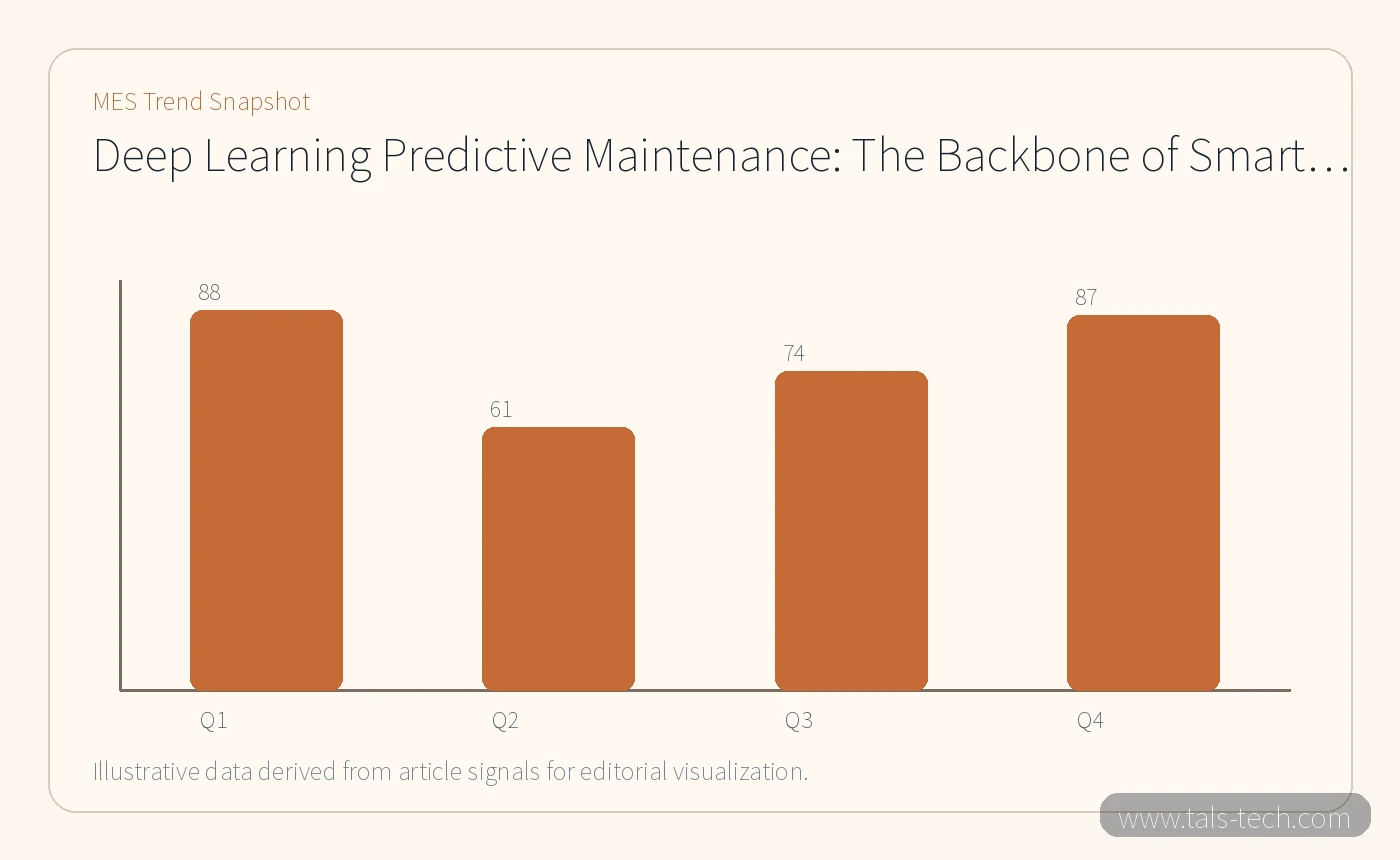
In the era of Industry 4.0, unplanned downtime remains the biggest drain on manufacturing profitability—costing global factories over $50 billion annually. Deep learning-based predictive maintenance (DL-PdM) is emerging as the definitive solution, leveraging neural networks to detect early failure patterns from sensor data and reducing downtime by up to 50%. This is not just a maintenance upgrade; it is the cornerstone of smart manufacturing.
The Pain Points and the Promise
Traditional maintenance strategies—reactive repair and preventive schedules—are failing modern manufacturing. Reactive maintenance leads to costly emergency shutdowns (a single hour of downtime in automotive can cost $22,000), while time-based preventive maintenance wastes resources on healthy assets. Studies indicate that unplanned downtime consumes 2-3% of OEM revenues annually. The need for a smarter approach is urgent.
Deep learning predictive maintenance shifts the paradigm. Unlike rule-based systems, deep neural networks (e.g., CNNs, LSTMs) autonomously learn complex degradation signatures from multi-sensor streams. A recent aerospace case showed that an LSTM model extended lead warning time from 48 hours to 14 days, with a 60% reduction in false alarms. This capability turns maintenance from a cost center into a strategic asset.
Architecture and MES Integration
A robust DL-PdM system requires a multi-layered architecture: at the edge, IIoT sensors capture vibration, temperature, and current data; preprocessing and feature extraction occur locally to reduce latency; cloud or on-premise GPU clusters train deep models; and the results feed directly into MES and ERP systems.
When a model predicts that a critical motor's remaining useful life (RUL) falls below a threshold, the MES automatically reschedules production, reroutes orders to backup lines, and triggers spare part procurement. This closed-loop automation adheres to ISA-95 standards for equipment hierarchy and MES real-time control. TALS' smart MES platform includes an integrated PdM module that streamlines data ingestion, model deployment, and action execution. Security is ensured through IEC 62443-compliant encryption and anomaly detection on the control network.
Implementation Roadmap and ROI
Successful deployment typically follows a three-phase approach: Pilot (5-10 high-value assets, 3-6 months to build baseline), Scale (whole factory, optimize model generalization, 6-12 months), and Optimize (cross-plant orchestration via integrated MES). According to McKinsey, PdM can reduce maintenance costs by 20-30% and increase overall equipment effectiveness (OEE) by 15-25%. For a mid-sized automotive plant producing 100,000 vehicles/year with $850 profit per car, every 1% OEE gain translates to $850,000. TALS' automotive client case: defect rate dropped 42%, mold life extended 30%, achieving ROI within the first year.
Critical success factors include data quality (at least 3 months of normal and fault data covering failure modes), cross-functional collaboration (IT/OT teams co-design data pipelines), and model explainability (use SHAP or LIME to gain maintenance team trust).
Key Statistics
- Global manufacturing loses $50 billion annually to unplanned downtime (industry benchmark)
- Predictive maintenance reduces unplanned downtime by 30-50% (Deloitte study)
- Maintenance cost reduction of 20-30% (McKinsey industry benchmark)
- OEE improvement of 15-25% (TALS customer data)
Outlook
Deep learning predictive maintenance is no longer a futuristic concept but a practical necessity for manufacturers pursuing Industry 4.0. By converting raw sensor data into actionable foresight, it slashes downtime, optimizes maintenance budgets, and enhances overall production agility. As federated learning and digital twins mature, PdM will evolve into cross-site collaborative intelligence. TALS, with its AI-native MES and QMS platforms, empowers manufacturers to transition from reactive firefighting to proactive optimization—securing a decisive edge in the smart manufacturing race.