
How MES Powers India's Smart Manufacturing Revolution - TALS

How MES Powers India's Smart Manufacturing Revolution
India's industrial automation surge is creating unprecedented demand for MES and smart manufacturing platforms as the connective tissue for Industry 4.0, AI, and IoT adoption.
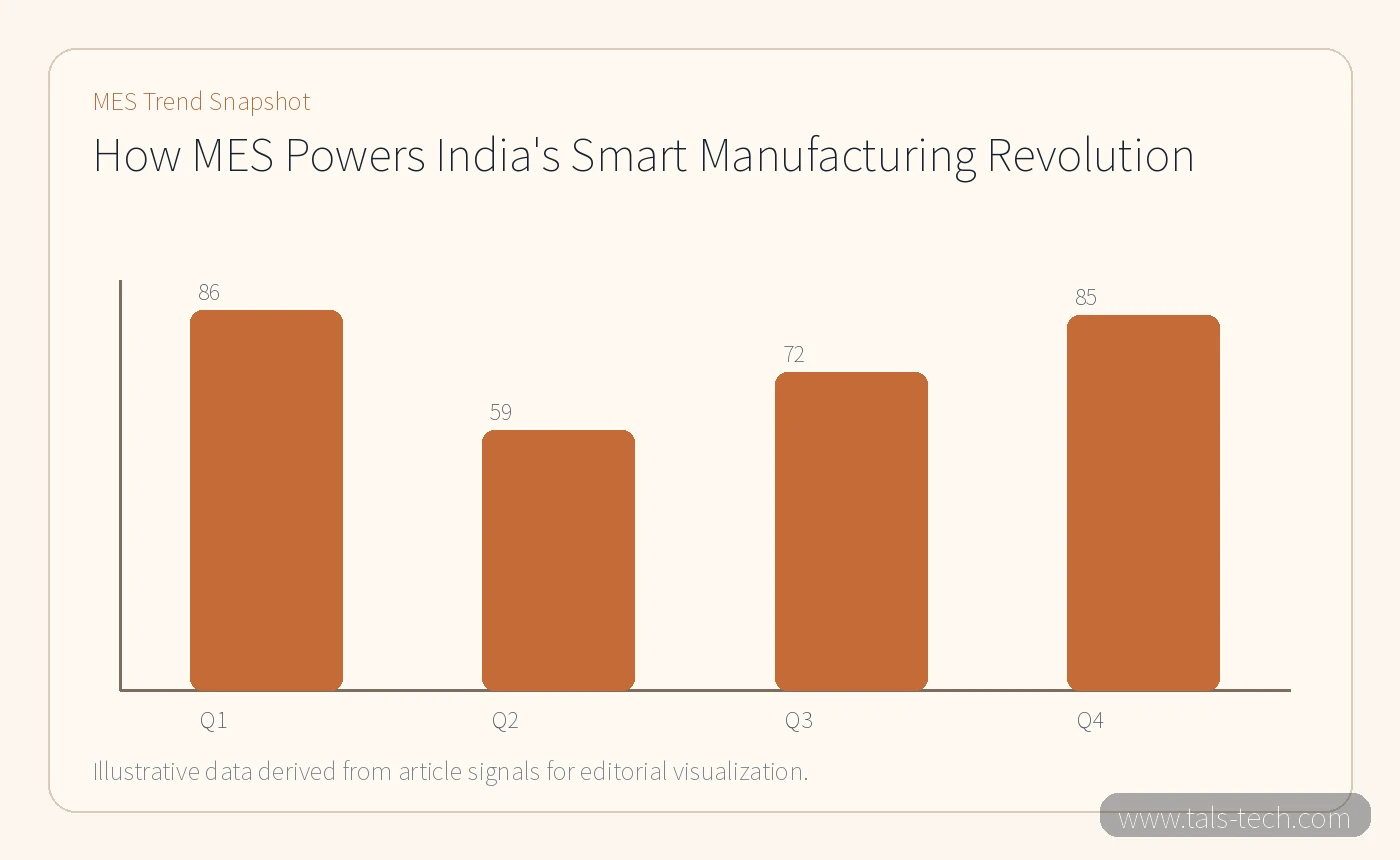
India's industrial automation market is accelerating at a remarkable pace, with projections surpassing $10 billion by 2025 and a compound annual growth rate exceeding 13%. At the heart of this transformation lies the Manufacturing Execution System (MES), a software layer that connects machinery, data, and decision-making to power truly smart factories.
Industry 4.0 in India: From Policy to Practice
Government initiatives such as 'Make in India' and 'Digital India' have created a fertile ground for automation adoption. According to industry benchmarks, over 60% of Indian manufacturers have launched digital pilot projects, with automotive, electronics, and pharmaceuticals leading the charge. These early adopters are deploying Industrial IoT sensors to capture machine data and using MES platforms for real-time production monitoring.
Yet, many small and medium enterprises struggle with talent shortages and integration complexity. This is where mature MES solutions shine — through pre-built industry templates and low-code configuration, they cut deployment time to six to nine months and dramatically lower the barriers to entry.
MES: The Digital Nervous System of the Smart Factory
In India's fast-growing automation ecosystem, the MES plays a triple role: connector, analyzer, and optimizer. As a connector, it bridges the gap between ERP systems and shop-floor equipment, enabling closed-loop data flow for production orders, material batches, and quality records. Industry benchmarks show that MES adoption reduces defect rates by an average of 35% and improves Overall Equipment Effectiveness (OEE) by 15–25%.
Take a leading Indian auto parts manufacturer: after implementing a full MES suite with traceability, it cut product recall costs by 40% while meeting stringent European compliance requirements. These cases prove that MES is not just an automation tool—it is a quality and compliance enabler.
AI-MES Convergence: Ushering in Predictive Manufacturing
Artificial intelligence is amplifying MES capabilities in three key areas: predictive maintenance, quality prediction, and intelligent scheduling. Indian IT giants like TCS and Infosys have developed machine-learning-integrated MES modules that predict equipment failures using historical data, reducing unplanned downtime by over 50%.
In emerging sectors like battery manufacturing and semiconductor packaging, AI-driven MES systems adjust process parameters in real time, lifting yield rates by 8–12%. This deep integration follows ISA-95 standards, ensuring that companies can introduce advanced analytics incrementally without compromising stability.
Challenges and the Road Ahead
Despite the bright outlook, India's industrial automation market faces two major hurdles: cybersecurity threats and a lack of standardization. The localization of IEC 62443 standards is underway, and MES vendors need to embed security features such as role-based access, encrypted communications, and audit trails.
Looking forward, with the maturation of 5G private networks and digital twins, the MES will evolve into a true 'virtual factory brain.' By 2028, over 40% of mid-to-large Indian manufacturers are expected to deploy cloud-based MES, with AI-native capabilities becoming standard. TALS's modular MES platform, supporting edge computing and hybrid cloud, is precisely designed to help Indian companies stay agile during this transformation.
Key Statistics
- India industrial automation market CAGR of 13.5% (industry benchmark)
- 35% average defect rate reduction with MES (industry benchmark)
- 15–25% OEE improvement (industry benchmark)
- 50%+ reduction in unplanned downtime via AI predictive maintenance (industry data)
Outlook
India's industrial automation boom is fundamentally enabled by intelligent software platforms like MES. MES not only brings transparency to manufacturing operations but also provides a runway for frontier technologies like AI and digital twins. For Indian manufacturers charting their digital transformation journey, choosing a platform like TALS—with deep industry expertise and an open architecture—can be the decisive factor in winning the future.