
MES Market to Hit $32.9B by 2032 as Smart Manufacturing Adoption… - TALS

MES Market to Hit $32.9B by 2032 as Smart Manufacturing Adoption…
The MES market's explosive growth to USD 32.9 billion by 2032 underscores the critical role of manufacturing execution systems in enabling Industry 4.0 and smart factory initiatives, driving demand for integrated, real-time production management solutions.
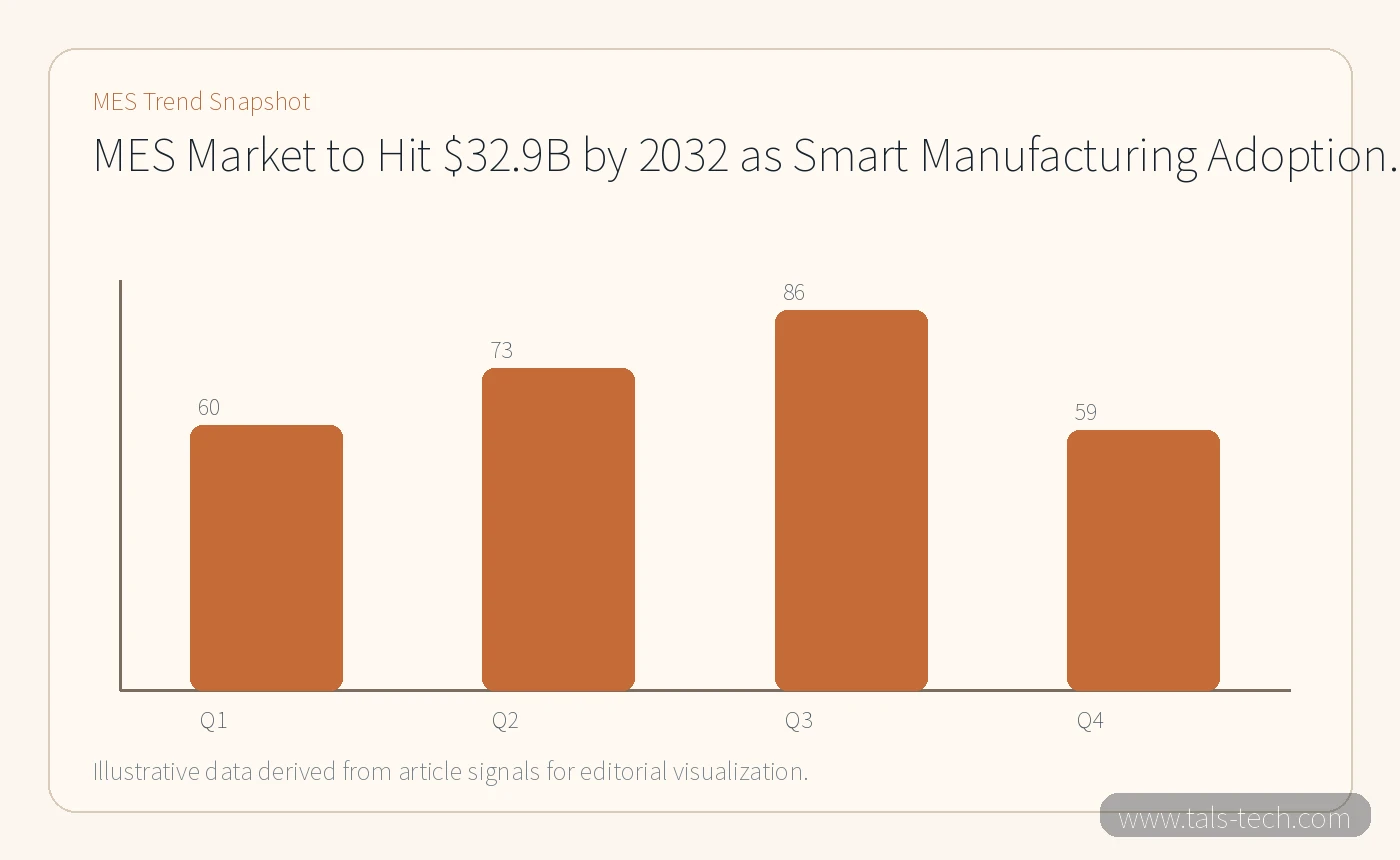
The global Manufacturing Execution Systems (MES) market is projected to reach USD 32.9 billion by 2032, according to a new report by SNS Insider, driven by the accelerating adoption of Industry 4.0 and smart manufacturing practices. This explosive growth reflects a paradigm shift where real-time production visibility, quality traceability, and data-driven decision-making have become non-negotiable for competitive manufacturers. For industrial enterprises, MES has evolved from an optional efficiency tool to the digital backbone of the factory floor.
Market Trajectory and Key Figures
Valued at approximately USD 15 billion in 2023, the MES market is forecast to more than double to USD 32.9 billion by 2032, exhibiting a compound annual growth rate (CAGR) of around 8-10%. Automotive, electronics, pharmaceuticals, and food & beverage sectors are leading the demand, with Asia-Pacific emerging as the fastest-growing region due to rapid industrialization in China and India. The report highlights cloud-based MES and AI-powered predictive maintenance as pivotal growth catalysts, as manufacturers seek scalable and intelligent solutions to manage increasingly complex operations.
Industry 4.0 and Data Integration Drive MES Adoption
Industry 4.0's essence is data-driven manufacturing, and MES serves as the critical middleware between enterprise resource planning (ERP) and shop-floor control systems (PLC/SCADA). By capturing real-time production data, MES enables measurable improvements: overall equipment effectiveness (OEE) gains of 20-30%, defect rate reductions of over 35%, and energy savings of 15-25%. Standards such as ISA-95 provide a robust integration framework, breaking down data silos to create a seamless digital thread from order to delivery. Cybersecurity compliance under IEC 62443 is also increasingly vital, as interconnected MES platforms become prime targets for cyber threats.
Addressing Industry Pain Points with Intelligent Execution
Conventional manufacturing grapples with opaque production processes, inefficient scheduling, and cumbersome quality traceability. For instance, when a defect is discovered, manual batch tracking can take hours or days; MES with barcode/RFID integration cuts this to minutes. In energy management, MES combined with IoT sensors can reduce per-unit energy consumption by 15-25%. Leading platforms like TALS' solutions embed machine learning to predict equipment anomalies and prevent unplanned downtime. These capabilities translate into rapid return on investment (ROI), typically within 12-18 months, making MES a financially compelling proposition.
Future Outlook: AI, Edge Computing, and Cloud-Native MES
The next wave of MES innovation centers on AI-driven self-optimizing production, edge computing for low-latency decisions, and cloud-native architectures that democratize access for small and medium enterprises. By 2025, over 40% of new MES deployments are expected to be SaaS-based. Low-code/no-code platforms are emerging, enabling business users to adapt workflows without deep programming. The fusion of digital twins allows MES to simulate production scenarios virtually—‘try before you produce’—drastically reducing trial costs. TALS is at the forefront of these trends, delivering a modular, scalable MES suite that grows with the factory.
Key Statistics
- MES market to reach USD 32.9 billion by 2032 (CAGR ~8-10%)
- OEE improvement of 20-30% and defect rate reduction >35% after MES implementation (industry benchmark)
- Quality traceability response time reduced from hours to minutes
- 15-25% reduction in energy consumption via MES-IoT integration
Outlook
The MES market's soaring trajectory underscores a fundamental shift: smart manufacturing is no longer a futuristic vision but an operational imperative. Manufacturers that invest in MES today are building the digital infrastructure for tomorrow's autonomous factories. TALS, with its comprehensive MES, ERP, and QMS solutions, empowers enterprises to harness real-time data for continuous improvement and competitive advantage. As AI and edge computing converge on the shop floor, TALS remains committed to delivering the ‘digital brain’ that drives intelligent, agile manufacturing worldwide.