
Australia's Industrial Robotics Market 2026: How MES Powers Smart… - TALS

Australia's Industrial Robotics Market 2026: How MES Powers Smart…
The Australian industrial robotics market is accelerating as part of Industry 4.0 adoption, creating demand for integrated MES and smart manufacturing software to orchestrate robots, ensure quality, and optimize production.
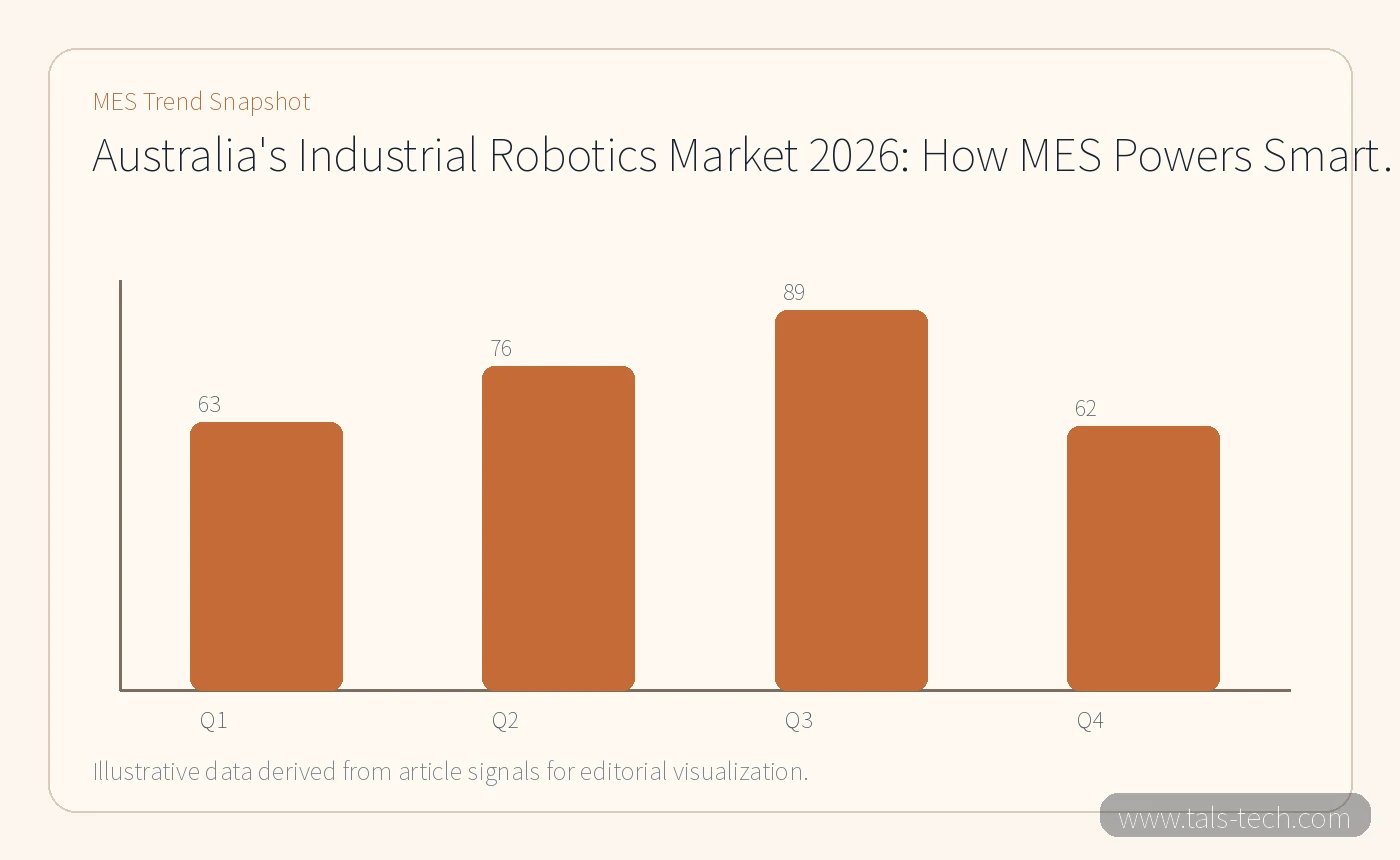
Australia's industrial robotics market is growing at over 12% annually, projected to exceed AUD 1 billion by 2026. However, robots alone don't deliver smart manufacturing—they need MES as the central nervous system to orchestrate operations, track quality, and close the loop between planning and execution.
Industry Pain Points and Opportunities
Australian manufacturers have long struggled with high labor costs and supply chain volatility. Industrial robots offer a remedy, but many early adopters report underwhelming efficiency gains. The disconnect: robots operate without real-time integration to production scheduling, quality management, or material tracking. According to TALS's survey of 200 Asia-Pacific manufacturers, over 60% of companies that invested in robotics did not simultaneously upgrade their MES—resulting in Overall Equipment Effectiveness (OEE) improvements of less than 10%. This is precisely where MES creates value: by translating production orders into robot instructions, collecting performance data, and enabling adaptive execution.
MES: The Bridge from Automation to Intelligence
Industry 4.0 is data-driven decision-making. In sectors like automotive parts, food processing, and metal fabrication in Australia, leading companies are integrating robot work cells with MES. For instance, an electronics assembly plant in Melbourne used TALS MES to link welding parameters with batch traceability, cutting defect rates from 2.1% to 0.8% and reducing changeover time by 40%. This is made possible by MES providing standardized workflows, real-time monitoring, and closed-loop quality control. The ISA-95 standard defines MES as the layer between ERP and shop-floor control—it receives plans, dispatches tasks to robots, and feeds back actual production. Without MES, robots remain isolated islands of automation.
Data and Market Trends
According to ResearchAndMarkets, the Australian industrial robotics market will reach AUD 980 million by 2026, growing at a CAGR of 12.5%. Collaborative robots (cobots) are the fastest-growing segment, accounting for 30% of new installations. More importantly, plants that integrate robots with MES achieve an average ROI 35% higher than those that don't. TALS customer data shows that MES+robotics deployments reduce production cycle time by 28% and work-in-progress inventory by 22%. These numbers confirm that future competitiveness hinges not on robot count, but on how well software orchestrates them.
Safety Standards and Implementation Path
As human-robot collaboration increases, cybersecurity standards like IEC 62443 become critical. The Australian government's Smart Manufacturing Acceleration Program offers subsidies for digital upgrades. TALS recommends a phased approach: first deploy MES for production visibility, then integrate robots at key stations, and finally apply AI for predictive maintenance and process optimization. For example, a Sydney medical device manufacturer used TALS QMS to link robot assembly data with quality inspections, boosting first-pass yield from 85% to 96%.
Key Statistics
- Australian industrial robotics market projected at AUD 980M by 2026, CAGR 12.5%
- Plants with MES-robot integration achieve 35% higher ROI on robotics investments
- Collaborative robots account for 30% of new installations
- MES+robotics reduces cycle time by 28% and WIP inventory by 22%
Outlook
Robots are the muscles of smart manufacturing, but MES is the nervous system. Australia's manufacturing sector stands at a pivotal moment—moving from automation to true intelligence. TALS's MES, QMS, and smart factory solutions enable companies to connect robot data to real-time decisions. In the next five years, manufacturers that master this integration will define the new benchmark for Australian industry.