
Manufacturing Agility in Oil Price Volatility: The Smart Factory… - TALS

Manufacturing Agility in Oil Price Volatility: The Smart Factory…
The article explores how oil price volatility following geopolitical events like the Strait of Hormuz reopening creates urgent operational challenges for downstream manufacturing sectors, highlighting the critical role of MES and smart manufacturing technologies in enabling agile production optimization, cost control, and supply chain resilience.
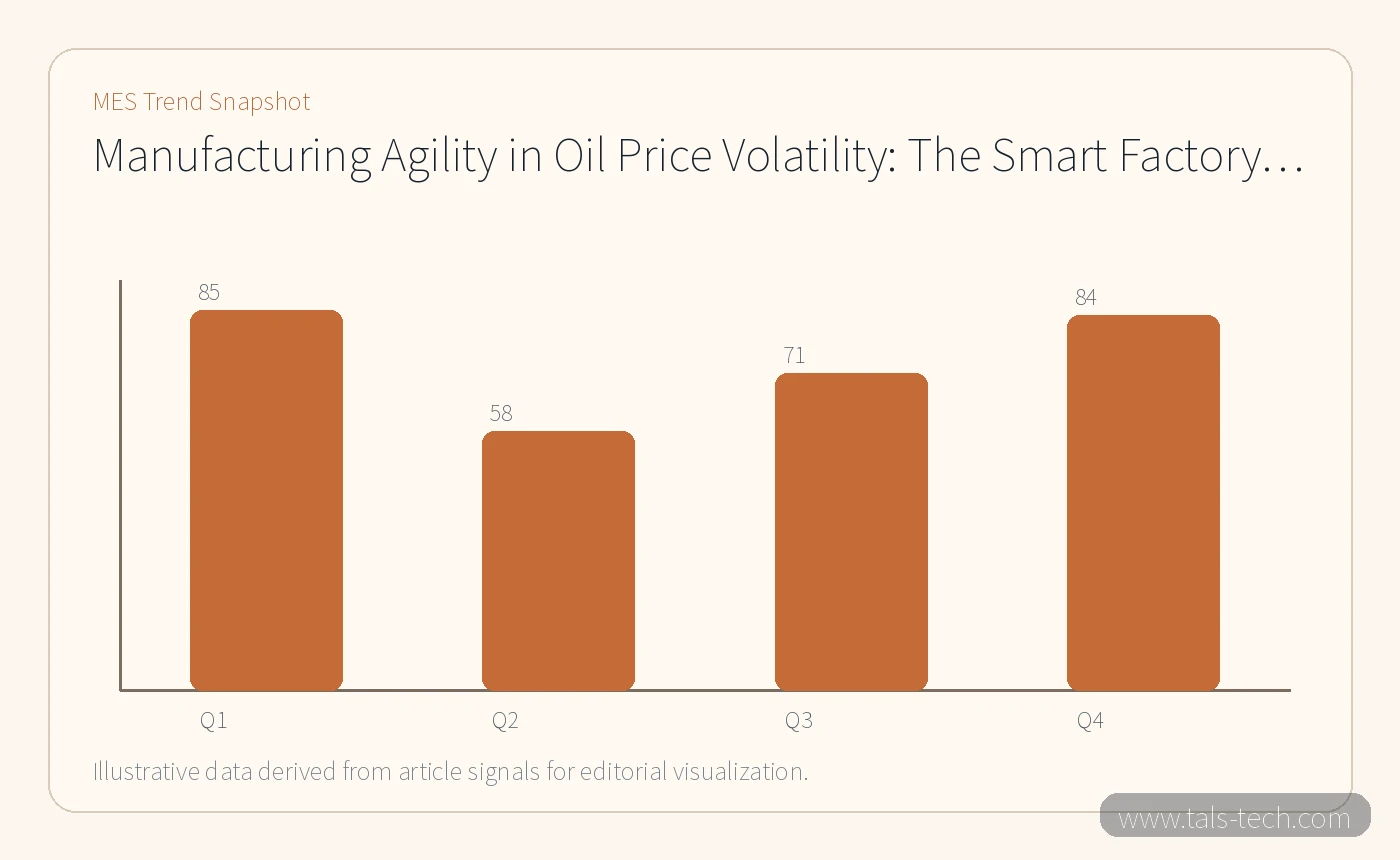
The reopening of the Strait of Hormuz and normalization of Saudi refinery flows have triggered dramatic oil price fluctuations, creating immediate operational challenges for manufacturing sectors worldwide. As raw material costs swing unpredictably, manufacturers face the critical test of production agility—how quickly can they adapt processes, optimize efficiency, and control costs? This isn't merely about survival; it's about leveraging technology to turn volatility into competitive advantage.
The Direct Impact of Oil Price Volatility on Manufacturing
Oil serves as a fundamental industrial feedstock, with price fluctuations directly affecting plastics, chemicals, transportation, and numerous manufacturing segments. When prices collapse by over 15% in a single day, as seen recently, companies confront dual pressures: inventory devaluation of raw materials and the urgent need to adjust product pricing strategies. In the plastics industry, for instance, petroleum derivatives account for 60-70% of material costs, meaning every $10/barrel change in oil prices translates to a 3-5% shift in final product costs.
Such rapid changes demand real-time cost accounting capabilities. Traditional ERP systems typically analyze costs based on monthly or quarterly data, struggling to respond to daily or even hourly market movements. Modern Manufacturing Execution Systems (MES), however, integrate live production data with market price feeds to enable dynamic cost calculations. When oil prices drop, these systems can immediately identify production lines using high-petroleum-content materials and recommend schedule adjustments to maximize profitability.
Smart Manufacturing Response Mechanisms
In the face of raw material price volatility, smart factories implement rapid response through a three-layer architecture. The first layer is data acquisition, where IoT sensors monitor energy consumption, material usage rates, and equipment efficiency in real time. The second layer is analytical decision-making, where MES systems combine market data, inventory levels, and order demands to optimize production scheduling using advanced algorithms. The third layer is execution, where automated systems adjust production parameters based on optimized plans.
Consider the chemical industry: when oil prices fall, smart systems can automatically adjust formulation ratios to increase the use of lower-cost ingredients while maintaining quality standards. Simultaneously, systems recalculate optimal batch sizes to balance inventory and procurement costs. While traditional factories might take days to implement such changes, smart factories can execute within hours, reducing losses from price volatility by 40-60%.
Supply Chain Collaboration and Risk Management
Oil price volatility disrupts not only production costs but entire supply chains. Transportation cost variations, supplier price adjustments, and shifting customer demands create cascading effects. Smart manufacturing platforms address this through supply chain visualization tools that integrate data from suppliers, logistics providers, and customers into a unified interface. When abnormal oil price movements are detected, systems automatically trigger alerts and recommend alternative logistics routes or backup suppliers.
Manufacturing operations management systems built on the ISA-95 standard enable seamless integration from enterprise resource planning to shop floor control. For example, when falling oil prices reduce transportation costs, systems might suggest shifting from large-batch, low-frequency deliveries to smaller, more frequent shipments—reducing inventory costs while improving customer responsiveness. This end-to-end optimization capability helps companies maintain competitive edges amid price fluctuations.
Data-Driven Long-Term Strategy
While short-term responses are crucial, manufacturers must build data-based long-term resilience against volatility. By collecting historical price data, production response records, and market trends, AI algorithms can predict future fluctuation patterns and develop preventive strategies. Machine learning models, for instance, might analyze decade-long correlations between oil prices and production costs, recommending procurement adjustments when similar geopolitical signals emerge.
Digital twin technology plays a key role here. Companies can create virtual factory models to simulate production scenarios under different oil price conditions, evaluating the effectiveness of various response strategies. This simulation-based decision support shifts risk management from reactive to proactive planning. Industry research indicates that companies adopting predictive analytics experience profit volatility 50% lower than traditional firms during raw material price swings.
Key Statistics
- Oil price swings of over 15% daily cause 3-5% cost variations in plastic products
- Smart factories respond 80% faster than traditional plants, reducing losses by 40-60%
- Companies using predictive analytics show 50% lower profit volatility during price fluctuations
- ISA-95-based integrated systems improve supply chain collaboration efficiency by 30%
Outlook
Oil price volatility exposes the fragility of traditional manufacturing models while underscoring the urgency of digital transformation. In an era where uncertainty is the norm, manufacturers need not just better equipment but smarter decision-making systems. TALS's Manufacturing Execution Systems and smart factory solutions—through real-time data integration, algorithmic optimization, and supply chain collaboration—help companies maintain operational resilience amid price swings. When markets shift again, those investing in intelligent technologies won't merely survive; they'll seize opportunities to outperform.